If you’ve ever walked a marina after a storm and seen the gelcoat smeared across a dock piling, you already understand why the mooring whips vs fenders boat protection debate matters so much. I’ve spent twenty years on the Gulf Coast building and repairing docks, and I can tell you — most hull damage I’ve seen was completely preventable. The boat owner had either no fenders, undersized fenders, or fenders that rolled out of position. A few had nothing at all keeping their hull off the dock. That’s money left bleeding into the water.
Here’s the misconception I hear constantly: “I’ve got fenders, so I’m covered.” Fenders are not a complete protection system. They are a passive barrier. They work until they don’t — until a wake hits sideways, until a fender slides up a piling, until the wind pins your boat hard against the dock for six straight hours. I’ve seen $400 in fenders fail to prevent $3,000 in hull repairs. That’s a painful lesson that doesn’t need to be yours.
In this post, I’m going to walk you through exactly how mooring whips and fenders work, where each one excels, where each one falls short, and how to combine them intelligently. I’ll also share the specific setup I’ve been recommending to clients and installing myself for the past several years.
How Fenders Actually Work — and Where They Fail
Fenders are simple devices. You hang a cushion of air or foam between your hull and the dock, and it absorbs the contact force. Cylindrical fenders, like the Taylor Made or Perko round styles, are the most common. Round ball fenders work well on pilings. For flat dock faces, you want a flat fender or a fender board running across two cylindrical fenders. That last point alone saves a lot of gelcoat.
The problem with fenders is positioning. A fender only protects the exact spot it’s hanging at the exact height it’s sitting. Wake from a passing boat lifts your hull, and suddenly the fender is below the rub rail and your hull is kissing wood. I’ve pulled apart fender setups after minor incidents and found the fenders perfectly intact — hanging six inches too low to have done anything useful. Fenders also need to be large enough for the boat. Most people undersize them.
As a general rule, I recommend 1 inch of fender diameter for every 4 feet of boat length. A 24-foot boat needs at least 6-inch diameter cylindrical fenders. Go bigger if you’re in a high-wake area or on a floating dock with significant tidal movement. Smaller is always a mistake.
When Fenders Are the Right Tool
Fenders shine in short-term docking situations. Coming into a slip, tying up at a fuel dock, visiting a transient slip for a weekend — fenders are ideal. They’re portable, inexpensive, and quick to rig. A decent set of three or four cylindrical fenders runs $80–$150 and handles most day-use situations well. For long-term slip use, however, you need more than fenders alone.
How Mooring Whips Work — and Why They Change Everything
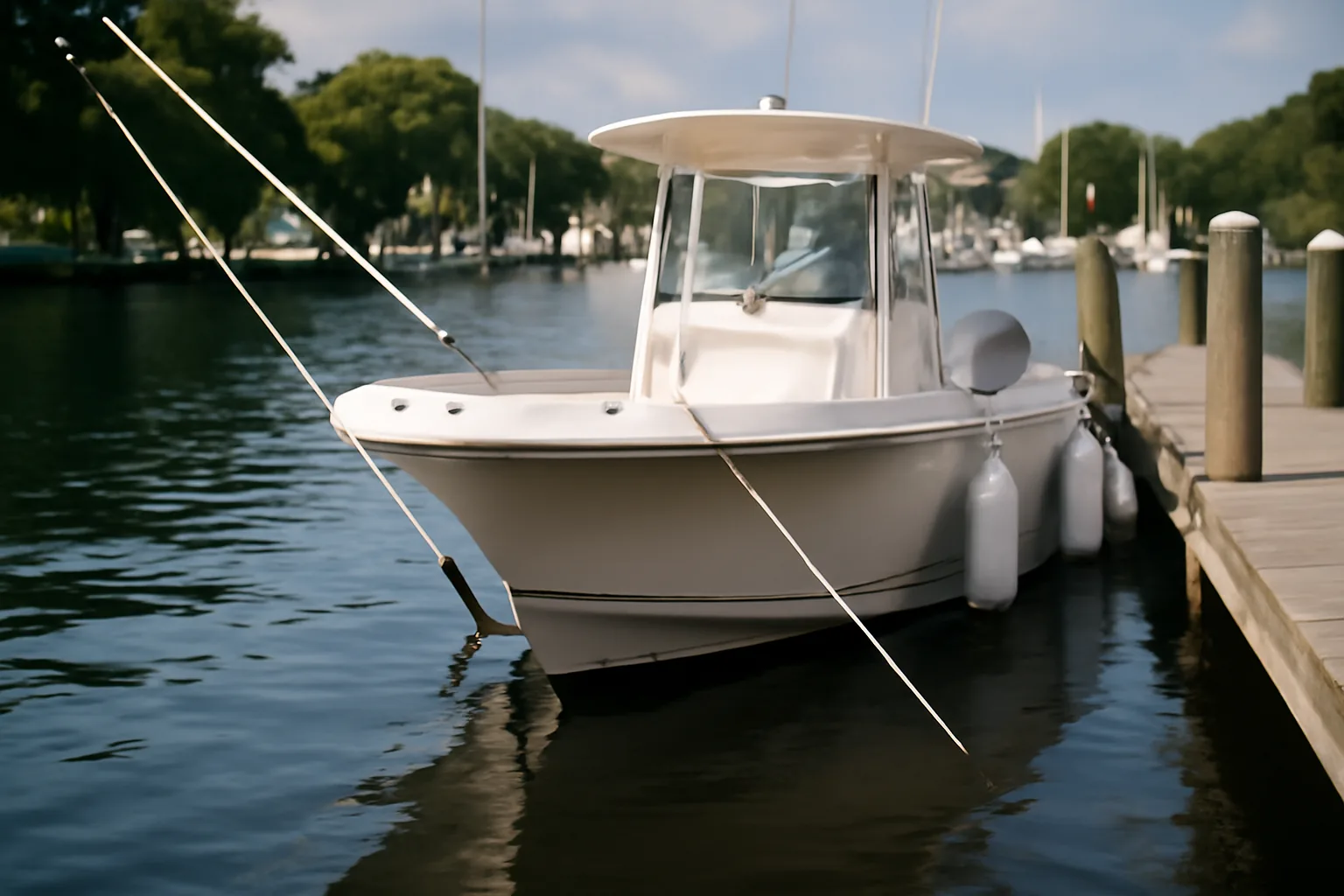
Mooring whips are spring-loaded fiberglass poles that mount to your dock and hold your boat away from the dock using bungee-style lines. The poles flex under load, absorbing energy from wind, wake, and current. Instead of your hull pressing against a fender and transferring that force into the dock structure, the whips hold the boat in open water. There’s no contact at all — which is the point.
I first started installing mooring whips about fifteen years ago when a client on Pensacola Bay called me after his second hull repair in eighteen months. Same slip, same dock, kept getting damage in afternoon winds. We pulled the fenders, installed a pair of whips, and he didn’t call me again about hull damage. That’s a strong endorsement. Since then, I’ve installed them for dozens of clients in Gulf Coast slips ranging from 22-foot center consoles to 38-foot sport fish boats.
The key physics advantage is this: whips keep the boat in constant, gentle motion rather than pinned against a static object. A boat that can move absorbs energy. A boat pressed hard against a dock transfers that energy into the hull. For overnight storage or long-term slip use, whips win that comparison every time.
Mooring Whip Sizing — Don’t Guess at This
Sizing mooring whips correctly is non-negotiable. Too short and they don’t hold the boat far enough off the dock. Too light a rating and the poles won’t handle the load during a storm. The rating is based on boat displacement — not length — which trips up a lot of DIYers. A 26-foot boat that weighs 8,000 lbs needs a different whip than a 26-foot boat that weighs 14,000 lbs. Check your boat’s displacement spec, not just the LOA.
Mooring Whips vs Fenders Boat Protection: Direct Comparison
Let me lay this out plainly. Both tools have a place. Neither one is universally superior in every situation. Here’s how they stack up across the factors that matter most.
Long-Term Slip Storage
Mooring whips win this category outright. If your boat lives in the same slip for weeks or months, whips keep the hull clear of the dock continuously. Fenders require constant adjustment as tide levels change and as fenders shift position. In my experience, most boat owners don’t adjust their fenders nearly often enough. That’s how you get rub rail damage building up gradually over a season.
Short-Term and Transient Docking
Fenders win here. Mooring whips are mounted hardware. You can’t bring them along to a fuel dock or a restaurant marina. For any situation where you’re tying up somewhere temporary, a good set of fenders in the right sizes is exactly the right tool. Carry them in a mesh bag in the bow locker. Rig them before you come in.
Wind and Wake Exposure
Mooring whips handle this much better than fenders. When a 35-knot afternoon thunderstorm blows through — and on the Gulf Coast, that’s not rare — fenders can only protect the hull at their exact position. Whips hold the entire boat off the dock dynamically. Specifically, in high-wind or high-wake environments, whips reduce the risk of fender rollout, which is what happens when a fender rotates up and out from between the hull and dock under load.
Cost Comparison
A quality set of four cylindrical fenders runs $100–$200. A pair of quality mooring whips runs $250–$500 depending on size and load rating. However, one hull repair from inadequate fender protection runs $500–$3,000 or more depending on severity. Frame it that way and the cost calculation becomes obvious. The whips pay for themselves the first time they prevent a contact event.
The Setup I Recommend and Install — Taylor Made Premium Mooring Whips
After trying several brands over the years, I keep coming back to Taylor Made. Specifically, for boats in the 20,000 lb and under range, I recommend the Taylor Made Premium Mooring Whips 14′ Length — model PMW.1400. These are 2-inch diameter fiberglass poles with a 14-foot reach, rated for boats up to 20,000 lbs displacement. I’ve installed probably thirty pairs of these along the Gulf Coast, and they hold up.
The 2-inch diameter fiberglass construction is the right balance between flex and strength. Too thin and the pole fatigues quickly under repeated load cycles. Too stiff and it doesn’t absorb energy properly — it just transmits it back into the dock mount. The PMW.1400 flexes correctly across a full range of conditions. I’ve seen these handle sustained 40-knot winds on a 17,000 lb sailboat without the boat touching the dock. That’s a real-world test most fender setups would fail.
These whips are specifically noted as ideal for sailboats and high-profile boats — and that matters. High-profile boats catch more wind load. A sailboat with a tall rig generates enormous lateral force in a crosswind. Standard fenders simply can’t manage that load the way a properly sized mooring whip pair can. For that application, the PMW.1400 is the right tool.
Installation takes about two hours for most dock configurations. You need to mount the base brackets to a solid dock cleat or dock post — not just a toe rail or a light-duty cleat. The poles drop into the brackets and the bungee lines attach to the bow and stern cleats on the boat. Run the lines at roughly a 45-degree angle for best holding geometry. Adjust tension so the boat sits comfortably away from the dock with a foot or two of clearance at its closest point.
If your boat is in the 34-to-46-foot range and displaces more than 20,000 lbs, step up to the Taylor Made PMW.1600. Same quality construction, sized for larger displacement boats. Don’t try to run the PMW.1400 on a 42-foot cruiser — the load rating matters, and exceeding it shortens pole life and reduces holding effectiveness.
I Learned This the Hard Way
Early in my career, I installed a pair of whips for a client and skipped the fenders entirely. I thought the whips alone were enough. Three weeks later, a large wake from a passing trawler hit hard enough to momentarily compress the whips beyond their normal range. The bow bounced back and then swung sideways. No fenders, no backup. She tagged the piling with the forward quarter panel. That repair cost $1,100.
Since that day, I always recommend running both. Whips as the primary system, one or two fenders as a backup for the bow and the area closest to the dock. It’s a belt-and-suspenders approach, and it works.
When to Call a Pro Instead of Going DIY
Mooring whip installation is genuinely DIY-friendly for most boat owners. That said, there are situations where I’d tell you to bring in a professional.
- Dock structure is questionable. If the dock is aging, has soft spots, or has posts that move when you push them, fix the dock first. Mooring whips transfer load into the dock structure. A weak dock is a serious hazard.
- Boats over 30,000 lbs displacement. At that size, the loads involved need professional assessment of both the whip system and the dock mounting points.
- Hurricane or tropical storm prep. Mooring whips are not a storm-preparation solution. Get your boat out of the water or into a covered, reinforced slip before a major storm. Whips are for normal operational conditions, not 90-knot winds.
- HOA or marina rules apply. Some marinas restrict mooring whip installation. Check your slip agreement before you buy anything.
Also worth noting: mooring whip installations in commercial marinas may need to comply with ABYC (American Boat and Yacht Council) guidelines and local harbor authority rules. In Florida, for example, some county-managed marinas have specific requirements for dock hardware installations. Always check before drilling.
Final Thoughts on Mooring Whips vs Fenders Boat Protection
Here’s the bottom line after twenty years of dock work: fenders are a necessity, but they are not a complete system. Mooring whips are the upgrade that transforms how well your boat is protected in long-term slip storage. For the mooring whips vs fenders boat protection question, the honest answer is that the best setup uses both — whips as the primary hull protection system and fenders as a backup layer.
For most boats under 20,000 lbs, the Taylor Made PMW.1400 is the pair I’d install at my own dock without hesitation. The build quality is solid, the 14-foot reach works for a wide range of slip configurations, and the 2-inch diameter poles flex correctly under real-world conditions. Spend the $300–$400 now. It will absolutely save you more than that in hull repairs over the next five years.
Take care of the hull. Everything else on the boat is fixable. The hull is the boat.
This post contains affiliate links. As an Amazon Associate, I earn from qualifying purchases at no extra cost to you.