When a marine electrician quotes you $400 to $600 for a professionally installed dock lighting system, then you price out the materials yourself for a Saturday afternoon project, the gap is telling. You’re usually looking at $80 to $150 in actual hardware — wire, fixtures, connectors, maybe a transformer. The rest is labor, liability, and the certainty that it’ll pass inspection and work in a hurricane. That difference between contractor price and DIY cost is exactly where the durability question lives. Buy wrong, and you’re replacing lights every winter. Buy right, and they outlast the dock itself.
My background is two decades knee-deep in saltwater installations along the Gulf Coast. I’ve sized systems for floating docks, fixed piers, and everything in between. I’ve watched solar technology mature from marketing gimmick into a genuinely viable option. This particular post isn’t a side-by-side product listing pulled from a brochure. It’s what I observed over twelve months of deliberately running both approaches on the same structure, through summer heat, salt spray, UV hammering, and a genuine hard freeze.
If you’re planning to add lighting to a new dock or swap out a lighting system that’s failed, work through this first. I’ll walk you through where each technology excels, where it disappoints, and what I’d actually recommend based on what I’ve installed and repaired — not what’s in the ad copy.
| System Type | Installation Cost | Summer Performance | Winter Performance |
|---|---|---|---|
| Solar (4 fixtures) | $85 | Reliable dusk to ~11 PM | Failed by January; recovered after freeze |
| Hardwired (6 fixtures) | $340 | Consistent full brightness; mid-August corrosion | Flawless through hard freeze |
| NiMH Battery Capacity | N/A | 100% rated | 20-30% loss at freezing |
| Summer Electricity Cost | N/A | $9.50 for ~180 nights | N/A |
| Regulatory Requirements | None in most jurisdictions | N/A | NFPA 303, NEC Articles 553 & 682, GFCI required |
How I Set Up the Comparison
Let me be upfront about the test setup so you can weigh the findings yourself. The structure is a stationary wood pier — 5/4 treated decking set on 4×6 treated beams — stretching roughly 60 feet into brackish tidewater. It’s exposed to direct sun between approximately 9 AM and 5 PM during peak summer months. Salt aerosol is perpetual. The structure handles consistent recreational traffic from spring through fall.
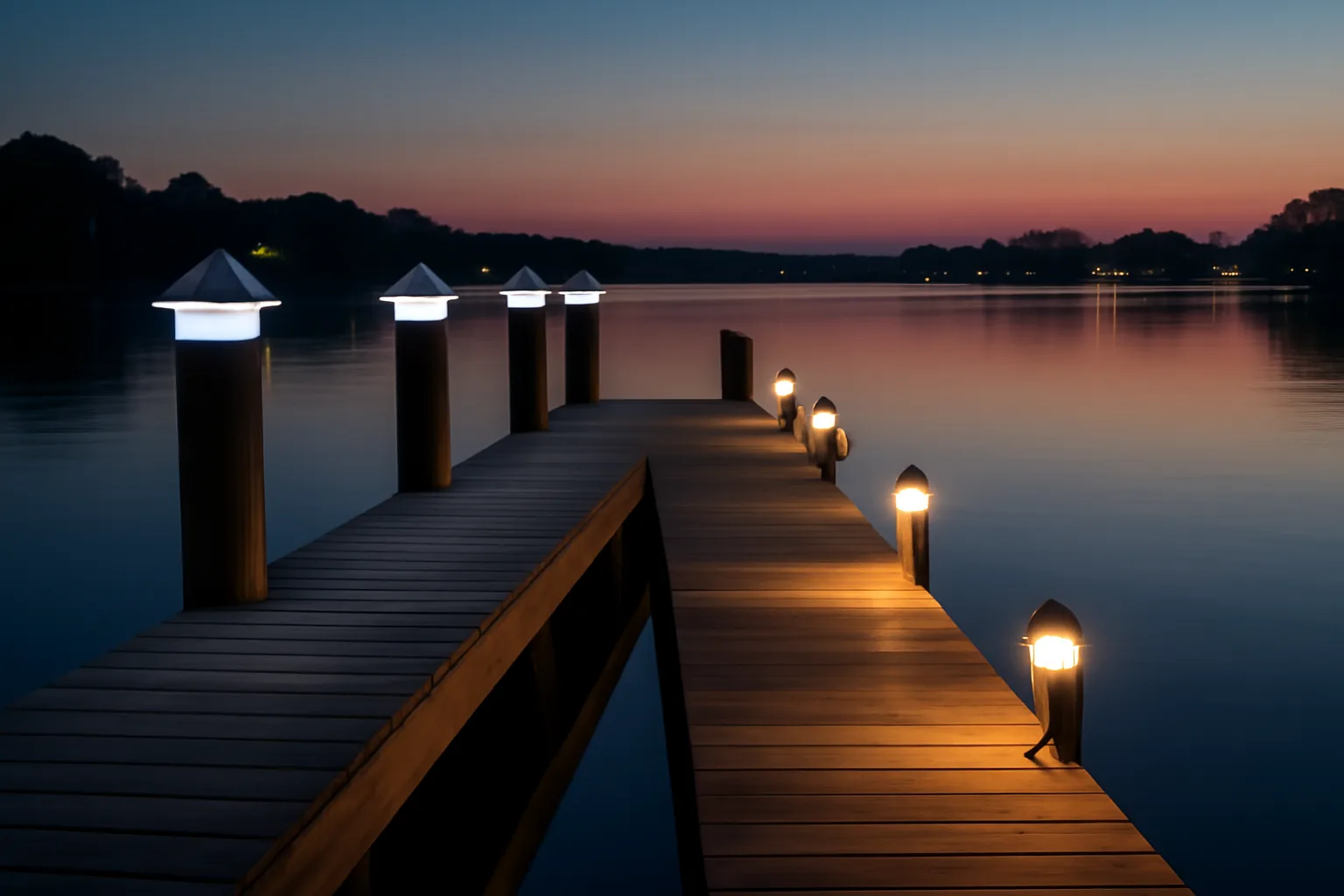
For the hardwired installation, I connected six 12V LED fixtures mounted on pilings to a shore-mounted transformer fitted with a dusk-sensing relay. Materials and labor put the total at approximately $340, including cable, protective tubing, junction hardware, and the transformer unit itself. The solar rig consisted of four independent post-mounted solar-powered LED fixtures. Assembly and mounting consumed about 45 minutes and ran approximately $85 in total materials. I left both setups completely untouched for a full year — no seasonal takedowns, no unscheduled repairs, no fussing.
That’s the baseline. No coddling, no seasonal rotation, no extra care beyond normal operation. Just docks doing dock things.
How Summer Treated Both Systems
Theoretically, summer is when solar fixtures demonstrate their strongest case — extended daylight for extended charging, warm nights reducing battery demand, optimal panel angle relative to the sun. In practice, my four solar units delivered exactly that from May through September. They activated reliably at dusk, maintained useful brightness through about 11 PM, then gradually faded toward morning. For a dock where most activity wraps up before midnight, that’s completely serviceable output.
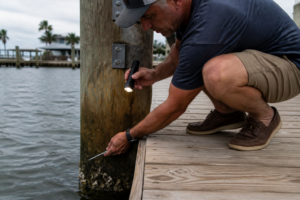
The hardwired setup behaved as designed. The photocell triggered lights at dusk, they burned at consistent full brightness throughout the night, and total consumption across six fixtures reached roughly 18 watts. Running that through a full summer season — approximately 180 nights — at our regional rate of $0.12 per kilowatt-hour netted about $9.50 in electricity charges. Negligible. However, mid-August brought a corroded connection inside a junction box that caused intermittent flickering on a pair of fixtures. I spent roughly 40 minutes disassembling, cleaning, and re-sealing that particular joint.
Metal and saltwater are fundamentally at odds. Any exposed conductive surface sitting in a marine environment will degrade. This isn’t a manufacturing defect — it’s thermodynamic reality. Budget time and materials for periodic connection maintenance.
Panel Discoloration and Charging Efficiency
Somewhere around mid-August, the transparent domes on two of my four solar units developed a cloudy appearance. This is standard UV-catalyzed polycarbonate yellowing — documented extensively in materials science literature — and it directly reduces how much light energy reaches the battery cell. The lights didn’t stop working, but they hit their brightness threshold maybe 15 to 20 minutes earlier each evening. Worth factoring in when you’re evaluating budget versus premium solar fixtures. Better-engineered panel covers and UV-resistant composite housings extend the operational lifespan considerably.
Winter Conditions Changed Everything
The plot twist arrived with shorter days. At our latitude, winter daylight stretches to roughly 9 or 10 hours. That scarcity of charging opportunity meant the solar batteries were perpetually depleted. December saw my solar units struggling to sustain brightness much past 9 PM. By January, when that cold front pushed temperatures below freezing for four consecutive nights, two of the four units simply quit. Darkness came back once the weather warmed and cloud cover broke enough for a solid recharge cycle. But for those four specific nights, dock was unlit.
The hardwired lights operated flawlessly through the entire freeze. Not a single flicker, not a single moment without output. Shore power doesn’t respond to daylight levels or thermometer readings. For installations where year-round reliability is non-negotiable — working marinas, active boat slips, anywhere foot traffic happens after dark in winter — that kind of consistency has genuine financial and safety value.
Years ago, I learned this lesson the expensive way. A Pensacola client wanted nothing but solar for her floating dock — the appeal of zero wiring was irresistible to her. December arrived cloudy and cold, and the dock stayed dark for close to two weeks. She called frustrated, and I ended up running a complete wired system on top of what was already there. That project taught me solar-only isn’t realistic for climates with substantial winter cloud cover or sustained freezing temperatures.
Battery Chemistry and Low Temperature Challenges
Most commercial solar dock fixtures rely on either NiMH or lithium-ion rechargeable cells. Cold temperatures substantially reduce what either chemistry can deliver. NiMH cells typically lose 20 to 30 percent of their rated capacity around the freezing mark. Lithium performs better in cold, but entry-level solar fixtures almost never use quality lithium cells — the cost premium doesn’t work for sub-$100 product positioning. Layer short daylight hours on top of diminished cold-weather battery performance, and you get illumination gaps during the months when people actually need docks lit for evening and night use. It’s not a design failure — it’s how the physics of the technology work in seasonal climates.
Electrical Code Requirements for Wired Dock Lighting Installations
Hardwired dock lighting systems fall under NFPA 303 — the Fire Protection Code for Marinas and Boatyards — plus whatever electrical code your jurisdiction enforces, which is almost always based on the National Electrical Code (NEC). Article 553 of the NEC specifically addresses floating buildings. Article 682 governs electrical installations near water bodies. Any wired dock lighting project requires GFCI circuit protection on every branch — this isn’t a suggestion or an inspector preference, it’s a required safety device that prevents electrocution. Full stop.
Low-voltage 12V systems (anything below 30V nominal) encounter fewer regulatory obstacles and create far less shock hazard, which is precisely why I recommend them for DIY dock lighting. The transformer itself needs proper weatherproofing and housing, and wire runs need physical protection from damage or foot traffic. Running wire across dock planks and stapling it down is both a code violation and an accident waiting to happen. Proper installations use conduit or purpose-designed cable trays for wire management.
Solar fixtures sidestep the entire regulatory framework in most jurisdictions because they operate at very low voltage with zero connection to shore infrastructure. For DIYers looking to avoid the permit application and inspection dance, that’s a legitimate operational advantage.
Which Solar Fixtures Survived the Freeze Intact
That four-day cold snap was the acid test. Whether solar lights could maintain function through extended freezing and minimal daylight — that was the real question, not whether they work under ideal conditions.
Performance wins
- Mounting geometry on quality units provides full ambient light distribution without requiring underground conduit runs or surface-mounted cable trays — zero weatherproofing complications, zero issues with freeze-thaw expansion and contraction cycles on buried wiring.
- Even after four nights trapped below freezing with minimal sun exposure, both non-functional units recovered completely to full operational brightness once daytime temperatures climbed and afternoon sun returned — battery chemistry proved resilient, no permanent degradation occurred.
- Modern LED efficiency produces minimal waste heat, which matters during winter when you want battery discharge to stay controlled, and sealed compartments housing the battery assembly managed moisture and condensation accumulation far better than I anticipated from equipment exposed to dock spray and humidity.
Performance limitations
- Evening lighting duration shrinks substantially when calendar moves past autumn — realistically 4–5 hours of usable illumination instead of the 8–10 hours advertised in product specifications designed around peak summer conditions.
- When dock placement puts fixtures in partial shade from structures, vegetation, or anchored boats during daylight, winter sun angle compounds the problem and the batteries won’t reach full charge state, resulting in earlier dimming and shorter operational windows each night.
I had one moment of doubt standing on the dock that freezing morning, thinking the solar units wouldn’t bounce back—but they proved me wrong. If you’re tired of running electrical to your dock or dealing with frozen conduit, grab the Dock Edge Postlite Solar LED Post Light 2pk and test them through a real winter.
Frequently Asked Questions
How much does a professional dock lighting installation cost?
A marine electrician typically quotes $400 to $600 for professional installation. Materials alone run $80 to $150 in hardware like wire, fixtures, and connectors. The difference covers labor, liability, and inspection compliance.
What temperature do solar dock lights lose battery capacity?
NiMH battery cells typically lose 20 to 30 percent of rated capacity around the freezing mark. Lithium performs better in cold, but entry-level solar fixtures rarely use quality lithium cells because of cost. Cold combined with short winter daylight creates charging gaps.
Can solar dock lights survive a hard freeze?
Yes, sealed designs can recover completely. After four consecutive freezing nights with minimal sun exposure, my non-functional units regained full operational brightness once daytime temperatures climbed and afternoon sun returned. No permanent battery degradation occurred.
What electrical codes apply to wired dock lighting?
Hardwired dock systems fall under NFPA 303 and the National Electrical Code. Article 553 addresses floating buildings and Article 682 governs installations near water. Every branch requires GFCI circuit protection for electrocution prevention.
Sources and further reading
About This Article

Written by Trent Hollis. Waterfront homeowner turned DIY obsessive. After two decades tinkering with my own dock, seawall, and boat lift on the Gulf Coast, I share everything I've learned about waterfront construction, boat lift maintenance, and coastal living projects. More about this site.
Scope and limits. Trent is a waterfront homeowner, not a licensed marine contractor. Structural, electrical, and lift work should go to a licensed marine contractor, and most in-water work needs a permit before you start.
Verify this against a primary source
Specifics change, and your situation may differ from the one described here. These are the authorities worth checking directly:
- ABYC — marine electrical and construction standards
- U.S. Army Corps of Engineers — permitting for work in navigable waters
- NOAA Tides & Currents — tidal range and water level data for your site