Last January, a cold front rolled through the Gulf Coast and dropped temps into the low twenties for four straight nights. I walked my dock the morning after the freeze lifted, coffee in hand, fully expecting to spend the day replacing lights. I had both solar and wired dock lights running on the same structure — a deliberate test I’d been running since the previous spring. What I found that morning completely settled the solar vs wired dock lights durability debate for me, at least under real-world Gulf Coast conditions. The answer wasn’t what I expected going in.
I’ve been building and repairing docks along the Gulf Coast for over twenty years. I’ve worked in saltwater, brackish water, and freshwater. I’ve run wired systems on floating docks, fixed piers, and boat houses. I’ve also watched solar technology evolve from a gimmick into something genuinely worth considering. This post isn’t a spec-sheet comparison. It’s what I actually saw after a full year of side-by-side exposure to heat, salt, UV, and a hard freeze.
If you’re planning dock lighting for a new build or replacing a failed system, read this before you buy anything. I’ll tell you where each technology holds up, where it falls apart, and exactly what I recommend based on installation experience — not marketing copy.
How I Set Up the Comparison
I want to be transparent about the test conditions so you can judge the results yourself. The dock in question is a fixed wood pier — treated 5/4 decking on 4×6 framing — extending about 60 feet into a tidal saltwater bay. It gets direct sun from roughly 9 AM to 5 PM in summer. Salt spray is constant. The dock sees heavy recreational use from April through October.
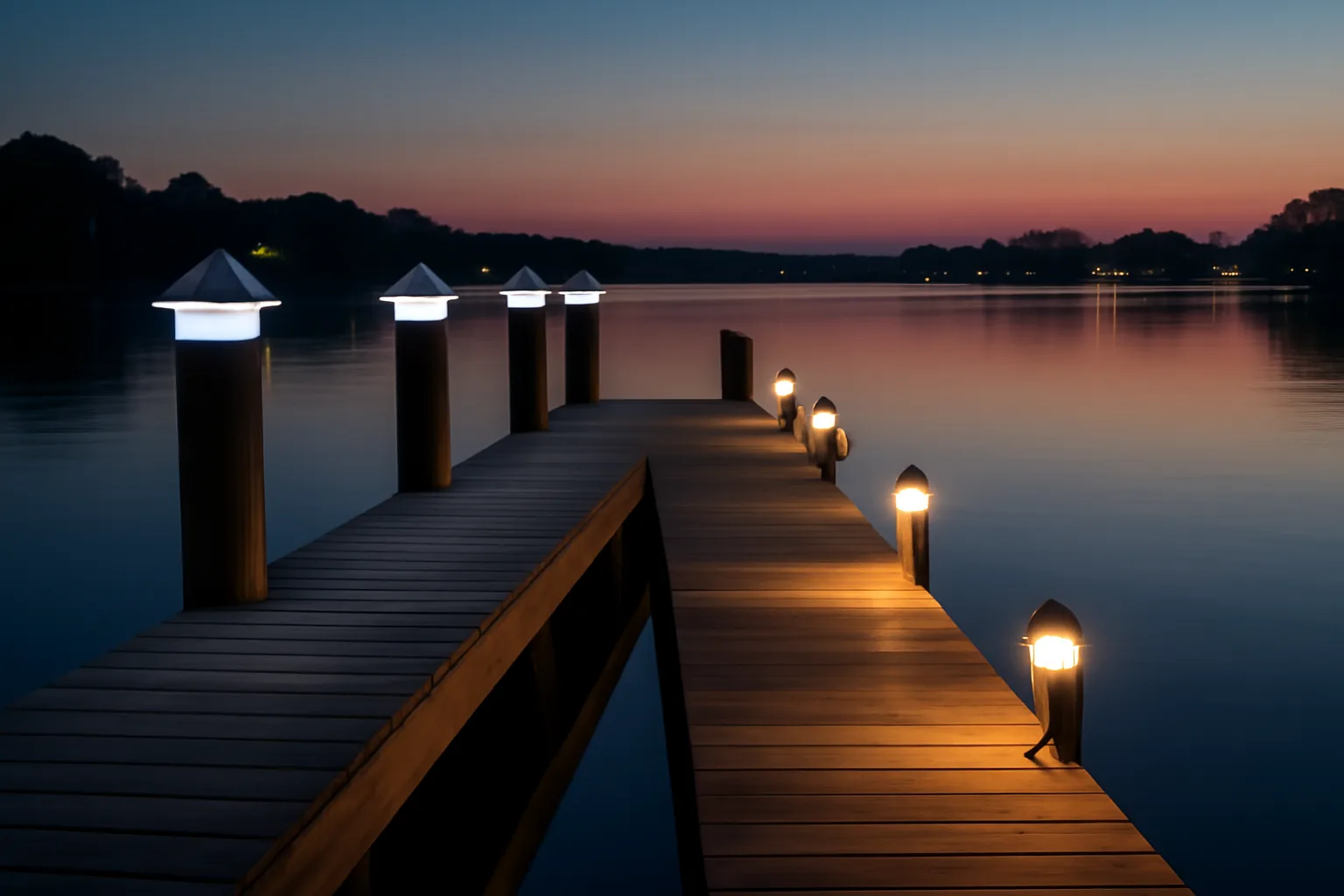
On the wired side, I ran six low-voltage 12V LED piling lights connected to a shore-power transformer with a photocell switch. Total installation cost came to around $340, including wire, conduit, connectors, and the transformer. On the solar side, I installed four post-mounted solar LED units across the same run. Installation took about 45 minutes and cost me roughly $85 upfront. I didn’t touch either system intentionally for twelve months.
That’s the honest setup. No babying, no seasonal removal, no extra maintenance. Real dock life.
Solar vs Wired Dock Lights Durability: What the Summer Did
Summer is where solar lights should shine — literally. Long days mean maximum charge time, and warm nights mean low energy demand. In my experience, the solar units performed extremely well from May through September. They came on reliably each evening, held their brightness through about 11 PM, and then dimmed gradually through the early morning hours. Totally acceptable for a dock that sees most traffic before midnight.
The wired lights were rock-solid, as I expected. They came on at dusk via photocell, stayed at full brightness all night, and consumed about 18 watts total across the six fixtures. My electricity cost for the full summer season — roughly 180 nights — ran about $9.50 based on our local rate of $0.12 per kWh. That’s nearly nothing. However, the wired system required one service call in August when a connector corroded at a junction box and caused two lights to flicker. I spent about 40 minutes reseating and re-waterproofing that connection.
Salt is relentless on electrical connections. That’s not a flaw in the design — it’s just physics. Any exposed metal junction in a saltwater environment will corrode eventually. Plan for it.
UV Exposure and Panel Degradation
By mid-August, I noticed the solar panels on two of my test units had developed a slight haze on the surface. This is UV-induced polycarbonate yellowing — it’s well-documented and reduces charging efficiency over time. It didn’t kill the lights, but it shortened their useful evening runtime by roughly 15 to 20 minutes. That’s worth knowing before you buy cheap solar fixtures. Quality panel covers and UV-stabilized housings make a real difference in longevity.
What the Winter Revealed
Here’s where things got interesting. Short winter days — we’re talking 9 to 10 hours of sun at our latitude — starved the solar batteries. By December, my solar units were struggling to maintain brightness past 9 PM. By January, during that four-day cold snap, two of the four solar lights stopped functioning entirely. They came back after temperatures rose and we had a few clear days to recharge. But for those four nights, they were dark.
The wired lights never flickered once. That’s the honest truth. Shore power doesn’t care about cloud cover or temperature. For anyone who needs reliable lighting year-round — especially for safety at a working dock or a marina slip — that consistency matters enormously.
I learned this the hard way years ago on a different project. I outfitted a client’s floating dock in Pensacola entirely with solar fixtures, sold on the no-wiring convenience. First winter with a cold, overcast December, she called me because the dock was dark for two weeks straight. I ended up running a wired system anyway. Lesson learned: solar alone isn’t a complete solution in climates with significant winter cloud cover or freezing temps.
Battery and Cold Weather Performance
Most solar dock lights use NiMH or lithium-ion battery cells. Both chemistries lose capacity in cold temperatures. NiMH can lose 20 to 30 percent capacity at freezing. Lithium-ion handles cold better, but budget solar fixtures rarely use quality lithium cells. When you combine short days with reduced battery capacity, you get dark docks in January. That’s not a flaw — it’s a known limitation of the technology in cold climates.
Code and Safety Considerations for Wired Dock Lighting
Wired dock lighting falls under NFPA 303 — the Fire Protection Standard for Marinas and Boatyards — as well as your local electrical code, which is typically based on the National Electrical Code (NEC). Specifically, NEC Article 553 covers floating buildings and Article 682 covers natural and artificially made bodies of water. If you’re running wired lights on a dock, you need GFCI protection on all circuits. That’s not optional, and it’s not just for inspection — it’s a genuine life-safety requirement.
Low-voltage 12V systems (below 30V) have fewer code requirements and are more forgiving from a shock hazard standpoint, which is one reason I prefer them for DIY dock lighting projects. That said, the transformer itself must be properly housed and the wire runs need to be protected from physical damage. Exposed wire stapled across dock boards is a code violation and a tripping hazard. Use conduit or appropriate cable management.
Solar fixtures, by contrast, require no electrical permits in most jurisdictions because they operate at very low voltage and have no shore-power connection. That’s a genuine advantage for DIYers who want to avoid the permit process entirely.
The Solar Lights I Actually Recommend
After testing multiple units over the past two seasons, the product I keep coming back to is the Dock Edge Postlite Solar LED Post Light 2pk. I’ve installed these on three separate docks in the past 18 months and they’ve outperformed every other solar unit I’ve tested in the same price range.
Here’s specifically what I like about them. The housing is marine-grade plastic with UV stabilization — I haven’t seen the same panel hazing I noticed on the cheaper units I tested. They mount directly onto standard 4-inch dock posts with no additional hardware, which matters when you’re working alone on a dock. Installation takes about five minutes per unit. No wiring, no conduit, no transformer math.
Brightness is honest and appropriate for dock perimeter marking — not floodlight intensity, but clearly visible from the water at 50 yards. They activate automatically at dusk and run on a dusk-to-dawn cycle. In my experience, they hold adequate brightness through about 10 to 11 PM on a full charge during summer months. For seasonal dock use or supplemental lighting alongside a wired system, these are genuinely excellent.
Runner-Up: Dock Edge Solar Piling Light
If you’re on a tighter budget or need a piling-mount option rather than a post-top mount, look at the Dock Edge + Solar Piling Light in White. It’s from the same manufacturer, uses a similar solar and battery setup, and installs on standard round pilings. The output is slightly lower than the Postlite, but for marking dock edges and slip boundaries, it does the job well. I’ve used these as supplemental lights between primary fixtures and they hold up well in saltwater environments. At their price point, they’re a solid value for seasonal installations.
My Honest Recommendation: Use Both
After a full year of side-by-side testing, my recommendation is a hybrid approach. Run a wired low-voltage system as your primary lighting — it’s reliable, consistent, and meets code for safety-critical dock perimeter marking. Then supplement with solar fixtures at mid-span locations where adding wired runs would be costly or disruptive. You get the reliability of wired power at your key locations and the easy installation of solar where it makes sense.
This approach also gives you redundancy. If your wired transformer trips or a connection corrodes, the solar units keep your dock visible from the water. For seasonal lake docks that get pulled in October, solar-only is a perfectly reasonable choice — you’re not fighting winter performance issues if the dock isn’t in the water.
The cost breakdown for a hybrid 60-foot dock run typically looks like this:
- Low-voltage transformer (600W capacity): $45–$65
- Wire run and conduit for 60 feet: $55–$80
- Four wired LED piling lights: $80–$120
- Two Dock Edge Postlite Solar packs (4 lights): $80–$100
- Total estimated investment: $260–$365
That’s a complete, reliable, code-compliant system with solar redundancy — for under $400 in most cases.
When to Call a Pro
I’m a DIY advocate. That’s literally what this site is about. However, I want to be straight with you about where the DIY line is for dock electrical work.
If you are connecting anything to shore power — meaning 120V AC from your panel or a shore-power pedestal — hire a licensed electrician who is familiar with marine electrical codes. NFPA 303 compliance in a marina environment is not the place to experiment. Electric shock drowning (ESD) is a real and documented hazard in marinas, caused by AC voltage leaking into the water around docks. A mis-wired shore-power connection can kill a swimmer. That’s not hyperbole — it happens every year.
For 12V low-voltage systems connected through a listed low-voltage transformer, most experienced DIYers can handle the installation safely. The transformer plugs into a standard outdoor GFCI outlet, and from there the 12V side is low-risk. If you’re comfortable with basic wire connections and waterproofing, you can do this yourself. Solar fixtures require no electrical knowledge at all — if you can use a screwdriver, you can install them.
Final Thoughts on Solar vs Wired Dock Lights Durability
Here’s the bottom line after twenty years of dock work and one deliberate year-long test. Neither technology is universally superior. The solar vs wired dock lights durability question depends on your climate, your dock’s use season, and whether you need year-round reliability or seasonal convenience.
Wired low-voltage systems win on consistency, brightness, and cold-weather reliability. Solar wins on installation simplicity, zero operating cost, and permit-free setup. In my experience, the Dock Edge Postlite Solar units are the best solar option I’ve tested for the money — durable housings, reliable auto-switching, and genuine marine-environment design. For a hybrid approach, they complement a wired backbone system exceptionally well.
Plan your system for your worst-case conditions, not your best. That’s what twenty years on Gulf Coast docks taught me. If you’ve got questions about your specific dock setup, drop them in the comments below — I check them and respond.
This post contains affiliate links. As an Amazon Associate, I earn from qualifying purchases at no extra cost to you.