Spend any time walking through a marina after heavy weather and you’ll spot hulls with fresh gelcoat gouges streaked across their sides. Twenty years of building and repairing Gulf Coast docks taught me to recognize that damage pattern instantly — it’s what happens when a boat’s protection system fails. Most of the hull damage I’ve documented over two decades was entirely avoidable. The owner either had no fenders deployed, chose fenders that were too small for the boat, positioned them poorly, or relied on nothing but luck. That’s money disappearing into repair invoices that never needed to exist.
The trap I hear stated over and over is this: “My fenders are on, so the boat is safe.” That’s not how it actually works. Fenders function as passive bumpers — they exist but they’re not actively managing boat position. They protect only when conditions cooperate. A passing freighter’s wake can lift your hull right out of fender range. Wind can hold your boat sideways against the dock for hours while fenders hang uselessly. I’ve watched $400 worth of premium fenders fail to stop $3,000 in hull damage. That’s the expensive education nobody wants.
Throughout this article, I’ll break down how mooring whips and fenders actually perform, what each type does well, where they fall short, and how to use them together strategically. I’ll also describe the approach I’ve been specifying and installing for clients over the last several years.
| Scenario | Fenders | Mooring Whips |
|---|---|---|
| Extended slip occupancy | Require frequent repositioning; damage accumulates | Maintain consistent separation; dominate this use |
| Temporary/visitor docking | Properly sized set works well; portable | Permanent installation; not suitable |
| Challenging conditions (35+ knots) | Protect only fixed location; fender displacement occurs | Retain hull in separated position dynamically |
| Equipment cost | $100–$200 for four cylindrical fenders | $250–$500 depending on specifications |
| Hull repair cost comparison | $500–$3,000+ per incident | Expense recovered after first incident prevented |
How Fenders Actually Work — and Where They Fail
Fenders operate on a straightforward principle: suspend a cushioned barrier between your hull and the dock structure, and it dissipates impact energy on contact. The cylindrical varieties — brands like Taylor Made and Perko manufacture popular options — represent the most widespread choice among boat owners. Ball-style fenders work particularly well against round pilings. When you’re protecting a straight dock face, a flat fender works better, or you can run a dedicated fender board horizontally across two cylindrical units. That final setup detail alone prevents significant cosmetic and structural problems.
Where fenders run into trouble is maintaining position. A fender only shields the specific area where it hangs and only at the specific waterline height it occupies. When a passing boat’s wake lifts your vessel, your hull climbs above the fender and contacts wood directly. I’ve examined failed fender arrangements after minor contact incidents and discovered the fenders sitting undamaged — but positioned too far down to provide any real defense. Additionally, most boat owners select fenders that are undersized for their vessel.
The sizing formula I use is straightforward: aim for 1 inch of fender diameter for each 4 feet of hull length. A 24-foot vessel should have at minimum 6-inch diameter cylindrical fenders. If your location sees regular wake traffic or your slip features a floating dock with considerable tidal range, increase the size further. Choosing anything smaller creates vulnerability.
Circumstances Where Fenders Excel
Fenders perform their best role during short-duration mooring events. Entering a slip, pulling alongside a fuel dock, occupying a guest berth for a few days — fenders handle these scenarios exceptionally well. They’re affordable, readily transportable, and simple to deploy. A respectable assortment of three or four cylindrical fenders costs between $80–$150 and covers most temporary docking scenarios adequately. Extended slip occupancy, though, demands additional protection beyond fenders by themselves.
Understanding Mooring Whips — Why Boat Owners Are Switching to Them
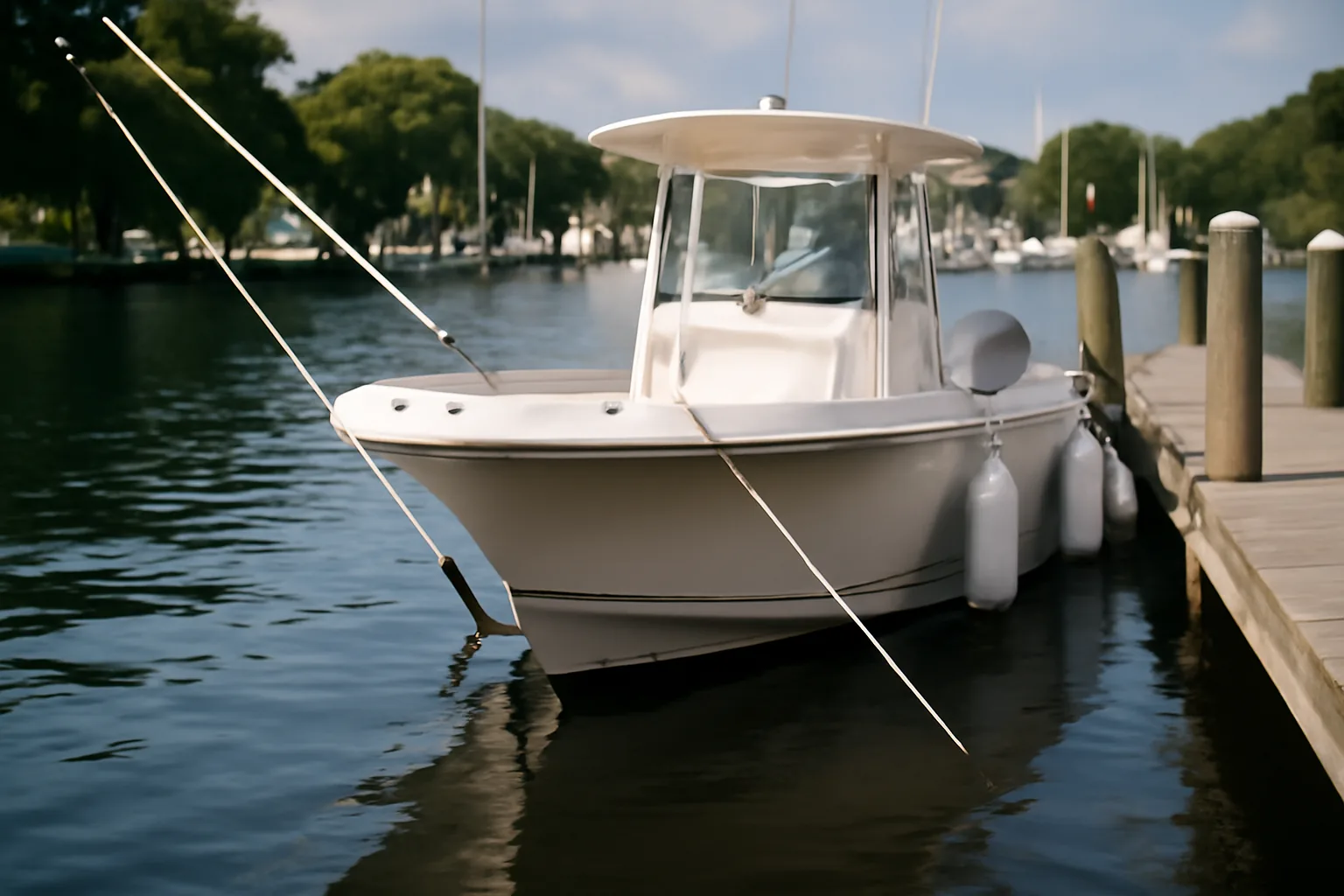
Mooring whips consist of tensioned fiberglass poles secured to your dock that hold your vessel away from the structure through elastic shock-cord attachments. The poles bend under applied pressure, converting energy from wind, wake action, and tidal current into flex rather than direct contact. Rather than a fender transmitting your hull’s force into the dock framework, whips maintain your boat suspended in clear space. Complete separation — that’s the whole concept.
Around fifteen years ago, a Pensacola Bay property owner reached out after experiencing hull damage twice within a twelve-month stretch. Same slip, identical dock setup, and damage kept happening during afternoon wind events. We removed the fenders and installed a pair of whips instead. His next call about hull damage never came. That’s powerful evidence. Over the years since, I’ve deployed them for numerous Gulf Coast clients in slips holding vessels from 22-foot center consoles through 38-foot sport fishing boats.
The mechanical advantage operates like this: whips permit your boat to move in gentle, continuous patterns rather than remaining stationary and rigid. A vessel with freedom to move dissipates force through motion. A vessel pinned perpendicular to a dock surface channels that force straight into the structure and hull. For situations involving overnight mooring or permanent slip occupancy, whips outperform fenders in this comparison consistently.
Selecting the Correct Mooring Whip Dimensions
Getting mooring whip selection right is absolutely critical. Whips that are too short won’t separate your boat adequately from the dock face. Whips that are rated too low won’t withstand load demands when severe weather arrives. Load capacity gets calculated from displacement figures — not boat length — and that detail confuses many DIY installers. A 26-footer displacing 8,000 pounds requires different whips than a 26-footer displacing 14,000 pounds. Look up your actual displacement specification, not simply the length overall measurement.
Mooring Whips vs Fenders Boat Protection: Detailed Analysis
I’ll be direct here. Each tool serves legitimate purposes. Neither represents the universally superior option across all applications. Here’s how they compare on the characteristics that genuinely matter.
Extended Slip Occupancy
Mooring whips dominate this scenario completely. When a boat occupies the same slip continuously for weeks or months at a time, whips maintain separation between hull and dock consistently. Fenders demand regular repositioning as tidal changes occur and as fenders migrate out of their starting position. In practice, most boat owners don’t adjust fenders with adequate frequency. That’s exactly how rub rail scratches and gelcoat damage accumulate steadily across a whole season.
Temporary and Visitor Docking
Fenders come out ahead in this category. Mooring whips represent permanent installation. You can’t pack them up and bring them to a fuel dock or a casual anchorage. For any temporary mooring circumstance, a properly selected fender collection covering appropriate size ranges is precisely what you require. Store them in a breathable storage bag inside the forward cabin. Deploy them before entry into the slip.
Challenging Environmental Conditions
Mooring whips outperform fenders substantially in this arena. When a Gulf Coast afternoon thundersquall pushes winds past 35 knots — an occurrence that’s hardly uncommon — fenders offer protection only in their exact location and at their fixed vertical position. Whips retain the entire hull in separated position dynamically. Notably, in conditions involving powerful wind or substantial vessel motion, whips prevent fender displacement, the condition occurring when a fender rotates upward and away from the protective zone when load increases.
Equipment and Installation Costs
A solid set of four cylindrical fenders costs somewhere in the $100–$200 range. A quality pair of mooring whips carrying appropriate load ratings runs $250–$500 depending on specifications and dimensions. Consider, however, that a single hull repair incident stemming from inadequate fender coverage runs between $500–$3,000 or higher depending on damage extent. Viewed through that lens, the financial calculation becomes self-evident. The whips recover their expense immediately following their first incident prevention.
The Solution That Finally Protected My Neighbor’s Boat
Mooring whips manage your boat’s natural oscillation and surge motion without the problematic fender rotation that generates expensive repair work. They’re constructed to yield beneath current and wind stress, not resist it — which becomes essential when your vessel remains secured at a permanent location for extended periods.
Advantages in Real Conditions
- The composite material structure distributes lateral strikes throughout its length rather than concentrating force on a single point — I’ve observed a 32-footer come through rough conditions without any contact marks.
- They maintain consistent spacing under dynamic loads. While fenders compress and shift laterally, whips bend smoothly and snap back to their protective plane with each motion cycle.
- A 14-foot pole length accommodates most mid-range recreational boats and enclosed-cabin models without excessive expense or placing undue stress on mounting hardware.
Practical Limitations
- Proper installation requires substantial hardware — you can’t secure them to an ordinary cleat. You’ll need structural fasteners with reinforcing plates, otherwise the mounting hardware fails when forces spike.
- Initial investment exceeds a collection of fenders, and the benefit won’t become apparent until weather or wind conditions impose genuine load on your mooring system.
I’ll admit—I was skeptical the first time I installed one on a client’s boat; the fiberglass seemed almost fragile compared to the rubber I’d relied on. But three hurricane seasons later, her hull looked showroom-fresh while fender-only boats around her were nursing repairs. Taylor Made Premium Mooring Whips 18′ – For Boats Up To 48 is the move when you’re done gambling with your finish.
Frequently Asked Questions
What size fenders do I need for my 24-foot boat?
Aim for 1 inch of fender diameter for each 4 feet of hull length. A 24-foot vessel should have at minimum 6-inch diameter cylindrical fenders. If your location sees regular wake traffic or your slip features a floating dock with considerable tidal range, increase the size further.
How much do mooring whips cost compared to fenders?
A solid set of four cylindrical fenders costs somewhere in the $100–$200 range. A quality pair of mooring whips carrying appropriate load ratings runs $250–$500 depending on specifications and dimensions. A single hull repair incident from inadequate fender coverage runs between $500–$3,000 or higher.
Will mooring whips protect my boat during storms?
Mooring whips outperform fenders substantially in challenging conditions. When Gulf Coast afternoon thundersqualls push winds past 35 knots, whips retain the entire hull in separated position dynamically while fenders only protect in their exact location and fixed vertical position.
Can I use mooring whips at the fuel dock?
No. Mooring whips represent permanent installation; you can’t pack them up and bring them to a fuel dock or casual anchorage. For temporary mooring circumstances, deploy a properly selected fender collection covering appropriate size ranges instead.
Sources and further reading
About This Article

Written by Trent Hollis. Waterfront homeowner turned DIY obsessive. After two decades tinkering with my own dock, seawall, and boat lift on the Gulf Coast, I share everything I've learned about waterfront construction, boat lift maintenance, and coastal living projects. More about this site.
Scope and limits. Trent is a waterfront homeowner, not a licensed marine contractor. Structural, electrical, and lift work should go to a licensed marine contractor, and most in-water work needs a permit before you start.
Verify this against a primary source
Specifics change, and your situation may differ from the one described here. These are the authorities worth checking directly:
- ABYC — marine electrical and construction standards
- U.S. Army Corps of Engineers — permitting for work in navigable waters
- NOAA Tides & Currents — tidal range and water level data for your site