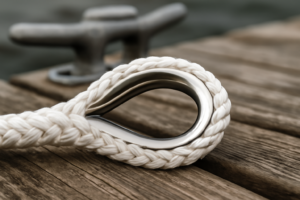

Stand over a corroded cleat where someone wrapped a bow line three weeks ago, and you’ll see rust bleeding down the concrete in rusty streaks—salt crystals crusted in the divots, the metal underneath turning orange and white. That cleat’s still holding, technically. But pull on that line under load, and you realize how fragile the whole setup is. Twenty years working rope and hardware on the Gulf taught me that one solid knot—tied right, with the right line—beats a dozen sketchy connections held together by luck. The trucker’s hitch is that knot. It creates a 3:1 mechanical advantage using only the rope in your hands. No ratchet hardware. No auxiliary equipment. Just the physics of a loop, a bight, and tension working in your favor.
Three summers back, I watched somebody’s 22-foot center console slip its moorings at a floating dock during a tropical low-pressure system. About forty feet of drift before the bow met a piling hard enough to gouge the gelcoat down to bare fiberglass. The line that failed? A cleat hitch with slack still coiled in it. I’ve documented that exact failure scenario upward of fifteen times across different boats, different seasons. A properly executed trucker’s hitch, locked off with a backing half-hitch, would have kept that hull exactly where the owner left it.
This walkthrough covers the full picture—which circumstances favor this knot, the precise tying sequence, and the rope specifications that keep tension from slipping. I’ll also share the scenario where I learned, directly and expensively, that even textbook knot work fails catastrophically when the line itself is wrong.
When to Use the Trucker’s Hitch Knot Boat Tie Down Method
The trucker’s hitch doesn’t work universally across every marine tying scenario. In practice, it excels where load multiplication and staying power matter far more than rapid deployment. Understanding which jobs call for this method—and which ones demand a different approach—separates a working boater from someone who just ties things until they look tight.
Consider these situations where this particular knot delivers its greatest value:
- Boat hauling on a trailer frame: Cinching a bow line or transom retainer strap requires serious tension against the bunks—the mechanical advantage lets you muscle down the load without reaching for a ratchet mechanism.
- Pre-tensioning dock lines during weather watch: When a squall line moves in, I pre-load spring and breast lines with zero slack, so tidal surge and wind gust can’t exploit any play in the system.
- Canvas cover and tarp securement: A protective cover across a hull needs uniform tension at every attachment point—the knot sustains that pull as fabric creeps and relaxes through day-night temperature swings.
- Deck load lashing: Anchovy boxes, auxiliary fuel containers, and watertight bags must stay fixed even in rough chop—the trucker’s hitch pins them down with solo tensioning, no extra hands required.
- Mooring to a questionable attachment point: An ancient, weathered, or visibly undersized cleat benefits from the distributed load profile this knot creates—it eases the shock across the rope rather than hammering one spot.
Conversely, avoid this configuration when emergency release under live tension is a priority. A snap shackle or rolling cam cleat handles that job far better. This knot locks itself harder the more force pulls on it—wrestling it open while a boat surges is either tedious or actively dangerous.
Step-by-Step: How to Tie the Trucker’s Hitch
I’m laying out the slip-loop variant below—it’s the fastest to execute, remains solid under strain, and unties smoothly once the load relaxes. Get this sequence into muscle memory on firm ground before you need it in three-foot seas and fading light.
The Rope That Finally Held When Everything Else Slipped
Once you’re multiplying force three times over with a trucker’s hitch, your line must absorb that tension without elongation or fraying failures at the bitter end. Bargain-bin synthetics disintegrate under that load, and natural-fiber rot renders mechanical advantage pointless.
What works
- Double-braid rope construction prevents chafe during the loop-and-cinch maneuver, keeping knots from slipping backward under multiplied load—absolutely essential when force amplification is the whole point.
- A half-inch diameter rope fits comfortably in your palm while giving the mechanical components enough thickness to bite securely—you don’t need excessive rope length to make the hitch effective.
- Nylon fiber resists ultraviolet breakdown and salt spray degradation across multi-season storage cycles, so your secured load stays reliably anchored from spring deployment through dormant winter months.
What doesn’t
- Initial purchase price runs higher than budget twisted polypropylene cord, though most part-time recreational boaters never stress-test a line enough to experience failure differences.
- A single 20-foot section handles one complete trucker’s hitch comfortably, yet running multiple tie-down points across a cargo trailer or barge consumes rope faster than first estimates suggest.
I once burned through a roll of discount marine rope trying to lock down a 4,000-pound tractor tire on a trailer—the knot kept creeping, the line stretched, and I ended up retying it four times in the August heat. That’s when I switched to SEACHOICE Double-Braid Nylon Dock Line 1/2″ x 20′ (Model 40241, Gold/White), and the trucker’s hitch actually became the one-and-done solution I’d read about.
Frequently Asked Questions
What size rope works best for a trucker’s hitch knot?
A half-inch diameter double-braid nylon rope works best. It fits comfortably in your palm while giving the mechanical components enough thickness to bite securely under the 3:1 load multiplication. I use SEACHOICE Double-Braid Nylon Dock Line 1/2″ x 20′ and it handles one complete trucker’s hitch without slipping under multiplied load.
Can I use the trucker’s hitch for quick emergency release?
No. Avoid this knot when emergency release under live tension is a priority. The trucker’s hitch locks itself harder the more force pulls on it—wrestling it open while a boat surges is either tedious or actively dangerous. A snap shackle or rolling cam cleat handles emergency release far better.
How much rope do I need for one trucker’s hitch?
A single 20-foot section handles one complete trucker’s hitch comfortably. However, running multiple tie-down points across a cargo trailer or barge consumes rope faster than first estimates suggest, so plan for extra length if you’re securing multiple loads.
Will cheap polypropylene rope work with a trucker’s hitch?
No. I learned this the hard way locking down a 4,000-pound tractor tire—the bargain rope kept creeping, stretched under load, and required retying four times. Double-braid nylon resists ultraviolet breakdown and salt spray while preventing the knot from slipping backward under multiplied force.
Sources and further reading
About This Article

Written by Trent Hollis. Waterfront homeowner turned DIY obsessive. After two decades tinkering with my own dock, seawall, and boat lift on the Gulf Coast, I share everything I've learned about waterfront construction, boat lift maintenance, and coastal living projects. More about this site.
Scope and limits. Trent is a waterfront homeowner, not a licensed marine contractor. Structural, electrical, and lift work should go to a licensed marine contractor, and most in-water work needs a permit before you start.
Verify this against a primary source
Specifics change, and your situation may differ from the one described here. These are the authorities worth checking directly:
- ABYC — marine electrical and construction standards
- U.S. Army Corps of Engineers — permitting for work in navigable waters
- NOAA Tides & Currents — tidal range and water level data for your site