You’ll hear it at the marina or the lumber counter, usually from someone who’s never actually driven a piling: “Just rent the cheapest hammer and get it done fast.” What sounds smart on a Tuesday afternoon falls apart the moment saltwater enters the equation. The wrong equipment choice—or worse, the right equipment operated in the wrong soil—can trap you in a project that drags on for weeks, costs double the estimate, and leaves your dock sitting on a foundation that was never properly set. I’ve cleaned up enough of those disasters to know better.
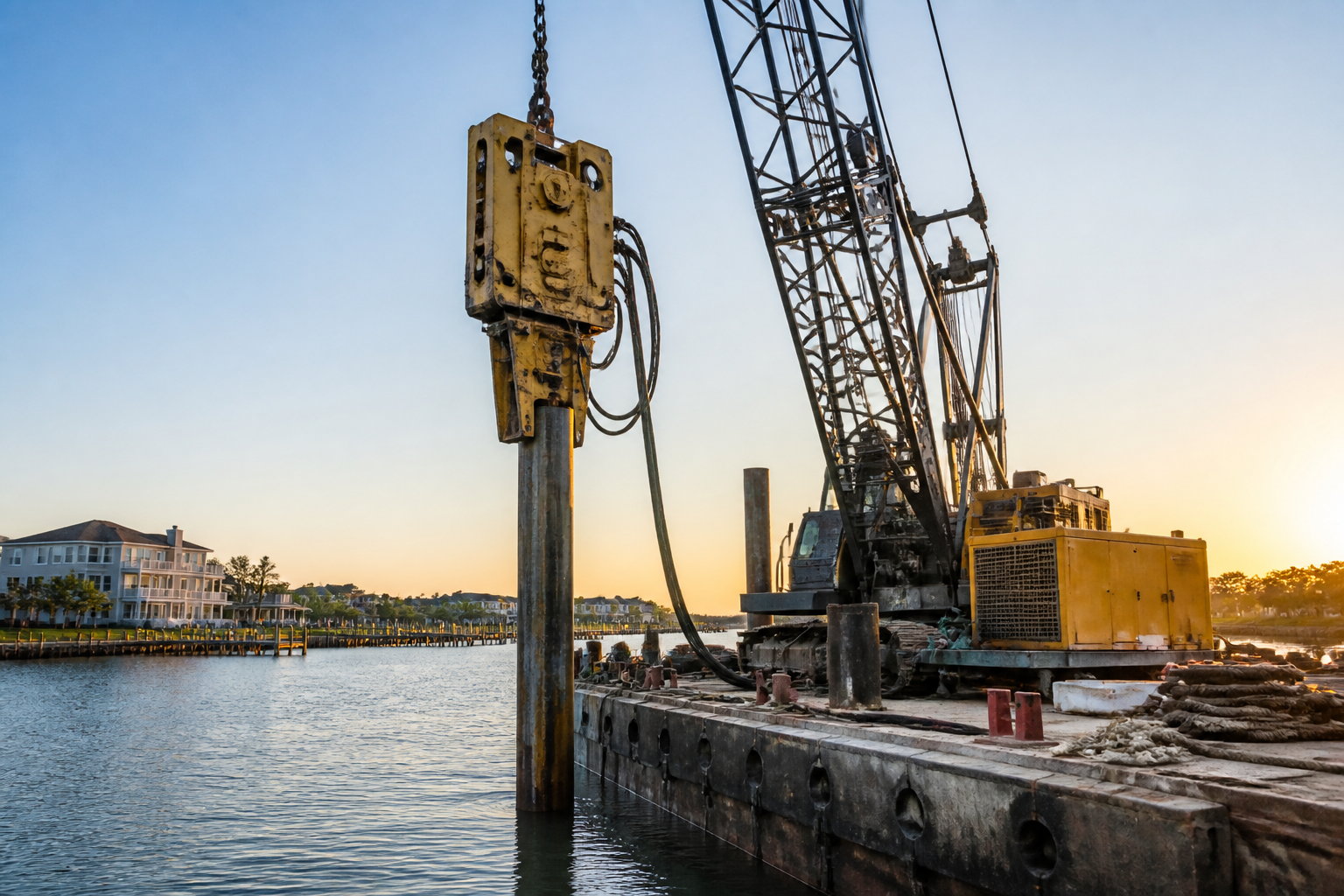
During the aftermath of Hurricane Ian, I spent three days on a barge 200 yards offshore watching crews reset pilings that had shifted when the storm surge hit. One crew had a vibratory pile hammer working the Gulf bottom—a 50-foot treated timber disappeared into the soft mud in roughly six minutes. The machine produced this constant, bone-shaking hum that you could feel in your ribcage from thirty feet away. No explosions. No dramatic impacts. Just systematic, rhythmic physics doing what physics does best: moving weight through space into resistant material.
That experience stuck with me. For two decades now, it’s shaped how I think about dock construction and what I explain to people asking the hard questions. Most property owners will never climb into the operator’s cab themselves—that’s certified contractor work, period. But understanding what these machines actually do, and knowing why your crew chooses one system over another on day one, gives you genuine leverage over your project’s success. Plus, the engineering is honestly remarkable, and I think it deserves respect.
Let’s break down the two primary systems that literally force pilings into the lakebed or seafloor—and why that initial choice might determine whether your dock gets finished in days or weeks.
| Characteristic | Hydraulic Impact | Vibratory |
|---|---|---|
| Operating cycles per minute | 8 to 12 | 1,500 to 2,500 |
| Energy per cycle | 50,000 to 150,000 foot-pounds | 2,000 to 4,000 foot-pounds |
| Time to set 40-foot piling in Gulf mud | 15 to 25 minutes minimum | 4 to 7 minutes |
| Noise level at 50 feet | 95 to 105 decibels | 80 to 90 decibels |
| Daily equipment rental | $3,000 to $8,000 | $4,000 to $10,000 |
| Best soil conditions | Loose, yielding material | Loose to medium-density material |
| Poor performance conditions | Hard clay, compacted sand, shell beds, bedrock | Hard clay, compacted sand, shell beds, bedrock |
The Hydraulic Impact Method: Traditional Approach With Real Limitations
When you picture a pile driver in your mind, you’re almost certainly visualizing a hydraulic impact system. It’s the established technology, relied on for decades, and fundamentally straightforward: a crane or barge-mounted rig suspends a substantial steel mass—anywhere from 10,000 pounds on up to 50,000 pounds depending on what diameter piling you’re setting and how dense the subsurface material is. That mass gets hoisted and released, drops under gravity, and slams into the top of the piling with massive concentrated force. The piling sinks. Repeat.
The acoustic signature is impossible to miss: a loud, percussive BOOM that travels across water and resonates through neighboring properties. I’ve had landowners call from a mile away convinced something had exploded. The kinetic energy per strike typically lands between 50,000 and 150,000 foot-pounds, scaled to hammer class. The machine cycles through roughly 8 to 12 impacts per minute on larger pilings, fewer on dense substrate or resistant materials.
My education on where impact hammers reach their boundaries came through trial and error on a commercial reinforcement job in Destin about two decades back. The dock had settled gradually over time. Beneath it lay what the soil report called “Gulf-bottom clay with shell inclusions”—softer than limestone, but substantially firmer than typical mud. We deployed a standard impact hammer on a 50-foot piling and hit absolute refusal at 38 feet. The machine simply couldn’t generate enough force to push through that resistant layer without creating structural risk. Hydraulic impact excels when soil is yielding and cooperative, but encounters real barriers when clay becomes compacted, sand becomes densified, or you encounter shell beds or actual stone.
The financial side: equipment rental for an impact rig typically runs $3,000 to $8,000 each day, contingent on rig capacity and your geographic market. Contractor crews (operator, safety personnel, marine insurance, diesel) add another $2,500 to $5,000 in daily labor costs on top of that machine rental.
The Vibratory System: Speed Meets Controlled Force
A vibratory pile hammer operates on an entirely different foundation. Rather than delivering single, massive blows, it employs a system of counterbalanced, eccentric masses that vibrate at extreme frequency—standard units typically perform 1,500 to 2,500 cycles per minute, with heavy-duty specialty models exceeding 3,000 cycles per minute. That sustained, controlled oscillation essentially liquefies soil surrounding the piling, dropping friction coefficients and permitting the piling’s own weight combined with downward pressure from the crane to gradually sink through the ground.
Observing a vibratory pile hammer for the first time left me genuinely startled at the pace. A 40-foot timber in soft Gulf-coast bottom could vanish completely in four to seven minutes. That identical piling under impact hammer operation would require 15 to 25 minutes minimum, potentially longer if soil resistance appeared. Per-cycle energy output ranges from 2,000 to 4,000 foot-pounds, but executed thousands of times per minute, cumulative force becomes genuinely formidable.
The critical boundary: vibratory systems reach their own performance ceiling when soil transitions to genuinely dense material or bedrock emerges. The vibration becomes ineffective at liquefying hard clay, densely compacted sand, thick shell deposits, or actual rock. Contractors recognize this limit and switch to impact-driven methods when soil conditions demand it. Impact becomes the practical solution for hard clay, compacted sand, shell beds, or confirmed bedrock contact.
Equipment rental for vibratory rigs runs $4,000 to $10,000 daily—marginally higher than impact in certain markets, yet frequently counterbalanced by the speed advantage. A project requiring 3 to 4 days with vibratory might stretch to 6 to 8 days using impact on soft material—so cumulative project expense can genuinely favor vibratory despite its higher per-day rental cost.
The Selection Process: Soil Assessment, Acoustic Considerations, and Regulatory Requirements
My two decades of decision-making in the field has taught me to follow a consistent framework: your contractor must initiate the project with professional soil boring. That means systematically drilling to depth—typically 50 to 100 feet below surface—extracting sample material, cataloging soil stratification, and determining probable refusal depths. This investigation costs $800 to $2,000 per location, but that expense returns dividends because it informs every subsequent choice.
Loose Gulf-coast sediment, standard lake-bottom material, or predominantly sandy composition? Vibratory delivers faster turnaround, minimal acoustic intrusion, and more favorable total cost. Medium-density or hard clay, shell accumulation, or geological mixture requiring mixed approaches? Impact hammer becomes the practical selection. Suspected bedrock or confirmed refusal conditions? Impact becomes mandatory, and possibly rock-drilling equipment becomes necessary.
Noise restrictions carry genuine importance beyond neighborhood relations. Hydraulic impact systems generate 95 to 105 decibels measured at 50 feet away—sufficient volume that numerous coastal jurisdictions impose strict temporal limitations. Florida’s Gulf counties regularly restrict impact operation to defined windows: often 7 a.m. to 6 p.m., with complete seasonal prohibitions during fish reproduction periods (commonly March through June for species like snook and redfish). A vibratory pile hammer produces 80 to 90 decibels at identical distance—still prominent, but materially less intrusive, and frequently allowed under more relaxed permit conditions.
This acoustic advantage proved decisive on a Crystal River project I supervised last summer. The location sat within a manatee conservation zone. Vibratory equipment permitted 6 a.m. start times, maintained compliance with acoustic permit thresholds, and completed 240 linear feet of dock reinforcement across five consecutive days. Impact hammer would have confined operations to noon-through-5 p.m. availability, and the project would have consumed ten working days.
The Physical Reality: What Your Experience Will Actually Be
Since you’ll probably be nearby during the operation, let me describe what you’ll actually perceive, because this matters for your logistics and expectations. A hydraulic impact hammer produces a deep, recurring THUD sensation—you feel it radiating through your core, transmitted across miles, fundamentally percussive and relentless. Standing 100 feet from the dock, it’s dominating and inescapable. That shock propagates through the water; anyone swimming within striking distance (not that they would be during active operation) would sense that vibration throughout their body.
A vibratory pile hammer generates a distinctly different acoustic environment: higher-frequency humming or whining, occasionally likened to an industrial diesel engine at maximum load. It’s not necessarily quieter in subjective volume; rather, the sound disperses across a different frequency band. From the dock you’ll hear it distinctly, but it doesn’t propagate across residential neighborhoods with the same carrying force that impact produces. Vibration manifests as steady and predictable rather than startling and percussive.
Diesel generator units powering either system produce constant mechanical rumbling—your acoustic baseline. Pile-driving equipment layers on top of that foundation, resulting in a working environment that necessitates hearing protection and precise crew communication. That’s why qualified operators employ hand signaling and radio headgear for crew coordination.
Identifying Equipment Quality: What Professional Systems Include
If you’re evaluating a contractor’s operational capabilities and want to confirm they’re equipped with current technology, contemporary vibratory pile hammer setups typically incorporate adjustable frequency modulation, computerized control systems, and enclosed power generation designed for saltwater service. Reputable units demonstrate 2,000+ cycle-per-minute capacity with modifiable downward force that operators can fine-tune based on real-time soil feedback.
Companies like ICE and Soilmec maintain substantial market presence in this segment, but anticipate that your contractor leases rather than owns—a single modern rig represents substantial capital investment, frequently exceeding six figures. Equipment brand matters less than maintenance record and crew competency.
What genuinely matters: equipment receives proper maintenance scheduling, the operator holds appropriate certification (numerous jurisdictions mandate pile-driver qualification credentials), and the contractor maintains sufficient marine liability insurance coverage. When a contractor resists detailed conversations about equipment specification, soil investigation methodology, or equipment selection justification, that’s your signal to seek alternative vendors.
When This Becomes Contractor Territory: Why DIY Doesn’t Apply
Let me be unambiguous on this point: personally operating either a hydraulic impact system or a vibratory pile hammer belongs entirely in the professional realm. Not a gray area. Not with proper precautions. These systems weigh 10 to 40 tons, function from barges or reinforced land equipment, necessitate professional licensure across most states, require adequate marine liability protection, and carry genuine potential for fatal consequences if something malfunctions. A piling released from height or an equipment collapse during operation means destroyed machinery and destroyed lives.
What remains within your domain: selecting a qualified marine contractor with established track record, examining their maintenance documentation and operator qualifications, requesting contact information for similar completed projects, and obtaining a comprehensive scope of work that specifies soil boring completion, equipment selection methodology (including rationale), and realistic scheduling with contingencies for unexpected geological conditions or refusal situations.
During the planning conversation, inquire whether your contractor proposes vibratory or impact methodology for your particular location. If they can’t articulate their reasoning in detail or seem to prioritize cost reduction or schedule acceleration without addressing subsurface conditions, that’s a substantial concern. Optimal selection balances site geology, neighborhood noise restrictions, and genuine budget—not just operational convenience.
The Takeaway: Understanding the Foundation-Building Process
Twenty years reinforcing, reconstructing, and restoring docks across the Gulf Coast and Florida’s lake regions has demonstrated to me conclusively that pile-driving equipment represents the backbone technology of dock construction. Whether your contractor deploys a vibratory pile hammer or a traditional hydraulic impact configuration, that selection and the thought process supporting it determines project duration, acoustic impact on surrounding properties, and ultimately, whether your dock sits on a properly engineered foundation.
The ideal situation unfolds like this: your contractor arrives with completed soil investigation, articulates whether vibratory or impact aligns better with your conditions, moves forward with necessary permitting, and delivers a finished structure built to last 25+ years. You might never step foot in that operator’s cab, but you’ll comprehend the technology that drives pilings into position—and you’ll acknowledge the professionalism and accountability demanded for safe operation.
That comprehension is what a genuinely successful dock project depends on.
Frequently Asked Questions
How long does it take to set a 40-foot piling in Gulf Coast mud?
With a vibratory pile hammer in soft Gulf-coast bottom, a 40-foot timber typically disappears completely in four to seven minutes. That same piling under impact hammer operation would require 15 to 25 minutes minimum, potentially longer if soil resistance appears.
What’s the noise level difference between impact and vibratory pile hammers?
Hydraulic impact systems generate 95 to 105 decibels measured at 50 feet away. Vibratory pile hammers produce 80 to 90 decibels at identical distance—materially less intrusive and frequently allowed under more relaxed permit conditions in coastal jurisdictions.
How much does it cost to rent a pile-driving rig per day?
Equipment rental for impact rigs typically runs $3,000 to $8,000 each day, contingent on rig capacity and geographic market. Vibratory rig rental runs $4,000 to $10,000 daily—marginally higher than impact in certain markets, yet frequently counterbalanced by the speed advantage.
Why would a contractor choose impact hammer over vibratory?
Impact hammer becomes the practical selection for medium-density or hard clay, shell accumulation, or geological mixture requiring mixed approaches. When suspected bedrock or confirmed refusal conditions exist, impact becomes mandatory, and possibly rock-drilling equipment becomes necessary.
Sources and further reading
About This Article

Written by Trent Hollis. Waterfront homeowner turned DIY obsessive. After two decades tinkering with my own dock, seawall, and boat lift on the Gulf Coast, I share everything I've learned about waterfront construction, boat lift maintenance, and coastal living projects. More about this site.
Scope and limits. Trent is a waterfront homeowner, not a licensed marine contractor. Structural, electrical, and lift work should go to a licensed marine contractor, and most in-water work needs a permit before you start.
Verify this against a primary source
Specifics change, and your situation may differ from the one described here. These are the authorities worth checking directly:
- ABYC — marine electrical and construction standards
- U.S. Army Corps of Engineers — permitting for work in navigable waters
- NOAA Tides & Currents — tidal range and water level data for your site