- 20-ton hydraulic bottle jack with a 12-inch extension
- Reciprocating saw with demolition blades (I use Milwaukee Sawzall blades, 12-inch 6TPI) The cutting and removal always takes longer than you think—I’ve stood there with a half-severed piling, the saw binding in the grain, wondering if I should’ve called in professional demo crews instead.
- Post driver or manual pile driver — I like the 16 lb steel driver from Bon Tool
- Hydraulic farm jack (Hi-Lift style) for leveraging old pilings out of soft Gulf Coast sand
- Galvanized carriage bolts, 1/2 inch diameter, 8 and 10 inch lengths
- CCA or ACQ pressure-treated round pilings, #2 Southern Yellow Pine minimum
- Temporary shoring lumber — 4×6 pressure treated
Expect to spend $85–$140 on each CCA-treated timber piece, scaled to your length and diameter specifications. Tack on another $60–$80 in fasteners and hardware per unit. A three-piling replacement job lands you in the $450–$650 materials range before protective wrapping or any added sealant treatments enter the picture. Those numbers reflect what honest work costs. Anyone undercutting that significantly is probably gambling on corrosion defense.
How to Replace Dock Pilings DIY Without a Barge — Step by Step
What follows is the operational backbone. Working methodically, one skilled person plus an assistant can handle a single piling in four to six hours under standard Gulf Coast substrate conditions. Rocky terrain or clay-based bottoms stretch that window. Here’s the sequence I follow every single time:
Step 1 — Stabilize the Overhead Structure
Load transfer precedes everything else. Position temporary 4×6 shoring members on both flanks of your target piling, extending them down until they reach solid footing against the dock’s structural frame. Compress everything with your bottle jack until movement stops completely. This step cannot be compromised. Neglecting it invites injury and catastrophic structural failure.
Step 2 — Sever and Extract the Compromised Piling
Saw straight through the deteriorated piling at deck-frame level using your reciprocating saw. Next, hook a chain to the remaining stub and use your Hi-Lift jack to overcome the seal created by surrounding substrate. Soft sand responds to this approach reliably. Denser soils demand supplemental action—deploy a water jet, nothing fancy, just a pressurized garden hose fed through PVC pipe to destabilize the material around the obstruction. I discovered this solution the difficult way during a clay-bottom retrofit near Mobile Bay. Omitting the jet nearly destroyed my equipment when the stuck piling resisted brute force.
Step 3 — Install the Replacement Piling
Lower your new piling into the cavity. Check plumb orientation across both axes using a level before proceeding. Strike it to specification depth using either a manual post driver or rented pneumatic equipment—most rental centers stock these units at $90–$130 per day. Minimum penetration for standard residential docks sits at 5–6 feet below grade. For applications exposed to heavy wake action or substantial wave energy, I push that down to 8 feet.
Step 4 — Bolt to Existing Structure
Fasten your new piling to the existing stringers and cap beam via galvanized carriage bolts. Deploy two fasteners per junction, offset vertically to avoid creating failure planes along the grain. Pair every bolt with galvanized washers and nylock fasteners—conventional nuts have no place in saltwater construction. Apply enough tension to seat everything firmly without crushing the surrounding fiber. Withdraw your temporary supports only once every connection is secure and torqued to spec.
Protective Wrapping: Preventing Next Decade’s Replacement
Once you’ve invested the labor in jacking, severing, and driving fresh pilings, allowing them to degrade from environmental exposure within half a decade cancels that effort entirely. Wrapping material keeps a single repair from becoming a recurring cycle.
Advantages of pile wrap
- Application happens quickly after pilings reach final position—an entire dock’s set of new pilings can be wrapped in one working day without reinstallation or specialized contractor mobilization.
- The 48-inch coverage span addresses the zone receiving maximum solar degradation and moisture assault, delivering overlap sufficient for watertight sealing without voids.
- In Gulf conditions particularly, the service extension proves substantial—wrapped pilings consistently outlast their unwrapped counterparts by 5–7 years under identical environmental stress.
Limitations to acknowledge
- Seam closure and perimeter sealing demand attention during installation—careless wrapping negates the protective benefit, and the work cannot be abandoned partway through.
- A horizontal stripe becomes visible along each piling, and certain property owners object to this aesthetic alteration, particularly where wood has been finished or stained for appearance.
I’ll admit the first time I wrapped a piling I second-guessed whether the overlap was sealed tight enough to actually protect the wood underneath. Once I saw how that first batch of wrapped pilings held up after three Gulf Coast seasons, I never hesitated again. Get the Pier Protector – Pile Wrap for Docks & Piers (48 inch, 20 feet) and seal those seams right the first time.
How to Tell a Piling Actually Needs Replacing
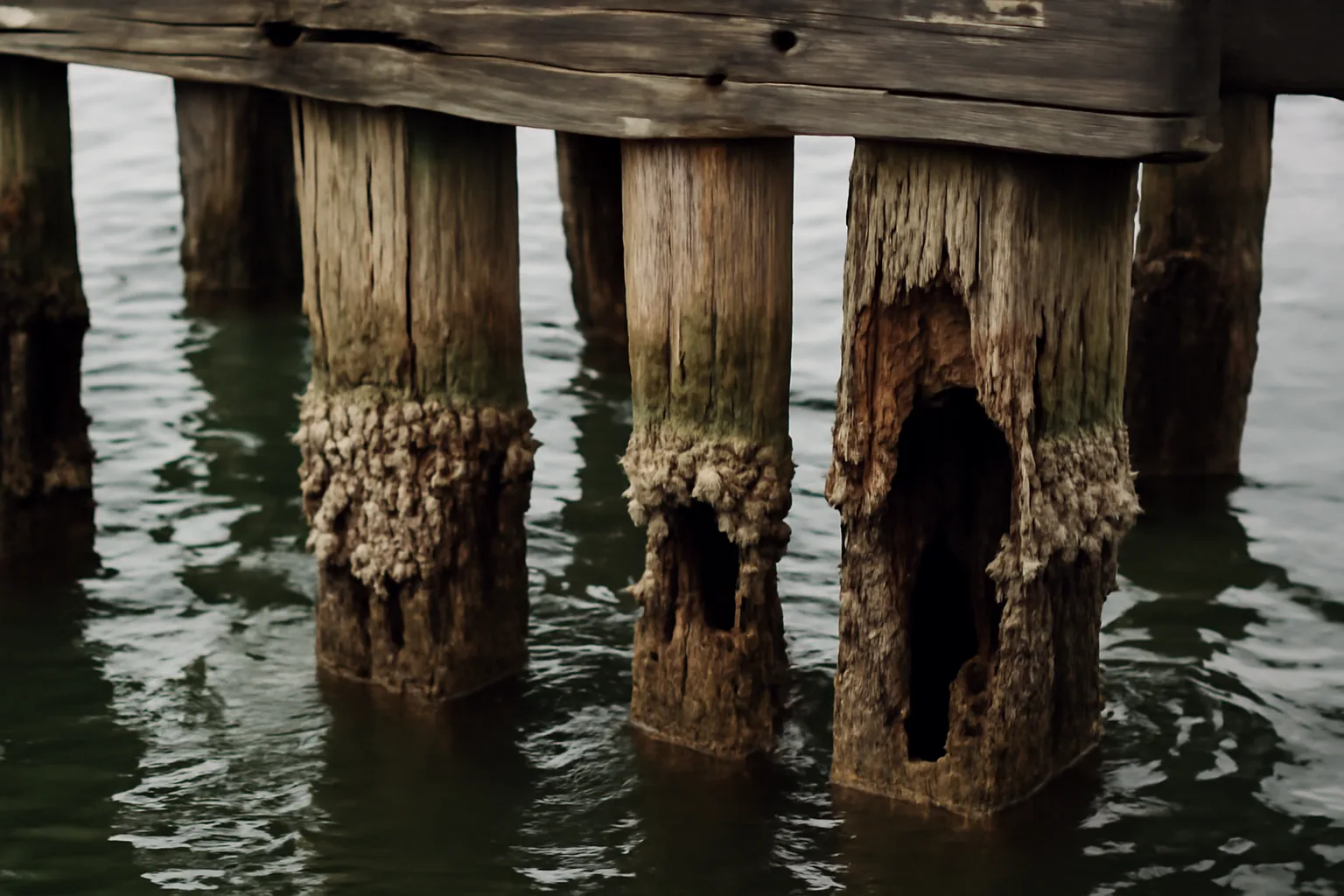
Before any of this method matters, be sure the piling is genuinely done. Replacing a sound piling is expensive, and leaving a failing one is worse. Treated timber pilings tend to look far better than they are, because the decay happens where you cannot see it.
The three zones, and which one actually fails
- Above the splash zone: usually the soundest part of the piling. Weathered gray surface means nothing structurally.
- The splash and tidal zone: where nearly every timber piling fails. Constant wet-dry cycling plus oxygen is ideal for decay fungi, and marine borers work the lower part of it.
- Fully submerged: generally sound in fresh water. In salt water, borers — teredo worms and gribbles — hollow pilings from the inside while leaving the surface looking almost untouched.
The awl test, and what the result means
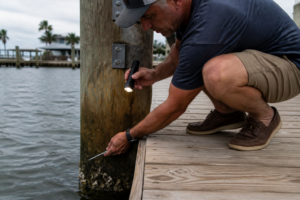
Push a scratch awl or a long screwdriver into the piling at several heights, hardest in the tidal zone. Sound treated timber resists; you should not be able to bury the tip easily. If it sinks in with hand pressure, or the wood gives way like wet cardboard, that piling is compromised.
| Awl penetration | What it means | Action |
|---|---|---|
| Under 1/4 inch | Sound | Monitor annually |
| 1/4 to 1/2 inch | Early surface decay | Wrap it and re-check in 12 months |
| 1/2 to 1 inch | Significant section loss | Plan replacement this season |
| Over 1 inch, or hollow | Structurally failed | Replace now, and do not load it |
Other signals worth acting on
- Visible crushing or mushrooming where the cap bears on the piling — that is compression failure
- More than about 2 inches of lean or deflection at the cap compared to its neighbors
- Fine sawdust-like frass around the waterline, indicating active borers
- Movement you can feel underfoot when you push sideways on the dock
- Fasteners that have loosened or pulled — often the wood around them has softened, not the bolt
When My Method Is the Wrong Call
I want to be straight about the limits of doing this from the dock rather than from a barge. The approach above works well for one or two pilings on a residential dock in manageable depth. It is the wrong approach in several situations, and knowing which is which will save you a great deal of money and possibly an injury.
- More than about three pilings at once: at that point you are effectively rebuilding, and the temporary support gets genuinely dangerous. Price a proper crew.
- Water deeper than roughly five feet at the piling: you lose the ability to work and control the piling from a standing position, which is what makes the method viable.
- Any piling carrying a boat lift: lift loads are concentrated and dynamic. This is not a place to improvise temporary support.
- Structural bracing already failed: if cross-bracing is gone, the dock may be relying on the very piling you are about to remove.
- Below the mean high water line in permitted waters: this frequently requires authorization regardless of who does the work. Check before, not after.
Everything else — a single rotted piling, moderate depth, sound structure around it — is genuinely within reach of a careful DIYer with a weekend and the right jack.
Frequently Asked Questions
How much does replacing one dock piling cost in materials?
A single piling replacement runs $85–$140 for the CCA or ACQ pressure-treated timber, plus $60–$80 in fasteners and hardware. A three-piling job lands in the $450–$650 range before wrapping or sealant. Those figures reflect honest costs; anything significantly lower is probably gambling on corrosion defense.
How deep should a new dock piling be driven?
Standard residential docks need minimum 5–6 feet below grade. For heavy wake action or substantial wave energy, I drive them to 8 feet. Denser soils and rocky terrain may require deeper investigation before you start, so know your bottom conditions first.
How long does dock pile wrap actually extend piling life?
Wrapped pilings consistently outlast unwrapped ones by 5–7 years under identical Gulf Coast environmental stress. Wrapping extends a piling’s service life from 8–10 years to 15+ years on saltwater docks when seams are sealed tight during installation.
How long does one person need to replace a single piling?
One skilled person plus an assistant can handle a single piling in four to six hours under standard Gulf Coast substrate conditions. Rocky terrain or clay-based bottoms stretch that window considerably, especially if you need to deploy a water jet to break the seal around the stub.
Sources and further reading
About This Article

Written by Trent Hollis. Waterfront homeowner turned DIY obsessive. After two decades tinkering with my own dock, seawall, and boat lift on the Gulf Coast, I share everything I've learned about waterfront construction, boat lift maintenance, and coastal living projects. More about this site.
Scope and limits. Trent is a waterfront homeowner, not a licensed marine contractor. Structural, electrical, and lift work should go to a licensed marine contractor, and most in-water work needs a permit before you start.
Verify this against a primary source
Specifics change, and your situation may differ from the one described here. These are the authorities worth checking directly:
- ABYC — marine electrical and construction standards
- U.S. Army Corps of Engineers — permitting for work in navigable waters
- NOAA Tides & Currents — tidal range and water level data for your site