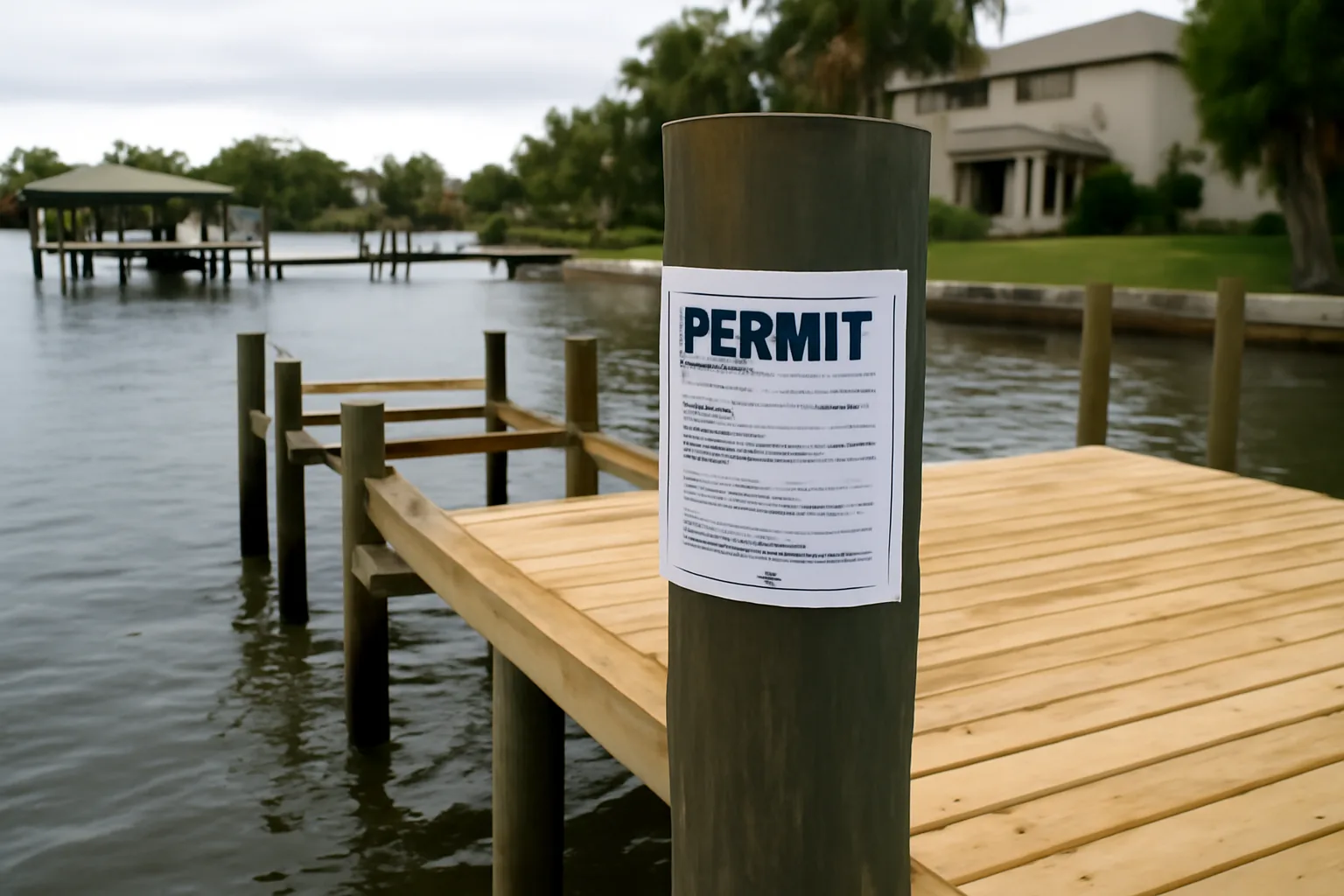
Back in 2009, a county inspector showed up at a Pensacola Bay dock where I’d just finished replacing twelve rotted deck boards and three corroded brackets. The citation read $1,200 for unpermitted structural work. Two days of labor, and suddenly I owed more in fines than the repair cost in materials. That experience shaped everything I’ve done since, and it’s why I’m writing this now: if you’re thinking about dock work—even repairs that seem straightforward—you need to understand the permit landscape before you touch anything.
Dock owners routinely believe permits apply only to new construction. It’s a widespread misunderstanding, and it drains wallets every year across the country. Depending on your location, the body of water involved, and what exactly you’re fixing, even basic maintenance can trigger simultaneous permit requests from multiple authorities. I’ve worked jobs requiring authorizations from the Army Corps of Engineers, state environmental protection offices, and county building departments—sometimes all three on the same project. Let me share what two decades on the Gulf Coast taught me about navigating these requirements.
When Is a Dock Repair Permit Required?
The straightforward answer requires looking at four distinct variables. Rather than being vague, here’s exactly which ones shape the outcome.
- Magnitude and nature of the repairs — Does your work simply swap out deteriorated components with identical replacements, or does it alter size, capability, or the underlying structural framework?
- Classification of your waterway — Waters open to commercial or recreational navigation fall under federal purview through Army Corps of Engineers Section 10 and Section 404 authority. Tidal classified waters add state environmental assessment layers.
- Financial threshold in your area — Most jurisdictions enforce a repair cost ceiling, typically ranging from $500–$2,000, beyond which permitting becomes mandatory.
- What constitutes structural versus non-structural work — Swapping out a single compromised board usually counts as maintenance. Replacing four or more supporting posts constitutes structural intervention. This distinction carries substantial weight in permitting decisions.
From what I’ve seen, property owners consistently undervalue what their own repairs will actually cost. Once you factor in labor expenses, numerous projects vault past permitting thresholds without materials ever coming into play. Specifically within Florida jurisdictions, any structural modification to a dock above navigable waters with a combined value surpassing $1,000 ordinarily triggers Florida DEP authorization requirements under Chapter 403. The dollar figure isn’t particularly high. Most dock rehabilitation jobs cross that line with ease.
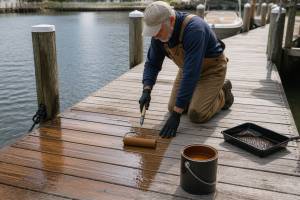
Purely functional upgrades—refinishing surfaces, replacing fittings, installing new anchor points—seldom trigger permitting obligations. However, jurisdictional codes establish precise criteria for what qualifies as “functional.” When uncertainty exists, contact your county’s building authority before commencing work. A brief phone conversation costs you nothing. A cease-and-desist notice carries real consequences.
Which Agencies Can Require a Permit?
Many people are caught off guard by overlapping regulatory authority. Waterfront construction typically intersects multiple jurisdictional layers. Over the years, I’ve navigated each of these independently, and occasionally had all of them apply simultaneously to a single undertaking.
Federal Level: Army Corps of Engineers
Docks positioned in or spanning waters classified as navigable under U.S. law enter Army Corps jurisdiction. The Rivers and Harbors Act, Section 10 (1899) governs built structures in navigable waterways. The Clean Water Act, Section 404 regulates activities involving dredging or placement of fill materials. Routine dock repairs commonly qualify under Nationwide Permit 3, which addresses upkeep of established structures. You must still confirm your specific project meets NWP 3 qualifications. The Corps maintains a Regulatory Request System where you can file a preliminary assessment at no cost. I’d strongly recommend using it. I’ve witnessed repairs become ineligible for NWP 3 coverage because the work extended the dock’s perimeter by mere inches.
State Level: Environmental and Coastal Agencies
Each U.S. coastal state operates its own permitting framework. Florida channels this through the DEP. Texas routes permits via TCEQ and the GLO. South Carolina processes them via DHEC OCRM. These bodies prioritize aquatic resource conservation, marsh habitat safeguarding, and submerged property law. Jobs involving piling installation or activities occurring seaward of the mean high-water elevation almost universally require state-level approval. Ordinary processing windows extend 60–90 calendar days. Fast-track options, when available, typically include supplemental charges of $500–$1,500.
Local Level: County and Municipal Building Departments
Municipal building authorities enforce construction safety protocols and code standards. They utilize the International Building Code framework or an adopted local equivalent. Dock repairs approaching a certain valuation—commonly $500 to $2,500 contingent on jurisdiction—necessitate a construction permit, property sketch, and occasionally a professional engineer’s authorization. Standard local permit fees span $150–$600 with approval timelines of 2–4 weeks. DIYers most frequently overlook these requirements. They’re simultaneously the permits generating the largest share of violation citations when ignored.
The Hard Way I Learned About Permit Violations
Let me expand on that 2009 situation I mentioned. A neighbor wanted to renovate the walking surface and rebuild two structural bays on her Pensacola waterfront dock. Materials ran approximately $900 total. She’d maintained the property for over a decade without needing permits for upkeep. Her surrounding neighbors hadn’t pulled permits either. We proceeded without authorization.
A property nearby lodged a complaint—supposedly unrelated grievances—which triggered a county inspection three days post-completion. The penalty for unpermitted structural modifications: $1,200. Afterward, we submitted an after-the-fact permit application, incurring $340 in application costs and $450 for a structural survey showing actual conditions. Then came a six-week waiting period for approval. The entire situation displaced a scheduled boat lift upgrade by two months. Her total expenses beyond the original repair: approaching $2,100. For work costing $900 in components.
After-the-fact permitting exists across most jurisdictions, though it comes at a substantial premium. Certain counties increase standard permit charges by 100–200 percent as punishment. Others mandate exposure of hidden elements for examination, requiring destruction of completed finishing work. I’ve encountered retroactive permits exceeding the price of the initial project. Don’t replicate this experience.
How to Research Permit Requirements for Your Property
Here’s the procedure I follow before starting any dock modification work. I’ve applied this methodology consistently since 2010 on every undertaking.
- Establish waterway designation. Does it carry navigability classification? Saltwater tidal status? Consult NOAA maritime reference maps or your state’s geographic water management database. This establishes which federal or state bodies maintain authority.
- Contact your local building or planning office. Pose this question directly: “What dollar amount triggers permit requirements for dock work in your jurisdiction?” Record the representative’s name and the conversation date.
- Research your state environmental office materials. Search the portal for phrases like “dock repair exemption” or “minor modification exception” plus your state designation. Numerous states publish specific exemption schedules.
- Examine your property records and filed restrictions. Waterfront parcels frequently carry submerged property rental agreements, riparian use limitations, or community association bylaws imposing supplementary authorization layers.
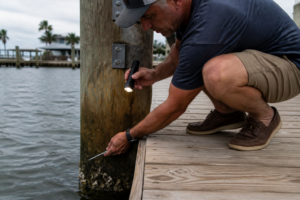
- Establish a photographic baseline. Capture images of your existing infrastructure from various viewpoints before undertaking modifications. This documentation proves invaluable should inspections occur afterward.
Step four represents the most overlooked checkpoint. A customer in southern Mississippi encountered a situation last spring where his dock occupied rented state submerged parcels. His lease contained language prohibiting structural updates without written authorization from state property administration. He had zero awareness of this constraint. State approval extended the timeline by five weeks during the resolution process.
A Resource I Recommend for Waterfront Property Owners
After years of watching waterfront owners stumble over property rights issues, I started recommending one book consistently. It’s called Buying, Owning, and Selling Rhode Island Waterfront and Water View Property: The Definitive Guide to Protecting Your Property Rights and Your Investment in Coastal Property. I know — it says Rhode Island. But don’t let the title fool you.
Its treatment of legal principles—riparian ownership concepts, public water law doctrine, submerged property title questions, and permit frameworks along the seacoast—holds relevance from Maine through California. I’ve personally consulted this reference to discuss riparian principles with clients spanning from the Alabama shores through the Texas coast. The composition reads clearly, follows a sensible sequence, and genuinely prepares owners to comprehend the permission structure framing their waterfront circumstances. The vast majority of dock issues I’ve handled transcend structural code alone. They involve property ownership questions that homeowners overlooked or unknowingly violated.
For anyone with waterfront real estate, maintaining this among your essential documents—filed alongside your property deed and property boundaries map—establishes critical baseline knowledge. Comprehending your obligations and entitlements before commencing work expenses far less than unraveling complications afterward. Several neighbors have received copies as gifts from me, and without exception, each has expressed regret about not studying it beforehand.
As a runner-up for property owners who want simple, visible boundary reminders posted on their dock or lot, I’ve also used this Metal Tin Sign for waterfront and private property zones. It’s an 8″x12″ fade-resistant sign — nothing fancy, but useful for marking storage areas and private access points. Small thing, but it’s come in handy more than once for keeping unauthorized traffic off a client’s dock while work is underway.
When to Call a Pro Instead of Going DIY
I champion the DIY philosophy, but candor matters equally. Certain dock repair circumstances fall outside the domain of DIY undertakings, irrespective of permitting considerations. Here’s where I separate the two categories:
- Replacing greater than two support pilings. Setting or jetting replacement pilings demands specialized machinery and technical expertise. Incorrectly positioning a piling jeopardizes the structural integrity of your whole installation.
- Anything associated with marine electrical infrastructure. Underwater wiring must conform to NFPA 303 (Marinas and Boatyards Fire Safety Code) and NFPA 70 (Electrical Installation Code). Electrical injury drowning constitutes a genuine and significant hazard. Avoid improvising.
- Work affecting tidal wetland zones or seabed vegetation communities. Regulatory infractions in these zones carry penalties climbing to $10,000 per calendar day under federal statute. These projects require contractors experienced in environmental authorizations.
- Modifications requiring engineer certification and approval. When your permitting authority mandates a registered engineer’s document authorization, retain one. Engineering sign-off on dock installations typically ranges $800–$2,500. It justifies the expense.
Through my experience, the optimal range for personal dock restoration includes: replacement of degraded platform boards on established frameworks, equipment and fitting replacements, minor frame member work, waterproofing finishes, and buoyancy system upgrades on inflatable dock systems. Undertakings affecting pilings, substructure, or energy distribution warrant contractor engagement—or at the least, qualified assessment.
Final Thoughts: Don’t Skip the Permit Research
The essential takeaway remains uncomplicated. Confirming authorization status for your dock modification through a handful of conversations and maybe sixty minutes of investigation takes minimal effort. Managing a regulatory transgression demands extended timelines, financial burden, and persistent aggravation extending long following project completion. I’ve experienced this. I’ve guided customers through it. The investment in proper authorization invariably surpasses the alternative.
Begin by contacting your regional building authority’s department. Subsequently, review your state’s environmental office resources listing exemptions. Cross-reference your title records regarding submerged property contracts or access limitations. Photograph your present installation before beginning alterations. That sequence demands only your effort, but it safeguards all resources you’ve invested in your waterfront premises.
Coastal properties command substantial monetary worth and present intricate legal frameworks most proprietors underestimate initially. Research thoroughly beforehand. Obtain required permissions when mandated. Develop a dock that increases value rather than introducing legal exposure to your property.
Do You Need a Permit to Repair a Dock? The Short Answer
Do you need a permit to repair a dock? In most coastal US jurisdictions, the answer is yes—even for work that feels minor to you. The threshold for triggering permit requirements is far lower than most dock owners expect. I’ve seen homeowners face $3,000+ retroactive permit fees and stop-work orders for what they thought was a simple piling replacement or deck board fix. The safest assumption: if water touches it, a permit probably applies.
Three things typically trigger the permit requirement. First, the dollar value of your repair work exceeds your local threshold—commonly $500 to $2,000, depending on your county or municipality. Second, your work involves structural elements like pilings, cross-bracing, or the main frame, even if the dollar amount is small. Third, your waterway is navigable (the Army Corps of Engineers has jurisdiction), which covers most docks on bays, sounds, and rivers. In my 20 years on Gulf docks, I’ve learned that “minor” and “exempt” are words building departments rarely use together.
Here’s what I tell everyone: call your local building or planning department before you buy a single fastener. Spend five minutes on the phone describing the work. Ask specifically about dock repair exemptions in your jurisdiction—they exist in some places but are narrower than you’d guess. Ask whether your waterway requires Army Corps notification. Get the name of the person you spoke with and note the date. That one conversation prevents the costly mistakes I made early on. A permit might cost $150–$400 and take two weeks. A retroactive permit, fines, or forced removal of unpermitted work costs ten times that and tanks your property value if you ever sell.
The Reference That Saved Me From Another $1,200 Mistake
After that citation, I realized I was flying blind on waterfront property law—especially the gray area between “repair” and “improvement” that triggers permit requirements. A solid guide to coastal property rights and local regulations isn’t just insurance; it’s the difference between a weekend project and a costly citation.
What works
- Breaks down the legal distinction between permitted repairs and unpermitted work—the exact line I crossed in 2009 without knowing it
- Focuses on waterfront property rights and easements, which directly affect what you can and can’t do on your dock without county sign-off
- Gives you language and confidence to ask the right questions when you call your local permitting office, instead of finding out mid-project
What doesn’t
- Focused on Rhode Island specifics, so you’ll still need to verify local codes for your county or state—it’s a foundation, not a substitute for your inspector
- Won’t give you the exact permit forms or application checklists you need; it teaches you *why* permits matter, not the paperwork itself
I kept this book within arm’s reach after the citation, though honestly, I second-guessed whether a book could really save me from another inspection disaster—until I caught a scope-creep job before the county did. Pick up Buying, Owning, and Selling Rhode Island Waterfront and Water View Property: The Definitive Guide to Protecting Your Property Rights and Your Investment in Coastal Property before your next dock project.
Frequently Asked Questions
How much did my neighbor’s unpermitted dock repair cost in fines?
Her unpermitted structural modifications cost $1,200 in fines alone. After-the-fact permitting added $340 in application costs and $450 for a structural survey, plus a six-week waiting period that delayed other work by two months. Total expenses beyond the original $900 in materials approached $2,100.
What dollar amount triggers dock repair permits in most jurisdictions?
Most jurisdictions enforce a repair cost ceiling where permitting becomes mandatory, typically ranging from $500–$2,000 depending on your county or municipality. In Florida, any structural modification above navigable waters with a combined value surpassing $1,000 ordinarily triggers Florida DEP authorization requirements under Chapter 403.
When does replacing dock boards require a permit?
Swapping out a single compromised board usually counts as maintenance and doesn’t require a permit. However, replacing four or more supporting posts constitutes structural intervention and triggers permitting requirements. The distinction between maintenance and structural work carries substantial weight in permitting decisions.
Which federal agencies regulate dock repairs in navigable waters?
The Army Corps of Engineers governs docks in navigable waters under the Rivers and Harbors Act Section 10 (1899) and the Clean Water Act Section 404. Routine dock repairs commonly qualify under Nationwide Permit 3, which addresses upkeep of established structures, but you must confirm your specific project meets NWP 3 qualifications.
Sources and further reading
About This Article

Written by Trent Hollis. Waterfront homeowner turned DIY obsessive. After two decades tinkering with my own dock, seawall, and boat lift on the Gulf Coast, I share everything I've learned about waterfront construction, boat lift maintenance, and coastal living projects. More about this site.
Scope and limits. Trent is a waterfront homeowner, not a licensed marine contractor. Structural, electrical, and lift work should go to a licensed marine contractor, and most in-water work needs a permit before you start.
Verify this against a primary source
Specifics change, and your situation may differ from the one described here. These are the authorities worth checking directly:
- ABYC — marine electrical and construction standards
- U.S. Army Corps of Engineers — permitting for work in navigable waters
- NOAA Tides & Currents — tidal range and water level data for your site