Most waterfront property owners operate under a fundamental misunderstanding: they believe that freezing temperatures pose minimal risk to dock equipment because they live on the Gulf Coast, not in Minnesota. This assumption is dead wrong. Ice doesn’t need weeks of subfreezing weather to inflict serious damage — it needs only one hard overnight freeze, the kind that catches us off guard in February, to generate enough expansion pressure to snap cleats, crack brackets, and destroy hardware. I learned this lesson years ago when a Pensacola dock owner called me in early February, voice shaking, after a single night of hard freeze had shifted his floating dock six inches, snapped two cleats completely off, destroyed his kayak rack, and seized his ladder so badly the fastener threads stripped when he attempted removal. The repair bill topped $800 and consumed his entire weekend. Every bit of that damage could have been prevented with two hours of preparation work.
Along the Gulf, we’re conditioned to think winter dock maintenance doesn’t apply to us. Freezes arrive without warning, often thaw just as quickly, and the odds seem stacked in our favor. Yet across my two decades in marine contracting, I’ve watched this same gamble backfire far more often than it succeeds. The physics is straightforward and unforgiving: ice forming in confined spaces — between dock components, inside fittings, around fastener threads — exerts pressure that most people dramatically underestimate. A quarter-inch of frozen water expanding in the wrong location can snap a bolt clean, fracture a bracket, or rupture a PVC connector. The expense of fixing this destruction always exceeds what the preparation would have cost by a comfortable margin.
What follows is a systematic breakdown of what needs to leave your dock before the thermometer dips below 32°F, plus what you should do about ice accumulation on the dock structure itself — because removal addresses only half the picture.
What to Remove from Your Dock Before a Winter Freeze: The Full Checklist
Back when I was winterizing my own 40-foot fixed pier on Mobile Bay for the first time, I removed the obvious stuff and patted myself on the back. Mistake. When March rolled around, I discovered a cracked hinge on my dock box, a corroded outlet cover, and a garden spigot fitting that had split at its base. Ice had wormed its way into every small gap I’d overlooked. That experience taught me to approach dock winterization methodically, which is why I now work through five distinct categories every year before the first freeze warning broadcasts.
Furniture, Cushions, and Decorative Items
Plenty of dock owners leave their Adirondack chairs and side tables in place, figuring they’ll weather just fine. They won’t. Water penetrates wood grain at the cellular level, then freezes and expands — the result is cracked seat slats, splintered armrests, and fractured tabletops. Every piece of furniture should be transported to a garage, storage shed, or covered area. If you can’t move it indoors, at the very minimum seal cushions inside waterproof plastic containers and set furniture on concrete blocks or pallets so standing ice can’t form trapped beneath it.
Container plants, outdoor banners, and battery-operated landscape lights belong inside as well. Water seeps into solar light enclosures around the LED chamber and then freezes, cracking the plastic housing. A replacement light set runs anywhere from $30 to $80 per unit, and when you’re replacing them annually come spring, that cost adds up fast.
Dock Lines, Fenders, and Boat Accessories
Submerged dock lines that spend a freeze cycle in water will stiffen, lose their load-bearing capacity, and can weld themselves to expanding ice sheets that subsequently yank your cleats under enormous mechanical stress. I’ve personally extracted cleats — lag bolts still attached — from dock framing because an ice-locked dock line functioned as a lever during thaw-freeze cycles. Before the cold arrives, haul all dock lines from the water, flush them with clean fresh water, coil them loosely for storage, and keep them in a dry location.
Vinyl fenders and bumpers must also be stripped off the dock. Hard-freezing temperatures render vinyl brittle and prone to cracking when ice pressure compresses them. That said, if you’re keeping your boat in the slip through winter, leave a pair of fenders rigged and inspect them beforehand — replace any that show damage or are beyond three seasons old, because deteriorated vinyl provides almost zero cushioning effect.
Electrical Components and Shore Power Pedestals
This is where most DIYers drastically underestimate the risk. Shore power pedestals carry outdoor ratings, but outdoor-rated doesn’t mean they’re bulletproof against freeze damage. Moisture infiltrates through outlet covers and cordset receptacles. Freezing temperatures crack the housing or warp the internal sealing gaskets. According to ABYC Standard E-11, electrical connections at marina-style docks must include weather-resistant covers classified for wet-location duty — yet “weather-resistant” remains distinct from “freeze-resistant.”
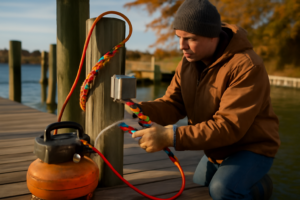
Strip every extension cord and power strip from the dock immediately. Unplug and relocate portable electronics — depth finders, VHF units, portable amplifiers — that normally live aboard or on the dock structure. For docks with permanent electrical infrastructure, flip the breaker to the subpanel before temperatures plunge and cover all receptacles with foam gasket blanks designed for winter service. Water and electricity in a dock environment already constitute a hazardous pairing; frozen water forcing its way into an outlet housing elevates that danger considerably.
Ladders, Cleats, and Hardware: Managing Permanent Fixtures
Removable dock ladders absolutely must be pulled before freezing weather arrives. The hinged base of a flip-up ladder sits precisely at the waterline — the exact location where ice generates maximum pressure. I’ve replaced innumerable ladder hinges that froze solid and fractured when residents forced them open in February. Most residential dock ladders employ stainless steel 316 fasteners, which resist saltwater degradation admirably but remain susceptible to stress created by ice expansion within the hinge assembly.
Fixed ladders that can’t be extracted should receive a thin application of marine-grade corrosion-inhibiting lubricant — Boeshield T-9 performs excellently for this purpose — across every hinge joint and threaded connection well before the freeze arrives. This won’t block ice formation, but it will inhibit the accelerated corrosion that freeze-thaw sequences otherwise trigger.
Installed cleats demand a different approach. Cleats permanently affixed with bolts obviously stay mounted, yet their fasteners require attention each autumn. Repeated freeze-thaw activity gradually loosens bolts over successive seasons. Specifically, grab a torque wrench and verify that your cleat mounting bolts remain at the torque specification listed by the manufacturer — typically 25–35 ft-lbs of rotational force for 3/8-inch stainless steel bolts fastening to composite or wood decking.
Dock Boxes and Storage Units
Drain and clear every object from inside your dock box prior to a freeze event. Condensation builds up inside even hermetically sealed boxes, and subfreezing temperatures freeze that trapped moisture, placing enormous strain on lid gaskets and hinge assemblies. The lid gasket typically fails first in my experience — once that barrier fails, your dock box becomes saturated with rainwater every precipitation event.
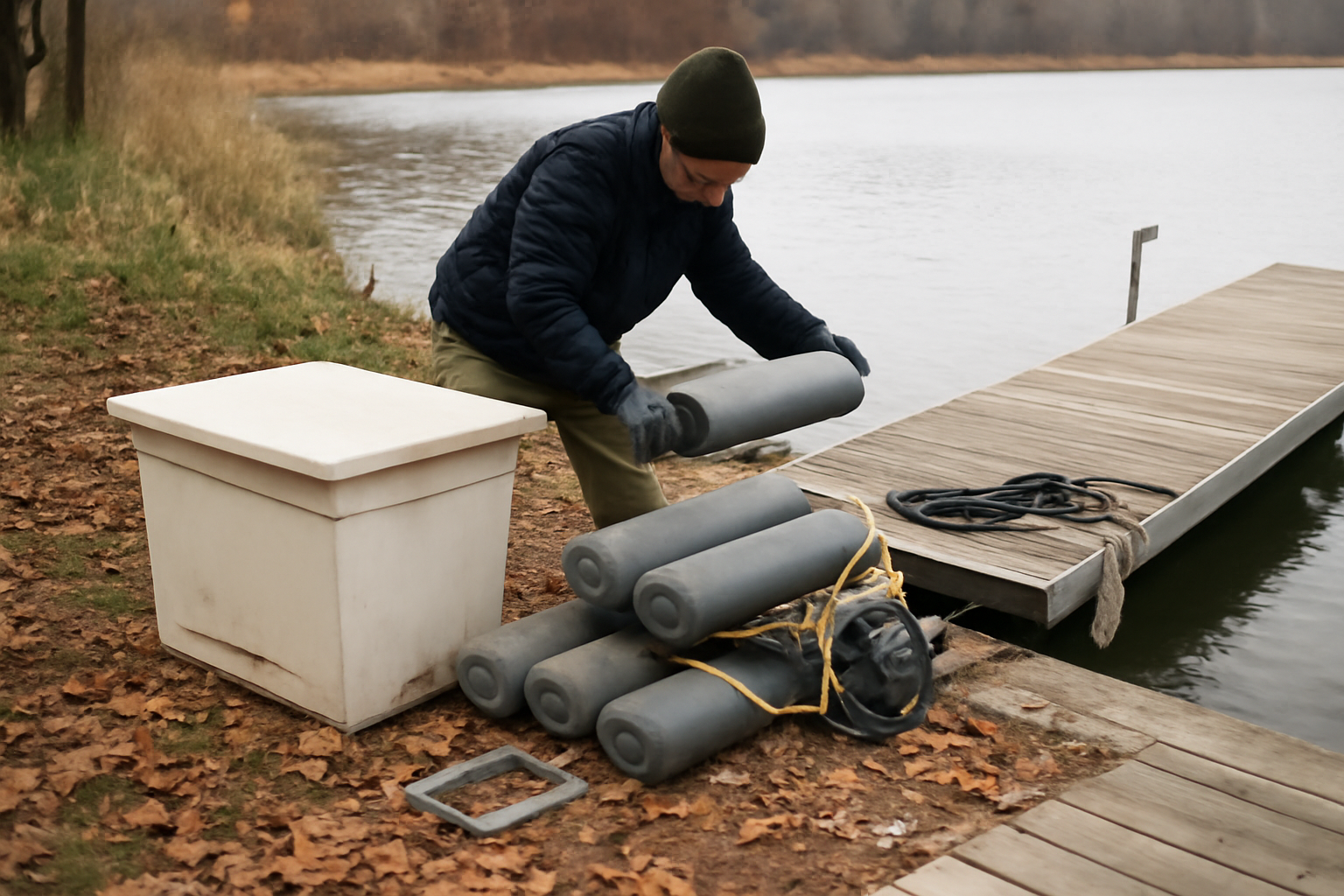
Prop the lid open slightly to permit ventilation and discourage internal pressure accumulation. For dock boxes that aren’t permanently installed, transport them indoors completely. Given that replacement dock boxes span a price range of $150–$600 according to storage capacity, protecting your investment requires just a few minutes of your time.
Protecting Your Dock Structure from Ice Damage
Removing loose gear addresses one dimension of the problem, but the actual dock infrastructure becomes the battleground when ice forms across its surface and within its crevices. I’ve documented floating dock segments displaced by ice pressure, aluminum gangways buckled by lateral force, and concrete support columns fractured by freezing conditions. On stationary piers, ice consolidating against the pilings and subsequently rising with tide swing can actually lift wooden deck boards completely off their support stringers.
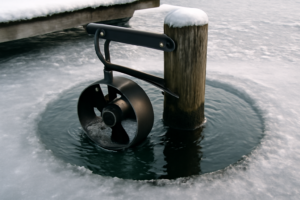
The single most effective countermeasure I’ve used over the years is installation of a dock de-icer or circulation bubbler unit. These systems pump comparatively warmer water from below the thermocline upward to the surface, blocking ice formation across the pilings and floating dock sections. This isn’t marketing hype — I’ve personally observed them maintain a 10-foot ice-free zone around dock supports in overnight temperatures of 18°F.
Why Propeller Condition Matters on Your De-Icer
One thing nobody anticipates until catastrophe strikes: the de-icer’s propeller endures extraordinary abuse. Floating debris, discarded rope, and invasive aquatic plants can dent or distort the blade geometry. A compromised propeller circulates water inefficiently — which translates to your de-icer potentially operating while providing minimal real dock protection. I discovered this personally three winters ago on my own dock when I left the de-icer running throughout the night and still woke to ice consolidating around two pilings. Upon inspection, I found one blade bent significantly; water movement was operating at perhaps 60% of its rated capacity.
That discovery reshaped my maintenance routine. Now, before each cold season arrives, I examine the propeller thoroughly and often replace it before active use begins. This modest expenditure guarantees your de-icing apparatus delivers actual performance when the temperature drops.
The De-Icer That Prevented Catastrophic Shift During That Pensacola Freeze
Floating docks installed in brackish or saltwater environments face ice accumulation around frame members and the support pilings — this is what drives those devastating shifts and structural breakage. A high-quality de-icer serves a purpose beyond simply carving a breathing hole; it actively suppresses the lateral ice pressure that destroys cleats and warps ladder frames.
What works
- The propeller circulation system maintains constant water movement within a concentrated zone surrounding your dock supports, resisting ice buildup on the frame and pilings where structural damage originates.
- Operates using minimal electrical draw and accepts timer-controlled scheduling throughout nighttime freeze windows, eliminating the need for constant freeze-warning monitoring.
- The propeller assembly swaps out effortlessly if salt corrosion or surface debris compromises it — complete unit extraction isn’t necessary mid-winter.
What doesn’t
- Insufficient effectiveness when atmospheric conditions remain perfectly calm and water temperatures sink below 28°F — water circulation capacity depends on existing flow patterns.
- Saltwater environments accelerate corrosion of fastener hardware relative to freshwater applications, necessitating connection and motor-housing inspections every few weeks throughout freeze season.
I almost skipped installing one my first winter because I figured the Gulf rarely froze hard enough to matter — then came that February call from Pensacola. Scott Aerator Aquasweep & Deicer Replacement Propeller is cheap insurance compared to replacing dock frame sections.
Frequently Asked Questions
Can a single hard freeze damage my Gulf Coast dock?
Absolutely. One overnight hard freeze generates enough expansion pressure to snap cleats, crack brackets, and destroy hardware. I watched a Pensacola dock shift six inches, lose two cleats completely, and rack up an $800 repair bill from a single February freeze. That damage could have been prevented with two hours of preparation work.
Should I leave my dock ladder in place during winter?
No. Removable dock ladders must be pulled before freezing weather arrives. The hinged base sits at the waterline — exactly where ice generates maximum pressure. I’ve replaced innumerable ladder hinges that froze solid and fractured when forced open in February.
How tight should dock cleat bolts be before a freeze?
Use a torque wrench to verify your cleat mounting bolts remain at the manufacturer’s specification — typically 25–35 ft-lbs of rotational force for 3/8-inch stainless steel bolts on composite or wood decking. Repeated freeze-thaw activity gradually loosens bolts over successive seasons.
What happens to dock lines left in frozen water?
Submerged dock lines that spend a freeze cycle in water will stiffen, lose their load-bearing capacity, and can weld themselves to expanding ice sheets. I’ve personally extracted cleats with lag bolts still attached because ice-locked lines functioned as levers during thaw-freeze cycles.
Sources and further reading
About This Article

Written by Trent Hollis. Waterfront homeowner turned DIY obsessive. After two decades tinkering with my own dock, seawall, and boat lift on the Gulf Coast, I share everything I've learned about waterfront construction, boat lift maintenance, and coastal living projects. More about this site.
Scope and limits. Trent is a waterfront homeowner, not a licensed marine contractor. Structural, electrical, and lift work should go to a licensed marine contractor, and most in-water work needs a permit before you start.
Verify this against a primary source
Specifics change, and your situation may differ from the one described here. These are the authorities worth checking directly:
- ABYC — marine electrical and construction standards
- U.S. Army Corps of Engineers — permitting for work in navigable waters
- NOAA Tides & Currents — tidal range and water level data for your site