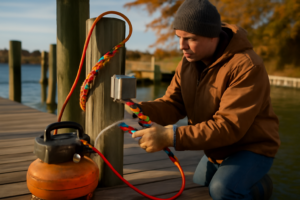
Three winters back, I got a call from a property owner near Pensacola whose dock had just taken serious structural damage from a hard freeze. Three of his pressure-treated pilings had split lengthwise — pilings I’d installed myself almost a decade prior. He’d gone back and forth on whether to install ice protection for two full seasons, never committing to either option. That indecision ended up costing him north of $4,200 in emergency structural work. Beyond the visible cracking, the lateral bracing had shifted enough that the entire platform needed re-shimming and re-leveling before spring use was safe.
What catches most waterfront property owners off guard is how ice actually damages wood and metal. It’s not just surface crushing. Ice expands horizontally with roughly 50,000 pounds of force per square foot. That pressure exploits every small check in your timber grain, every marginal weld seam in your steel, every bolt that’s even slightly loose in your aluminum frame. If you live where freeze cycles happen, keeping ice away from your pilings isn’t a luxury — it’s the equivalent of painting your hull. Choosing between a dock de-icer and a bubbler system is the real decision you need to make.
My background includes hands-on installation and maintenance of both systems across the Gulf region and in consulting roles further inland. This walkthrough reflects two decades of field experience — direct observation, no marketing language, no hedging. Let’s dig into what actually works.
| System Type | Initial Cost | Best Application | Key Limitation |
|---|---|---|---|
| Dock de-icer (1/2 HP) | $250–$400 | Residential docks, 4–12 pilings, 6+ ft deep | Requires adequate water depth for thermal stratification |
| Dock de-icer (1 HP) | $350–$550 | Extended docks or moving water | Needs dedicated 20-amp circuit |
| Bubbler system (residential) | $500–$900 | Shallow water under 5 feet deep | Current exceeding 0.5 knots breaks bubble column |
| Bubbler system (commercial) | $1,500–$4,000+ | Multi-slip marinas, large footprints | Compressor must be 25% oversized for extreme cold |
How Ice Actually Damages Dock Pilings (And Why Prevention Matters)
Getting into the specifics requires understanding two distinct ways that ice harms dock structures. Static ice pressure describes a frozen sheet that forms and then expands and contracts with temperature swings. Repeated freeze-thaw cycles turn this into a gradual vice-tightening action. Dynamic ice loading, though, is where moving ice sheets shift horizontally — driven by wind or current flow — and exert lateral force on your pilings. Dynamic loading causes the catastrophic failures you see in a single season, not gradually over years.
Timber pilings — I’ve built with Southern Yellow Pine extensively along the coast — carry particular vulnerability because the freeze-thaw rhythm accelerates longitudinal cracks. Those cracks are openings that let water in. Once water enters a check at or beneath the waterline, freezing converts it into an ice wedge that splits the wood further. I’ve examined pilings that looked structurally sound from the dock surface but turned out to be honeycomb ice damage down to the mud line.
Steel and aluminum structures also face ice damage, just through different failure points. Hardware connections, bolted penetrations, and welded joints all experience lateral stress from ice sheet movement. What I’ve typically observed is that fasteners and connections fail before the main members do — and connection failure is often harder to detect until the system actually shifts and something goes catastrophically wrong.
Dock De-Icer vs Bubbler System Ice Protection: Core Differences
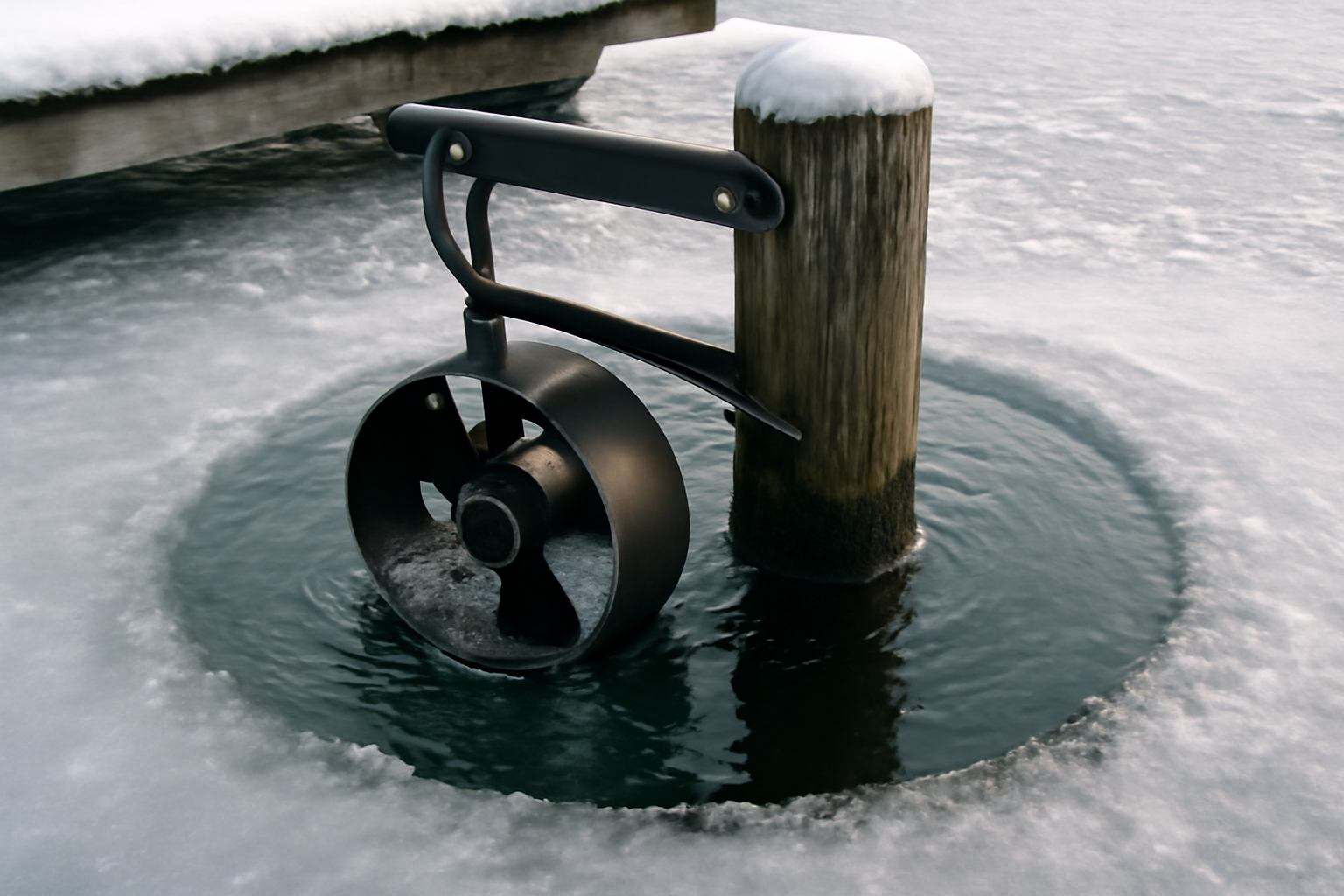
A dock de-icer is essentially a submerged motor and propeller unit that pulls warmer water up from depth and circulates it at the surface. Bottom water — typically found at 8 to 15 feet down — maintains a temperature around 39°F year-round in most North American freshwater. That’s above the freezing point. The de-icer lifts that water upward and holds an ice-free circulation zone around your dock structure. It’s direct, reliable, and needs minimal upkeep.
A bubbler system takes a different path: an air compressor mounted on shore connects via airline tubing to diffuser heads positioned near your pilings on the bottom. Air bubbles rising from the diffusers use the same thermocline displacement principle — bringing warmer bottom water toward the surface. The action is less forceful and less directional than a de-icer’s prop wash. Bubbler systems excel at protecting broad areas, which explains why you see them at full-service marinas protecting dozens of slips simultaneously. They do require more shore-side equipment, including the compressor itself, weighted tubing, and strategically spaced diffuser arrays.
The fundamental difference breaks down this way: a de-icer delivers concentrated, targeted thermal management right where you need it most — immediately around your pilings. A bubbler delivers gentler, wider protection across a larger surface area. Your specific dock layout, the depth of your water column, and what you’re able to spend will guide which fits your situation.
Cost Comparison at a Glance
- Dock de-icer unit (1/2 HP): $250–$400 to install, workable for DIY installation
- Dock de-icer unit (1 HP): $350–$550 to install, better for extended docks or locations with measurable water movement
- Bubbler system (residential-scale): $500–$900 total including shore compressor, airline, and diffuser apparatus
- Bubbler system (heavy-duty commercial): $1,500–$4,000+ depending on the total length of protected waterfront
- Annual operating cost (de-icer): approximately $40–$90 monthly for electricity at typical regional rates
- Annual operating cost (bubbler): comparable monthly draw but compressor service and repairs erode savings
When a Dock De-Icer Is the Right Call
On a typical residential property dock with anywhere from 4 to 12 pilings sitting in water 6 feet deep or deeper, a de-icer sits at the top of my recommendation list. Hanging one is straightforward — you’re mounting the unit from a dock bracket at approximately 45 degrees downward angle, positioned roughly 18 to 24 inches under the water surface. Standard residential de-icers draw current through 120V shore power, though larger 1 HP versions usually demand their own 20-amp dedicated circuit. Always have a licensed marine electrician walk through your installation and verify compliance with ABYC Standard E-11 for dock electrical systems.
Back in 2007 when I was testing one on my own structure, I miscalculated the mounting angle — went nearly perpendicular instead of the recommended pitch. The result was that my water circulation was essentially pushing straight down rather than sweeping horizontally across my pilings. Ice still locked up on the far side of my outermost pile because the circulation pattern was all wrong. The sweet spot sits between 20 and 45 degrees off vertical, angling your water jet directly toward the timber and hardware you’re trying to protect.
De-icers also outperform bubblers in water with any noticeable current. Tidal creeks, rivers, or channels where flow velocity runs meaningful will break apart the bubble column that a bubbler depends on before it can bring thermal benefit to the surface. Current that exceeds 0.5 knots genuinely undermines bubbler performance, based on what I’ve observed in the field. A de-icer’s directed pump action carries its advantage through flowing water much more reliably.
When a Bubbler System Makes More Sense
Bubbler systems find their best application in two narrow windows: shallow-water environments and oversized dock complexes. When your water depth sits under 5 feet, a de-icer can’t reach the thermal reservoir it depends on — the water column simply isn’t thick enough for meaningful temperature stratification. A bubbler hooked to a solid shore compressor can still create enough water agitation in those shallow conditions to suppress ice, particularly if the lake or river bottom retains any residual thermal mass from autumn.
Larger commercial docks and multi-slip marina facilities benefit from bubblers because a single perimeter run of diffuser tubing wraps protection around the entire footprint at once. Installing numerous de-icers across a crowded marina creates overlapping circulation patterns that fight each other, plus it introduces hazards — prop wash can create dangerous vortices for swimmers and diving operations. State permitting authorities and the U.S. Army Corps of Engineers both publish rules governing de-icer placement in jointly managed or permitted water bodies. Confirm local regulations before you mount anything in regulated zones.
I’ve witnessed bubbler systems underperform when extreme cold stretches below 10°F and the shore compressor wasn’t adequately sized. Consumer-grade compressors often can’t sustain their CFM rating when ambient temperature plummets. If you choose a bubbler setup, buy a compressor that’s 25 percent oversized relative to what the diffuser manufacturer lists as the baseline requirement. That margin prevents shutdown mid-freeze.
The Propeller That Finally Kept My De-Icer Running All Winter Without Cavitation
A de-icer only works if it keeps moving water. I learned this the hard way when my original propeller started cavitating halfway through January, leaving dead zones around my pilings where ice locked in tight. The right replacement propeller—one actually engineered for de-icer duty—makes the difference between a system that quits and one that holds the line.
What works
- Maintains consistent water circulation even when ambient temps drop below freezing and ice starts forming at the surface—no cavitation means no dead zones around your pilings.
- Designed specifically for shallow-draft dock applications where other propellers lose efficiency and start to slip or stall under load.
- Drop-in replacement means you’re not rebuilding your entire system mid-season—just swap the worn propeller and get back to work.
What doesn’t
- Not a universal fit—you have to match it to your exact de-icer motor model, which means measuring twice and ordering the right SKU or you’re stuck waiting another week.
- If your motor shaft or coupling is already corroded or misaligned, a new propeller won’t solve the underlying vibration problem.
I almost didn’t replace mine mid-season because I thought I could nurse the cavitating original through another six weeks—then I saw ice creeping up the pilings again and realized I was gambling with my dock. That’s when I ordered the Scott Aerator Aquasweep & Deicer Replacement Propeller.
Frequently Asked Questions
How much force does ice exert on dock pilings?
Ice expands horizontally with roughly 50,000 pounds of force per square foot. That pressure exploits every small check in timber grain, marginal weld seam in steel, and loose bolt in aluminum frames. Repeated freeze-thaw cycles tighten this vice gradually, while moving ice sheets driven by wind or current cause catastrophic failures in a single season.
What angle should I mount a dock de-icer?
Mount the de-icer unit at approximately 45 degrees downward angle, positioned roughly 18 to 24 inches under the water surface. The sweet spot sits between 20 and 45 degrees off vertical, angling your water jet directly toward the timber and hardware you’re trying to protect. Perpendicular mounting pushes water straight down instead of sweeping horizontally, leaving ice on outer pilings.
When is a bubbler system better than a de-icer?
Bubbler systems work best in shallow water under 5 feet deep, where a de-icer can’t reach the thermal reservoir it depends on. They also suit larger commercial docks and multi-slip marinas where a single perimeter diffuser run wraps protection around the entire footprint at once, avoiding overlapping circulation patterns that fight each other.
Do de-icers work in moving water and tidal creeks?
De-icers outperform bubblers in water with noticeable current. Current exceeding 0.5 knots undermines bubbler performance by breaking apart the bubble column before it brings thermal benefit to the surface. A de-icer’s directed pump action carries its advantage through flowing water much more reliably.
Sources and further reading
About This Article

Written by Trent Hollis. Waterfront homeowner turned DIY obsessive. After two decades tinkering with my own dock, seawall, and boat lift on the Gulf Coast, I share everything I've learned about waterfront construction, boat lift maintenance, and coastal living projects. More about this site.
Scope and limits. Trent is a waterfront homeowner, not a licensed marine contractor. Structural, electrical, and lift work should go to a licensed marine contractor, and most in-water work needs a permit before you start.
Verify this against a primary source
Specifics change, and your situation may differ from the one described here. These are the authorities worth checking directly:
- ABYC — marine electrical and construction standards
- U.S. Army Corps of Engineers — permitting for work in navigable waters
- NOAA Tides & Currents — tidal range and water level data for your site