Stand over the waterline of a neglected boat and you’ll see it immediately—rust-colored streaks bleeding down from every fastener, a chalky white bloom across the hull sides where salt crystals have etched themselves into the gelcoat grain. Run your fingernail across one of those streaks and you feel the texture, roughness where smooth gloss used to be. That degradation doesn’t happen overnight. It accumulates. Years ago, I watched an owner whose routine consisted of grabbing whatever “marine cleaner” sat on the shelf at the big-box store, applying it with missionary zeal every fourteen days through an entire summer. His hull went from showroom finish to dull and pitted. He’d been so diligent about cleaning that he’d actually sanded the gelcoat away, one aggressive application at a time. That’s when I understood how urgently boat owners need guidance on maintaining topsides without inadvertently destroying them in the name of upkeep.
My background spans two decades in marine contracting along the Gulf Coast—from building new docks in Pensacola to hauling rotted decking out of Mobile Bay, handling full-scale fiberglass and metal hull restorations across the Panhandle and beyond. I’ve worked with fiberglass, wood, aluminum, and steel hulls in conditions ranging from pristine to catastrophic. Gelcoat preservation has always been woven into that work. When boat owners began asking what they could manage themselves between trips to a professional detailer, I began documenting what actually preserves a finish and what quietly erodes it over months and years.
What follows is my tested approach to the task—the specific products that have proven themselves, the schedule I follow religiously on my own boats, and the costly errors I’ve made so you don’t have to repeat them. This discussion centers on everything above the waterline: hull exteriors, open deck areas, and cabin surfaces. These zones endure unrelenting assault from ultraviolet radiation, salt spray, organic matter like bird droppings and marine life residue, fuel spills, and oxidation. Each contaminant demands its own response, but they all share a common rule: clean with restraint, protect without interruption, and ensure the solution never becomes more destructive than the original problem.
Why Gelcoat Is More Fragile Than Most Boaters Realize
Gelcoat functions as something entirely distinct from paint, and recognizing that difference is foundational. It’s a thin polyester resin shell—typically between 18 and 20 thousandths of an inch—applied during the original manufacturing of fiberglass vessels. Once that layer erodes, restoration demands a certified professional job running anywhere from $200 up to $600 per panel, contingent on damage extent. Most fiberglass production boats manufactured from the 1980s onward employ either isophthalic or orthophthalic gelcoat formulations. Both deliver solid durability under normal use, yet both surrender quickly to aggressive chemical action and rough mechanical cleaning.
The culprit extends beyond simple dirt accumulation. The genuine problem originates from UV exposure combined with salt crystallization, both working together to create microscopic surface degradation. That degradation clouds the finish over time while creating pathways for contaminants to burrow deeper. Paradoxically, using an inappropriate cleaner to eliminate contamination accelerates deterioration exponentially. I’ve personally witnessed acidic hull cleaners—marketed as “professional strength” or “heavy-duty”—obliterate the shine from an otherwise pristine hull within a single calendar year. That owner I mentioned earlier? His product registered below pH 3, essentially applying a diluted acid wash to his topsides every two weeks without comprehending what he was doing.
The doctrine I adhere to and advocate follows this logic: calibrate your cleaning intervention to match the actual level of soiling you’re addressing. Surface salt haze dissolves with plain water and a gentle cloth. Stubborn waterline deposits warrant a targeted stain product. Advanced oxidation calls for a polish, not a chemically stronger cleaner. Resist the temptation to graduate toward harsher chemicals whenever moderate exertion and proper methodology would accomplish the objective safely.
Building a Gelcoat-Safe Topsides Cleaning Routine Around Regular Intervals
Scheduled prevention outperforms reactive intervention in every instance. My personal 22-foot Mako has remained in excellent condition throughout more than a decade under a frequency-based maintenance structure that avoids the temptation to use powerful solvents. Here’s how I organize the work by timeframe.
Immediately Following Each Outing (Ten to Fifteen Minutes)
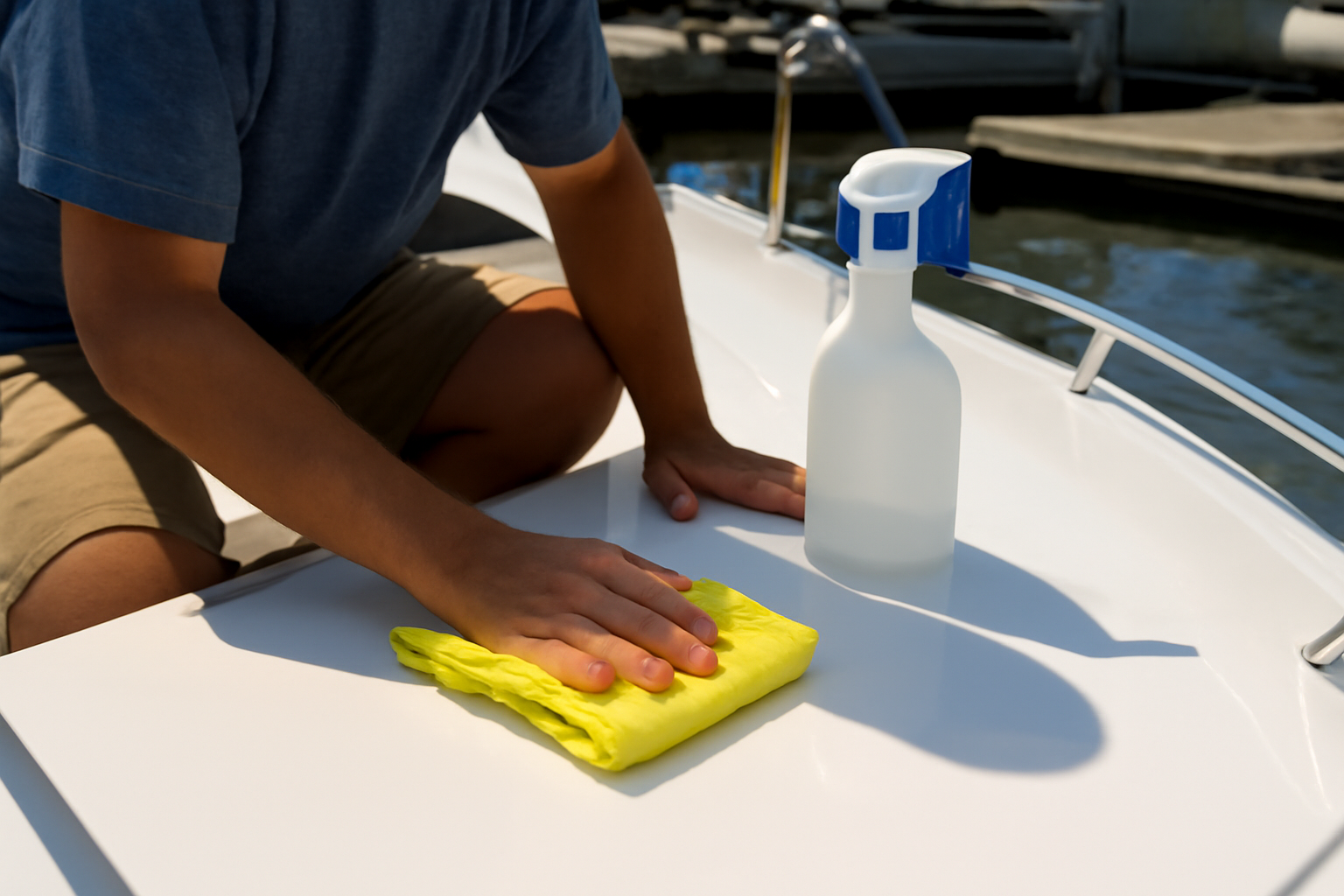
Direct fresh water across all topsides by way of a standard hose, proceeding from the highest points downward. Salt deposits don’t trigger immediate harm to gelcoat surfaces—but allow them to dry and recrystallize repeatedly, and those accumulations start behaving like abrasive particles under the friction of subsequent wiping motions. I maintain a dedicated microfiber wash mitt stored in a dock-side bucket. Once rinsing concludes, I perform a swift treatment using a dilute mixture—roughly ten parts water to one part boat-specific soap. The entire procedure consumes roughly a dozen minutes and constitutes the single greatest protective action available to preserve your hull’s appearance.
Full-Boat Wash Every Four Weeks (Half-Hour to Forty-Five Minutes)
On a monthly basis, I execute a comprehensive wash employing a pH-neutral deck and hull soap—brands like Star Brite Sea Safe and Meguiar’s M4332 Boat Wash have delivered reliable results in my experience without any adverse effects. Deploy a soft-bristled long-reach brush for horizontal surfaces and a gentle wash mitt for vertical hull panels. Progress methodically in approximately 4-square-foot increments to avoid letting soap evaporate before rinsing occurs. Complete the rinse on each section prior to moving forward, particularly during Gulf summer weather when exposed fiberglass routinely exceeds 110 degrees Fahrenheit.
This interval also serves as your diagnostic moment for staining problems. Biological residue stains, oxide streaks, and petroleum-based marks all respond favorably to targeted intervention at this juncture. The critical variable is timing—address them within two or three weeks and they lift away with modest effort. Postpone action for half a year and you’ve converted a simple task into a demanding restoration project.
Tri-Monthly Protective Coating Application (Two-Plus Hours)
Every twelve weeks, I layer a non-aggressive polish underneath a marine-grade wax or synthetic sealant. On a 22-foot hull, this undertaking spans roughly one hundred and fifty minutes when performed by hand, or under ninety minutes employing a random orbital buffer set between 1,200 and 1,500 revolutions per minute. Never attempt a rotary high-speed polisher on gelcoat unless you possess advanced detailing certification—excessive friction generates heat that exceeds what the resin can withstand, burning straight through the material. The wax layer exists as sacrificial armor. Solar radiation targets it first. Replenish it regularly and the underlying gelcoat remains sheltered.
Product Selection for Maintaining Gelcoat Safely Through Regular Topsides Cleaning
I should disclose from the outset that no manufacturer compensates me for recommendations. The substances listed here have either been deployed by me on my own watercraft or successfully utilized by colleagues on their client vessels with measurable positive outcomes. I’ll also flag one product I experimented with that will never enter my equipment locker again.
When it comes to routine hull washing, selecting a pH-neutral formulation remains absolutely essential. For addressing specific stains, I maintain inventory of a dedicated marine stain treatment containing oxalic acid as its primary active component—it destroys iron oxide and vegetative stains while sidestepping the pH complications inherent in hydrochloric chemistry. For the polishing phase, I employ a unified cleaner-wax product on well-maintained hulls and employ a sequential compound-then-wax methodology on those requiring renovation. Every cycle concludes with application of a UV-protective topcoat, particularly critical here on the Gulf where intense solar conditions dominate roughly three-quarters of the year.
The Incident That Reshaped My Approach to Product Application
Experience taught me this particular lesson in an unpleasant way during 2011 while preparing a 28-foot Grady-White for a client sale transaction. I selected a commercial-strength hull cleaning concentrate designed for 4-to-1 dilution when tackling stubborn soiling, but mistakenly blended it at 1-to-1 concentration and allowed it to remain in contact for eight minutes during a phone interruption. That specific hull section never regained its original reflective quality. Professional refinishing of the affected panels ran approximately $1,100 in materials and labor. The buyer wasn’t satisfied. Neither was I. That event prompted me to thoroughly research every product’s underlying chemistry before permitting contact with any hull under my stewardship.
Antifouling Coatings and Why Surface Preparation Determines Everything
When protecting submerged hull surfaces from biological growth and maintaining operational efficiency, a premium self-polishing antifouling coating becomes indispensable. However, no formula—regardless of laboratory performance—will adhere properly or perform as intended without meticulous substrate preparation, a lesson etched into my memory the hard way.
Where the approach succeeds
- Self-polishing mechanism functions as engineered, progressively releasing paint matrix and biofouling simultaneously instead of accumulating an increasingly thick paint layer that drags through the water and slows your boat down.
- Flows onto adequately stripped and prepared gelcoat or aluminum substrates without dripping or demanding specialized thinners, making execution manageable using basic application equipment and conventional rollers or brushes.
- Endures a complete year under saltwater immersion and continuous solar exposure without separating or producing the chalky deterioration seen with budget-tier marine coatings, protecting both function and market appeal.
Where it falls short
- Premium pricing creates temptation to compromise on preparation—skipping old coating removal, bypassing sanding stages, or neglecting cleaning—and that shortcut wastes the entire investment when coating fails within weeks.
- Container volume locks you into a larger undertaking; partial-hull repairs or trial applications would have benefited from smaller packaging, and you forfeit the flexibility to reconsider that decision later.
I nearly returned my first gallon after my initial coat went on uneven—turns out I’d rushed the cleaning step and didn’t account for salt residue bonding to the hull. Once I backed up, stripped it properly, and reapplied, the difference was night and day. Grab a TotalBoat JD Select Ablative Antifouling Bottom Paint (Black, Gallon) and treat surface prep like it’s half the battle—because it is.
Frequently Asked Questions
How often should I rinse my boat hull with fresh water?
I rinse my topsides with fresh water immediately following each outing, taking ten to fifteen minutes to spray from the highest points downward. Salt deposits don’t harm gelcoat immediately, but allowing them to dry and recrystallize repeatedly makes them behave like abrasive particles that damage the finish during wiping.
What pH should boat hull wash soap be?
I use pH-neutral deck and hull soap for my full-boat wash every four weeks. Brands like Star Brite Sea Safe and Meguiar’s M4332 Boat Wash have delivered reliable results without adverse effects on gelcoat surfaces.
How often do I apply wax or sealant to gelcoat?
I layer protective coating every twelve weeks, applying a non-aggressive polish under marine-grade wax or synthetic sealant. On my 22-foot hull this takes roughly one hundred and fifty minutes by hand, or under ninety minutes with a random orbital buffer set between 1,200 and 1,500 revolutions per minute.
What damaged my boat’s gelcoat more than anything else?
I once applied a commercial-strength hull cleaner at 1-to-1 concentration instead of the intended 4-to-1 dilution and left it for eight minutes. That hull section never regained its original reflective quality, and professional refinishing of the affected panels ran approximately $1,100.
Sources and further reading
About This Article

Written by Trent Hollis. Waterfront homeowner turned DIY obsessive. After two decades tinkering with my own dock, seawall, and boat lift on the Gulf Coast, I share everything I've learned about waterfront construction, boat lift maintenance, and coastal living projects. More about this site.
Scope and limits. Trent is a waterfront homeowner, not a licensed marine contractor. Structural, electrical, and lift work should go to a licensed marine contractor, and most in-water work needs a permit before you start.
Verify this against a primary source
Specifics change, and your situation may differ from the one described here. These are the authorities worth checking directly:
- ABYC — marine electrical and construction standards
- U.S. Army Corps of Engineers — permitting for work in navigable waters
- NOAA Tides & Currents — tidal range and water level data for your site