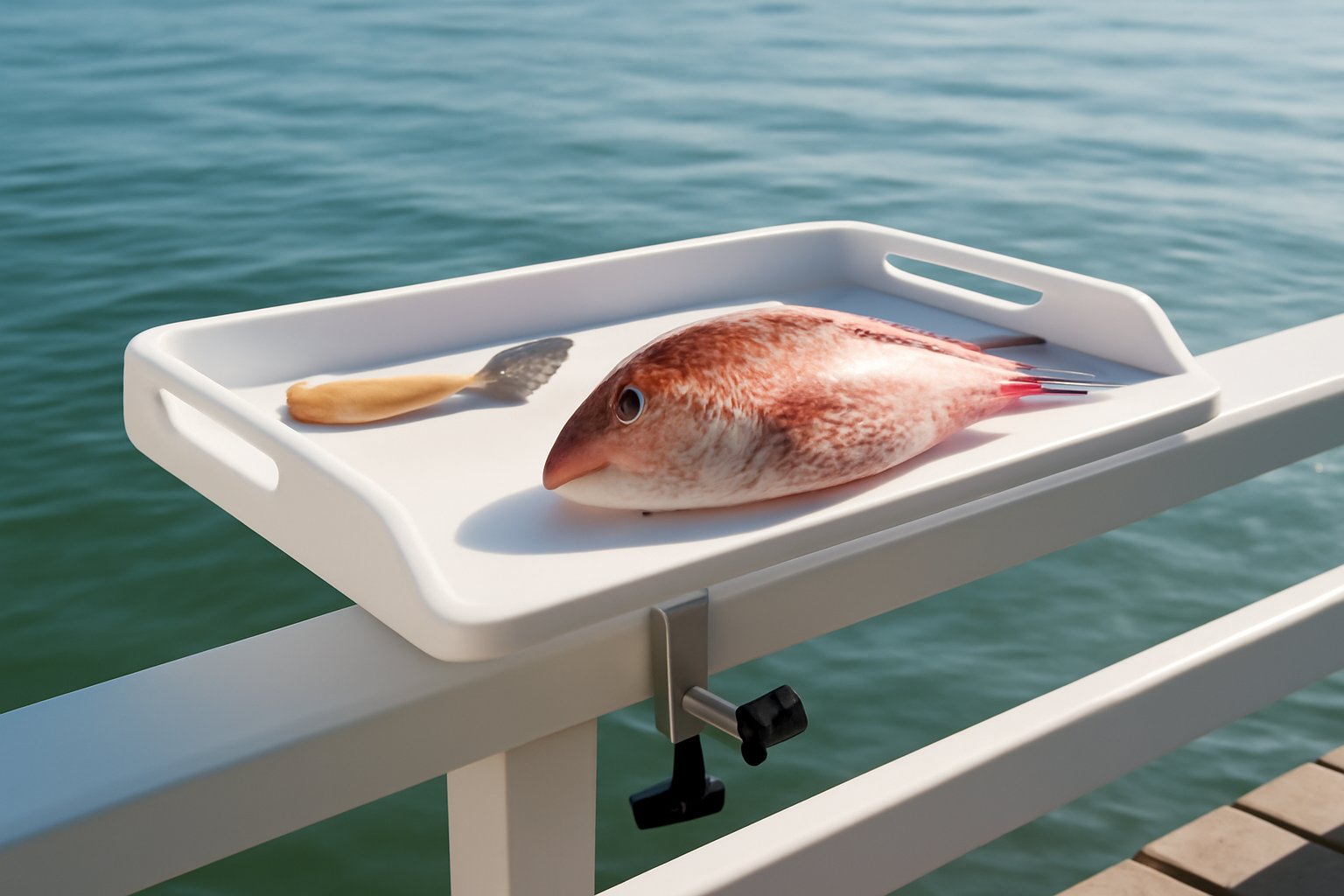
Spend enough time at the bait shop or hardware store and you’ll hear it: “Just bolt any old table to your dock rail and you’re good to go.” That advice evaporates the moment saltwater gets involved. I’ve watched dock owners follow that exact guidance, only to call me six months later when their mounting hardware has seized up, their table is listing sideways, and rust is bleeding down their pilings. A fillet station isn’t decorative—it’s a structural addition to your dock, and treating it casually costs real money in repairs.
When a setup is dialed in properly, cleaning fish shifts from aggravating to straightforward. Your back stays straight, your fish stays put, and the whole operation drains correctly so your dock doesn’t rot from underneath. Over two decades working saltwater structures along the Gulf, I’ve learned what separates a station that lasts from one that becomes a liability. Let me share what actually works when you’re standing on the dock with a knife in one hand and a 15-pound catch in the other.
| Material Type | Lifespan/Performance | Specification |
|---|---|---|
| Galvanized hardware | ~18 months before failure | Ordinary lag bolts |
| 316-grade stainless fasteners | 3+ seasons without replacement | 3/8-inch lag screws, 3-inch minimum bite |
| Aluminum work surface | 1-2 seasons before pitting | Non-viable for saltwater |
| HDPE work surface | Durable long-term | NSF-certified, bleach-cleanable |
| Powder-coated carbon steel frame | Fails after coating scratches | Rusts underneath protective layer |
| 304 or 316 stainless frame | Multiple surface replacements possible | Outlasts deck components |
Why Your Dock Setup Matters More Than the Table Itself
Most folks get this backwards—they buy a fillet table, then scramble to figure out how to attach it. The cart before the horse every time. Your dock’s construction, its compass orientation, and the fastening points already available to you dictate which table will function without wobbling or failing. I once installed a beautiful stainless-steel station that swayed like a ship’s mast because the mounting went to a handrail cap rather than the actual structural framing underneath.
What you’re hunting for is a solid anchor—a vertical post or through-beam connected to your dock’s skeleton, not trim or cosmetic railings. Most residential docks from Pensacola westward use either 4×4 or 6×6 pressure-treated posts, or their composite equivalents, as the primary load-bearing members. Those are your target mounting zones. Going smaller than that is a setup for failure. The accumulated weight of a table laden with fish, cutting tools, rinsing water, and your own body pressure can push 80 to 120 pounds of combined load through that connection point alone.
Think about where your water waste goes. Position your station so runoff and fish scraps exit away from your deck surface, not across it. Decaying tissue and organic matter accelerate wood deterioration and make walking treacherous when wet. I’ve repositioned more than one installation specifically because the operator would be standing in a constant stream of discharge.
Hardware Selection and Structural Compliance
This is where DIY work typically derails. In the saltwater zones I operate—the bays, inlets, and bayous stretching down the Gulf from Pensacola through Port Aransas—ordinary galvanized hardware becomes scrap within about 18 months. Back in 2009, my own dock fell victim to this exact mistake. I fastened a cleaning station using galvanized lag bolts, and come spring of the next year, corrosion had attacked them so viciously that the whole assembly was barely secured. That failure cost me a replacement table and structural repairs to the post beneath.
Specify 316-grade marine stainless steel fasteners, no exceptions. For a standard post-mounted fillet table, source 3/8-inch lag screws with a minimum 3-inch bite into solid timber. If your pilings are hollow composite construction, verify the manufacturer’s weight-bearing specifications first—some composite posts simply cannot accept lag hardware and demand through-bolts paired with backing washers instead.
In jurisdictions under U.S. Army Corps authority—which encompasses much of the Gulf Coast’s tidal waters—adding a permanent dock fixture technically enters permitting territory. Most residential-scale fillet stations fall beneath the threshold triggering formal review. Still, if your property sits in a controlled marina or HOA-managed waterway, you’ll want confirmation from the local authority before breaking out the drill on anything structural.
Work Surface Height and Dimension Requirements
Vertical positioning carries enormous weight in this equation, particularly during extended cleaning sessions. The sweet spot for a fillet surface runs somewhere between 36 and 38 inches above your deck—equivalent to standard kitchen counter height. Most manufactured options let you dial in your preference within that band, which becomes increasingly valuable when different family members or fishing partners use the dock. Spending three hours hunched over a 30-inch-high platform will destroy your lumbar spine. I’ve witnessed this injury scenario enough that ergonomic positioning is now my opening question whenever someone reaches out about installation.
On the horizontal plane, 48 inches represents the functional baseline for processing larger inshore species like redfish or doormat flounder without constant repositioning. If you’re regularly handling snook, cobia, or king mackerel, that additional length becomes non-negotiable. Anything shorter than 36 inches is honestly just a cutting board pretending to be a dock fixture.
Surface Composition: Which Materials Survive Salt Exposure
Every fillet table surface is not created equal, and I’m unequivocal on this point: aluminum as a primary work surface in saltwater is a losing bet. Oxidation, pitting, and corrosive patterning emerge within a season or two, creating microscopic pores where bacteria take root and multiply. I’ve removed two aluminum-deck stations from client docks after they’d become essentially impossible to sanitize properly.
High-density polyethylene—HDPE—is the correct material choice for a saltwater fillet table deck. It’s non-absorbing, resists fish-odor retention, handles UV punishment, and returns to sterile condition with straightforward bleach treatment. Commercial seafood processors mandate NSF-certified HDPE boards for precisely these characteristics. When I’m evaluating a product recommendation, surface composition is always my first filter.
Supporting structure—whether frame, legs, or brackets—should be 304 or 316 stainless. Powder-coated carbon steel frames appear pristine at first, but the moment a scratch penetrates the coating, rust initiates underneath. In practice, a solid stainless skeleton will outlast numerous surface replacements assuming you rinse after every use session.
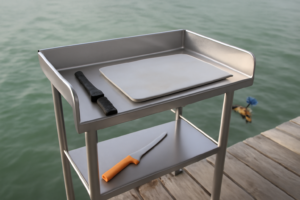
The 48″ Magma Table That Finally Stopped My Catch From Sliding Into the Water
I’ve witnessed more perfectly good fish make an unwilling dive straight back into the gulf than I can reasonably recall. When your fillet table isn’t properly sized, secured, or engineered, a prize-winning specimen can slip off the edge faster than you can react. The correct installation demands adequate workspace, rock-solid stability under dynamic pressure from knife work and fish weight, and materials resilient enough to withstand unending salt atmosphere without corroding into powder within 24 months.
What works
- The 48-inch expanse delivers genuine operational room—laying out a 20-pound king mackerel leaves me with surplus space for implements, absorbent cloths, and tackle organization without perpetual shuffling and rearranging.
- Integral drainage channels and a tilted cutting surface actively propel fluids and blood away from operator stance, which seems elementary until you’ve inherited a neighboring table where liquid pools directly underfoot.
- The marine-grade fasteners and sealed aluminum framework stand up to relentless saltwater exposure—my personal unit has been functioning on my dock through three full seasons without requiring fastener replacement or managing visible corrosion progression.
What doesn’t
- The acquisition price is substantial, and this represents a permanent fixture commitment rather than a temporary seasonal accessory you can store away between seasons.
- Proper installation demands a robust dock foundation—if your pilings show decay or your decking has softened, this station will immediately expose those structural deficits because it requires a truly stable base underneath.
I almost talked myself out of buying one after the sticker shock—seemed like overkill until my neighbor’s $80 plastic table warped mid-summer and became a death trap for anyone holding a knife near it. That’s when I pulled the trigger on the Magma Products T10-449B-HDP 48″ Tournament Series Dock Cleaning Station.
Frequently Asked Questions
What height should a fillet table be mounted on a dock?
The sweet spot runs between 36 and 38 inches above your deck, equivalent to standard kitchen counter height. I ask about ergonomics first because spending three hours hunched over a 30-inch platform will destroy your lumbar spine, and I’ve witnessed this injury scenario enough times to make vertical positioning my opening question.
What fasteners do I need for saltwater dock mounting?
Specify 316-grade marine stainless steel fasteners with no exceptions. Source 3/8-inch lag screws with a minimum 3-inch bite into solid timber. Ordinary galvanized hardware becomes scrap within about 18 months in Gulf saltwater—I learned that lesson in 2009 when corrosion attacked galvanized lag bolts so viciously the assembly barely stayed secured.
Can I mount a fillet table to my dock handrail?
No. You need a solid anchor—a vertical post or through-beam connected to your dock’s skeleton, not trim or cosmetic railings. I once installed a beautiful station that swayed like a ship’s mast because the mounting went to a handrail cap rather than actual structural framing underneath, which is a setup for failure.
What material should a fillet table work surface be?
High-density polyethylene (HDPE) is the correct choice for saltwater. It’s non-absorbing, resists fish-odor retention, handles UV punishment, and returns to sterile condition with bleach treatment. Aluminum oxidizes and pits within a season or two, creating microscopic pores where bacteria multiply—I’ve removed two aluminum-deck stations that became impossible to sanitize properly.
Sources and further reading
About This Article

Written by Trent Hollis. Waterfront homeowner turned DIY obsessive. After two decades tinkering with my own dock, seawall, and boat lift on the Gulf Coast, I share everything I've learned about waterfront construction, boat lift maintenance, and coastal living projects. More about this site.
Scope and limits. Trent is a waterfront homeowner, not a licensed marine contractor. Structural, electrical, and lift work should go to a licensed marine contractor, and most in-water work needs a permit before you start.
Verify this against a primary source
Specifics change, and your situation may differ from the one described here. These are the authorities worth checking directly:
- ABYC — marine electrical and construction standards
- U.S. Army Corps of Engineers — permitting for work in navigable waters
- NOAA Tides & Currents — tidal range and water level data for your site