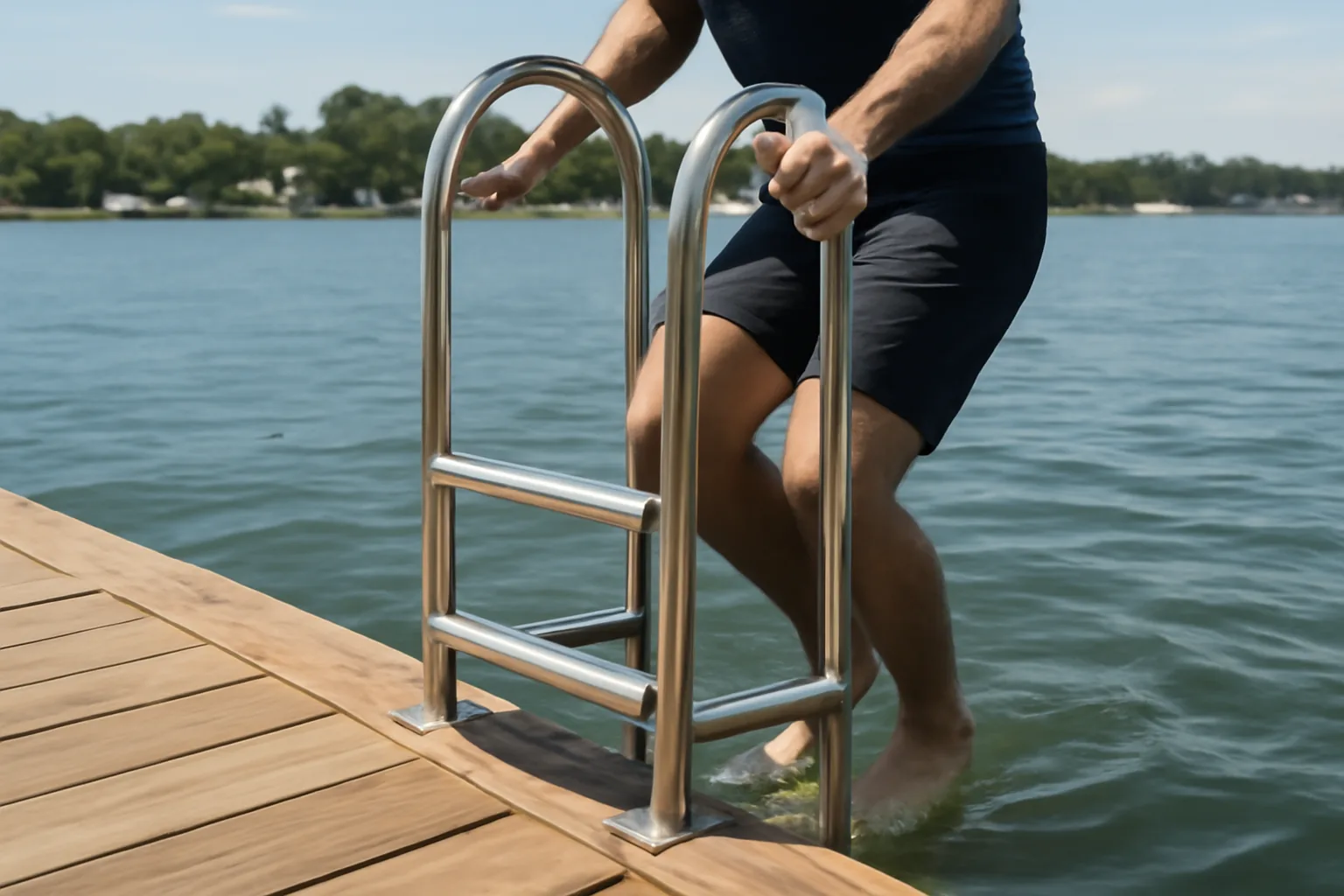
A corroded aluminum ladder with seized bolts cost my neighbor $340 to replace and took him out of the water for an entire weekend while we waited for the new one to arrive. The mounting hardware had worked loose sometime over the winter months, and nobody had thought to inspect it. That’s the moment I understood that dock ladder selection isn’t about picking whichever option has the highest ratings online — it’s about choosing equipment that actually performs when someone wet and exhausted needs to climb out, especially if there’s a child involved. Over the past two decades, I’ve installed somewhere north of 150 ladders along the Gulf Coast, and I notice the same problem crop up repeatedly: budget-conscious homeowners buy a discounted four-step model, bolt it down without much thought, and then watch it develop a wobble by the second season. One afternoon during last summer, I witnessed a neighbor’s teenage daughter struggling to pull herself up a corroded aluminum ladder whose steps had bent from corrosion and neglect. The bolts securing it had shifted loose over the preceding months, and the ladder had never received a maintenance check. That incident is precisely why I approach dock ladder decisions with the seriousness they deserve.
Finding the right ladder hinges on five essential variables: the width of the rungs, the load it can handle, the durability of its construction, the quality of its fastening system, and whether it’s designed to retract so it won’t interfere with boat traffic or create an underwater snag hazard. Nail these five elements and you’re looking at a ladder that performs reliably for ten years or more. Miss on any of them and you’ll be shopping for a replacement — or worse, handling a liability situation that your homeowners policy may not even cover. I’ve spent this post documenting everything my two decades on the water have taught me, including the specific ladder model I now point almost every homeowner toward when they ask for guidance.
Why Most Dock Ladders Fail Within Three Years
My 2007 dock project taught me something I’ve adhered to ever since. I specified a steel ladder with a painted finish instead of galvanized coating in order to keep costs down — the whole build had a $1,200 target. Paint started bubbling by year two. By the start of year three, the frame stringers showed significant rust damage right where they sat below the waterline. I removed it by hand — it had weakened that much. That experience locked in a principle for me: ferrous metals have no place on structures that remain partially submerged for months on end.
The combination of saltwater, direct sunlight, and temperature cycling from freeze to thaw degrades poor-quality components at an alarming rate. The correct material for dock ladders in almost every situation — whether saltwater estuaries, brackish systems, or inland freshwater — is marine-grade aluminum alloy. Every bolt, washer, and nut should be 316 stainless steel, full stop. Most manufacturers reduce costs by sourcing zinc-plated fasteners instead. In salt environments, these corroded and lock up permanently within about 18 months, transforming what should be a simple maintenance task into a destructive extraction.
Rung geometry represents another frequent cause of failure. Thin, cylindrical rungs measuring less than 3 inches in diameter create genuine safety hazards for someone climbing out barefoot, wet, and physically depleted. The American Boat and Yacht Council’s H-41 standard addresses crew boarding and exiting procedures on vessels, and although boatbuilders are its intended audience, the engineering principles translate perfectly to residential dock access. Substantial, textured rungs aren’t an optional upgrade — they constitute fundamental safety architecture.
Key Factors in Selecting Your Dock Ladder
Whenever someone asks for my recommendation on dock ladders for swimming applications, I lead with five criteria. Here’s the priority sequence, based on how these ladders actually perform in the field — not based on manufacturer marketing language.
1. Load Rating
Avoid anything carrying a rating lower than 300 pounds. A 200-pound person exiting the water with forward momentum and wet garments creates dynamic forces substantially greater than what their body weight alone would suggest. I suggest 350 pounds as your absolute floor for any dock that adults will use. That represents genuine protection, not inflated marketing numbers.
2. Rung Quantity and Vertical Distance
How many rungs you require depends on the elevation of your dock above the normal water level. A typical residential fixed dock extends 18 to 24 inches above water, though floating platforms and areas with significant tidal swings require a different calculation. Generally speaking: allow one additional rung for every 8 to 10 inches of vertical rise. Four rungs work for most residential situations where the dock sits between 24 and 30 inches above water. Five rungs become necessary when your dock height falls between 30 and 40 inches — which occurs more frequently than most property owners realize on permanent piers.
3. Rung Dimensions and Surface Grip
Rungs spanning at least 18 inches allow the foot to contact the surface correctly. Narrow rungs force an uncomfortable angled stance that wears you out and feels unstable. A textured, non-slip surface is absolutely mandatory. You want ribbed, grooved, or serrated step surfaces — not merely a thin rubber adhesive layer that deteriorates and separates after a single season.
4. Retractable Mechanism
Permanently submerged fixed ladders attract marine growth, catch floating debris, and risk striking boats that move through your swimming area. Retractable designs that stow flush against the dock’s vertical face eliminate all these complications. Consider a pontoon or skiff that operates in proximity to your dock — a ladder jutting into the water is a genuine collision risk. Retractable models handle this issue completely.
5. Deployment Rope or Assist Mechanism
This is something most people overlook until they find themselves treading water and unable to reach a ladder that’s currently stowed above their head. A rope system lets you lower the ladder from water level. That feature transcends mere convenience — it’s genuinely important for safety. Should someone go overboard and the ladder’s in the up position, they need a way to deploy it from below. A rope accomplishes this.
Installation Guidelines Based on Fieldwork Experience
Sound ladder selection becomes meaningless if installation quality is poor. I’ve dismantled and rehung more ladders than I can easily count — typically because the initial installer relied on wood screws driven into the deck surface rather than bolts threaded through the underlying frame. Here’s the straight truth: anchor your dock ladder using through-bolts that penetrate deep into structural framing. Avoid surface-mounting directly into decking boards.
Select 3/8-inch bolts manufactured from 316 stainless steel, paired with substantial fender washers and self-locking nuts. Drill accurate holes with a properly sharpened bit — resistance should be firm, not requiring excessive force or oversizing. Enlarged holes permit the fastening system to shift, generating wear cycles that gradually loosen the connection over successive seasons. When bolting into timber framing, apply elastomeric marine sealant around each bolt hole before final tightening, creating a barrier against water infiltration and subsequent timber decay.
During spring maintenance outside Pensacola, I found a homeowner’s ladder secured to the fascia trim board — essentially decorative edging material — rather than the central stringer that carries load. His 14-year-old’s weight pulled the entire assembly free from the dock. Fortunately nobody suffered serious harm, but the moment was frightening. The trim board split lengthwise. Forty-five minutes of labor and $12 worth of hardware would have prevented the entire incident. Anchor into the structural frame — without exception.
Orient the ladder so its lowest rung sits roughly 6 to 8 inches beneath the surface when in its deployed position. This provides swimmers with a foothold they can locate and engage before they begin their ascent. Positioning it too high demands an aggressive initial upward push that rapidly exhausts the climber — particularly children and senior adults who lack upper body conditioning.
Why Five Steps Changes Everything
Many dock ladders fail because they’re engineered below the requirements of genuine usage — a fatigued swimmer or young person climbing out generates forces that an undersized 4-step simply cannot withstand. The separation between a ladder that feels secure and one that shifts perceptibly under load traces directly to rung abundance and structural thickness, and it justifies spending a little extra on something taller.
What performs
- That additional fifth rung generates measurable improvement in how stable the entire ladder feels — climbers escape the requirement for an extended reach from the fourth step, which is precisely where people typically experience instability.
- The stowing capability keeps swimming space clear and prevents entanglement with water sports equipment or floating toys — a recurring frustration I hear from dock owners when they’re stuck with permanent ladders.
- Its expanded mounting footprint distributes contact evenly across uneven dock surfaces and avoids the rocking I used to encounter on angled pilings — I’ve largely stopped needing shims after adopting this design.
What requires trade-offs
- It carries more mass than a standard 4-step configuration, which becomes noticeable if you’re retracting and extending it repeatedly throughout the day — the difference registers within roughly two weeks of regular use.
- The retraction mechanism demands structural robustness in the mounting location; compromised or rotted dock framing will obstruct achieving a solid, non-shifting connection during installation.
I’ll admit I was skeptical the extra step would matter that much—figured it was marketing—until I tested one on my own dock with my nephew climbing. The moment he hit that fifth rung and planted his foot without any give, I realized I’d been settling for less all those years. Get the RecPro 5-Step Flip-Up Dock Swim Ladder if you want something that’ll outlast the season and actually feel safe under load.
What Actually Makes a Dock Ladder Easy to Climb
Nearly everyone shopping for an easy climb dock ladder is solving one of two problems: getting an older adult or a child out of the water safely, or getting yourself out while tired, cold, and wearing gear. Those need different things, and the spec that matters most is not the one most listings lead with.
| Feature | Why it decides how easy the climb is | What to look for |
|---|---|---|
| Step width | Narrow rungs concentrate load on the arch of your foot and hurt bare feet | 4 inches or wider, flat tread |
| Rung spacing | Wide spacing forces a big step up at the point you have the least strength | 10–12 inches, evenly spaced |
| Submerged depth | The number one reason a ladder feels hard — you cannot get a first foothold | At least 4 steps below the waterline |
| Handrail height | Determines whether you pull yourself up or haul yourself up | Rails extending 24–30 inches above decking |
| Angle | A vertical ladder is much harder than an angled one | Angled or flip-down beats straight vertical |
| Tread surface | Slick tubing is dangerous when wet | Textured, perforated, or rubber-wrapped |
Submerged depth is the one people get wrong
If I could change one thing about how dock ladders get sold, it would be this. A four-step ladder that only reaches 18 inches under the surface is a two-step ladder in practice, because you cannot get a foot on anything until you have already pulled your whole body up. Count steps below the waterline at low water, not total steps. Five submerged steps turns a genuinely hard climb into an easy one, and it is the single biggest difference between ladders that feel effortless and ladders that get replaced.
Easy climb picks by situation
- Older adults or limited mobility: angled ladder, wide flat treads, tall handrails on both sides, at least five submerged steps. This is worth paying for.
- Kids swimming: wide treads, close rung spacing, and rails they can actually reach — standard rail height is designed around adult shoulders.
- Getting out in gear or when exhausted: prioritize handrail extension above the deck. Pulling up on a rail that stops at deck level is where people slip.
- Big tidal range: a flip-up or telescoping ladder, since a fixed one is either too short at low water or in the way at high.
Frequently Asked Questions
What size bolts should I use to install a dock ladder?
Use 3/8-inch bolts manufactured from 316 stainless steel, paired with substantial fender washers and self-locking nuts. Thread them through the underlying structural frame rather than surface-mounting into decking boards. Apply elastomeric marine sealant around each bolt hole before final tightening to prevent water infiltration.
How many dock ladder rungs do I actually need?
For a typical residential fixed dock extending 18 to 24 inches above water, four rungs work fine. Five rungs become necessary when your dock height falls between 30 and 40 inches, which occurs more frequently than most property owners realize on permanent piers. Generally allow one additional rung for every 8 to 10 inches of vertical rise.
Why is my aluminum dock ladder corroding after one season?
Your fasteners are likely zinc-plated instead of 316 stainless steel. In salt environments, zinc-plated bolts corrode and lock up permanently within about 18 months, transforming a simple maintenance task into a destructive extraction. Every bolt, washer, and nut should be 316 stainless steel, full stop.
What minimum load rating should a dock ladder have?
Avoid anything carrying a rating lower than 300 pounds. A 200-pound person exiting the water with forward momentum and wet garments creates dynamic forces substantially greater than body weight alone. I suggest 350 pounds as your absolute floor for any dock that adults will use.
Sources and further reading
About This Article

Written by Trent Hollis. Waterfront homeowner turned DIY obsessive. After two decades tinkering with my own dock, seawall, and boat lift on the Gulf Coast, I share everything I've learned about waterfront construction, boat lift maintenance, and coastal living projects. More about this site.
Scope and limits. Trent is a waterfront homeowner, not a licensed marine contractor. Structural, electrical, and lift work should go to a licensed marine contractor, and most in-water work needs a permit before you start.
Verify this against a primary source
Specifics change, and your situation may differ from the one described here. These are the authorities worth checking directly:
- ABYC — marine electrical and construction standards
- U.S. Army Corps of Engineers — permitting for work in navigable waters
- NOAA Tides & Currents — tidal range and water level data for your site