Out on a job near Gulf Shores, I got called back to a property where the homeowner had installed a kayak rack two seasons prior. The structure looked solid enough at first glance — pressure-treated lumber frame, galvanized bolts, foam cradles. But when I ran my hand across one of the posts, the wood was soft. The bolts had that white crusty corrosion all over them, and the foam had turned into something that crumbled between my fingers like wet cardboard. Two sit-on-top kayaks, stored less than 40 feet from open water. The owner couldn’t figure out what had gone wrong. That job taught me the hard way that calling something “outdoor storage” and actually building something that survives saltwater are two entirely different propositions — a distinction I have not overlooked in any storage recommendation I have made since.
Down here on the Gulf, the climate does not negotiate. Eighty percent humidity or better runs year-round. Salt-laden air moves inland beyond two miles without effort. Between March and October, UV hammers everything it touches. If your rack cannot handle all three of those forces at once, time is working against you. What catches most homeowners off guard is grabbing their board in spring, only to discover that the rack sways, makes concerning noises, and has left rust stains across the hull.
Twenty years of building and fixing marine infrastructure — docks, boat lifts, waterfront storage — has given me a chance to see what works and what does not. I have tested countless rack options: custom builds, pre-made kits, and salvage jobs from installations that failed. Everything I know about building kayak and SUP storage that survives Gulf Coast conditions is outlined below.
Why Most Kayak Racks Fail Outdoors
Racks tend to break down using the same predictable sequence. A manufacturer designs something that looks bulletproof in product photography. Then corners get cut in two places: protective coating thickness and fastener materials. Perhaps the frame is steel with powder coat. That seems reasonable until you recognize that standard powder coat was designed for indoor spaces, not perpetual UV and salt bombardment. One summer of exposure and the coating develops hairline fractures. Water enters behind it. Rust appears weeks later.
Hardware represents the other critical failure point. I have stripped down racks where the structural frame was still serviceable, but every bolt and bracket had transformed into a corroded mass. When you couple dissimilar metals — a steel fastener threaded into an aluminum bracket, for instance — galvanic corrosion kicks in. That electrochemical reaction gets dramatically worse in humid conditions or near saltwater. The outcome is hardware that seizes, requires destruction to remove, and leaves stains on either your wall or your boat.
Wooden racks deteriorate along a different path, but the end result is the same catastrophic failure. Even ACQ-treated lumber — marketed as suitable for ground contact — will splinter, check, and separate under repeated moisture cycles while bearing weight. I have watched 4×4 timbers split lengthwise after holding a 65-pound touring kayak through two seasons. For waterfront storage applications, wood became a material I stopped proposing to clients approximately a decade ago.
Materials That Genuinely Perform in Waterfront Conditions
Through experimentation and considerable personal investment, I have narrowed it down to three materials that deliver genuine outdoor performance: marine-grade aluminum, HDPE polymer, and stainless steel hardware. Each serves a particular purpose.
Marine-grade aluminum — usually the 6061-T6 variety — represents the optimal choice for load-bearing components. It will not rust. It resists UV degradation. Its lightweight nature means repositioning it does not require additional help. Hard-anodized aluminum takes this further, creating a protective oxide layer that wards off scratching and salt corrosion. Within 500 feet of saltwater, insist on Type II or Type III hard-anodized finishes on any rack you purchase.
HDPE is the material commercial dock contractors specify for protective bumpers, fastening points, and slide channels. Moisture does not soak into it, UV does not break it down, and corrosion cannot touch it. For the cradle surfaces that support your kayak and the protective sleeves that wrap your mounting arms, HDPE or UV-stabilized EVA foam are the only viable materials. Off-the-shelf foam disintegrates under direct sun within 12 to 18 months — I have witnessed it happen repeatedly. Grade 316 stainless steel fasteners complete the corrosion-resistant package. Grade 304 stainless is adequate for sheltered locations. Grade 316 is what you require if salt-air exposure is part of the equation.
Load Capacity and Mounting Safety Considerations
Racks mounted to walls must anchor into structural framing — studs, backing boards, or concrete elements. Wall anchors designed for drywall should never be your only fastening method if the rack will support 100 pounds or more. The International Residential Code provides guidance under Section R301: wall-mounted structures supporting constant loads must use fasteners rated to the specific application and secured directly to the structural frame. For concrete or masonry surfaces, select sleeve anchors or Tapcon fasteners rated to handle three times your anticipated load. A rack certified to hold 200 pounds should use anchoring hardware with a minimum 600-pound shear capacity at each attachment location.
Evaluating Your Storage Layout and Mounting Options
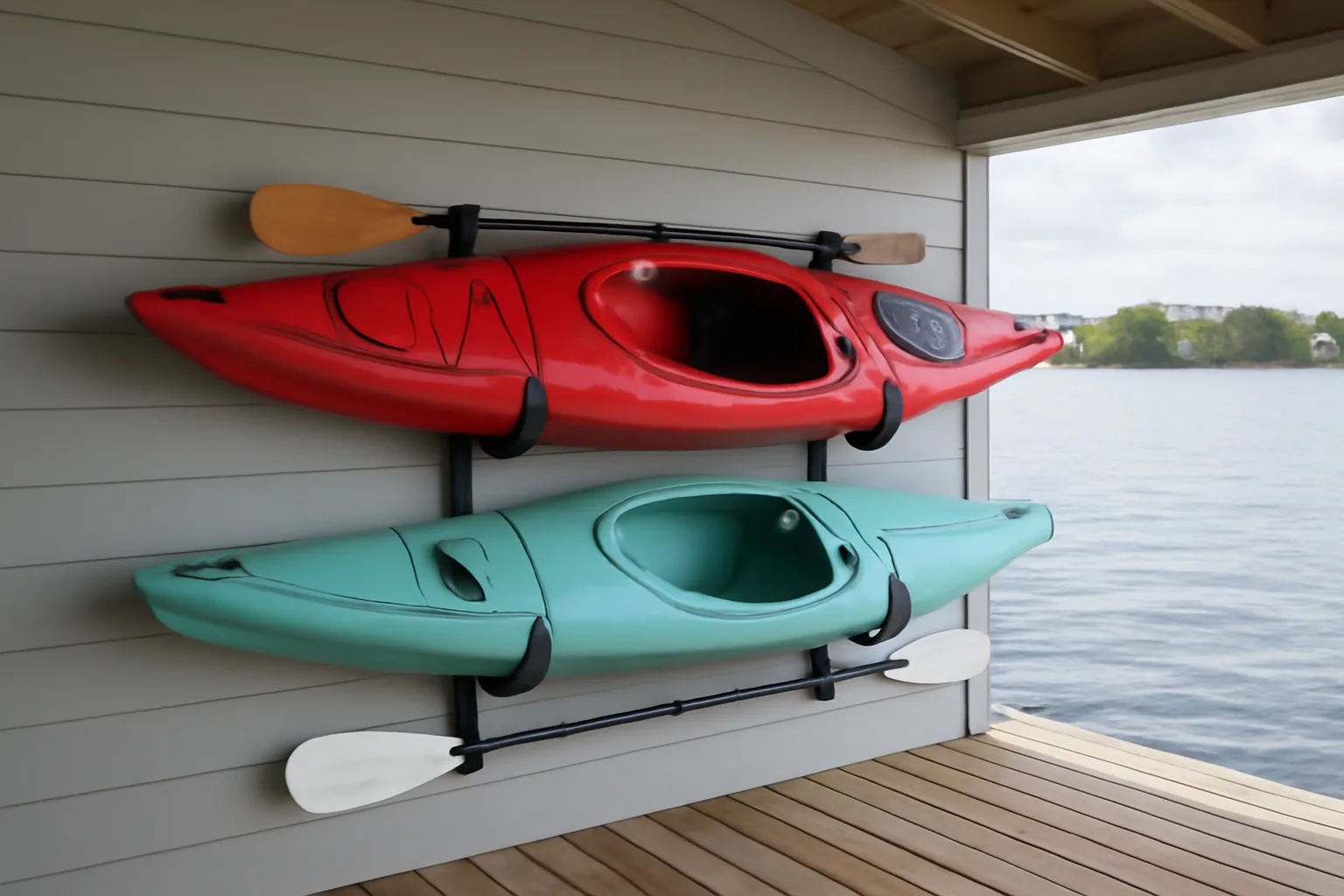
Wall-mounted racks represent my standard suggestion for the majority of property owners. Lifting kayaks off ground level safeguards the hull from pests, standing water, and ground-level UV damage — and it maximizes vertical space utilization. Typically, two kayaks require roughly 24 to 30 inches of horizontal wall width and extend 18 to 24 inches into the space when occupied. This configuration fits well against a garage wall, a storage shed, or a reinforced privacy fence line.
Pedestal-style racks become practical when wall installation is not feasible — tenant-occupied properties, exposed concrete pads with no adjacent structures, or larger paddleboards demanding access from multiple angles. Freestanding designs do present greater exposure to wind forces, however. In my experience, any pedestal-mounted rack storing equipment weighing more than 50 pounds in an open location should be secured to the earth using screw anchors or concrete piers. A freestanding unit that topples during a storm creates more damage than the original ground storage would have caused.
With paddleboards, the angle and orientation of the supporting cradle carries more significance than most people appreciate. A SUP positioned with its fin end down and its top surface in a shallow V-shaped cradle at an unsuitable pitch can develop permanent structural changes to the shape over an entire season. The correct approach: store paddleboards in a flat horizontal position across foam cradles, or standing upright on the tail end using a cushioned support base. Positioning a SUP diagonally against a bare wall with only mid-section contact generates stress concentration in the board’s most vulnerable zone and invites delamination failure.
Building a Rack System That Stops Corrosion and Rot Before It Starts
That job near Gulf Shores made the issue clear: I was fighting against the laws of material science. Wood and galvanized steel simply cannot endure the specific combination of factors that saltwater environments present. What I needed to construct was a storage solution engineered from the ground up with materials that maintain their integrity regardless of salt exposure, humidity, or direct sunlight damage.
Advantages of proper corrosion-resistant construction
- Aluminum paired with stainless fasteners eliminates timber deterioration, fastener rust, and the electrochemical decay that mixed metals trigger — the design foundation is saltwater durability from inception.
- Foam and polyethylene padding stays intact through seasonal cycles without breakdown, retaining cushioning qualities indefinitely, and protecting boat surfaces from scratching and wear.
- Vertical mounting gets boats elevated away from ground moisture pools that accelerate degradation, while reclaiming usable work area on your dock or yard.
Trade-offs and practical limitations
- A suitable wall surface must be present — open-frame structures or areas lacking solid mounting surfaces demand alternative approaches to your storage strategy.
- Initial expenditure exceeds what you would budget for building with pressure-treated wood, but that equation shifts dramatically when you factor replacement cycles of 18 months against a decade or more without maintenance costs.
I’ll admit I was skeptical the first time I mounted one — part of me wanted to believe my DIY lumber approach could work if I just picked the “right” wood. But six years in, watching that aluminum rack hold two kayaks and a paddleboard with zero signs of stress while my neighbor replaced his wooden cradle twice, I stopped doubting. Check out the StoreYourBoard G-Kayak Wall Rack if you’re ready to build storage that actually lasts.
Frequently Asked Questions
What materials should I use for kayak storage near saltwater?
Marine-grade aluminum, typically 6061-T6 variety, works best for load-bearing components. HDPE polymer and UV-stabilized EVA foam protect cradle surfaces. Use Grade 316 stainless steel fasteners within salt-air exposure. Hard-anodized aluminum with Type II or Type III finish is essential within 500 feet of saltwater.
How much wall space do 2 kayaks need for storage?
Two kayaks require roughly 24 to 30 inches of horizontal wall width and extend 18 to 24 inches into the space when mounted. Wall-mounted racks keep hulls elevated away from ground-level pests, standing water, and UV damage while maximizing vertical space utilization.
How should I position a paddleboard in storage?
Store paddleboards flat horizontally across foam cradles or standing upright on the tail end using a cushioned support base. Positioning a SUP diagonally against a bare wall with only mid-section contact generates stress concentration in the board’s most vulnerable zone and invites delamination failure.
What fasteners should anchor a wall-mounted kayak rack?
A rack certified to hold 200 pounds should use anchoring hardware with a minimum 600-pound shear capacity at each attachment location. For concrete or masonry, select sleeve anchors or Tapcon fasteners rated to handle three times your anticipated load, secured directly to structural framing.
Sources and further reading
About This Article

Written by Trent Hollis. Waterfront homeowner turned DIY obsessive. After two decades tinkering with my own dock, seawall, and boat lift on the Gulf Coast, I share everything I've learned about waterfront construction, boat lift maintenance, and coastal living projects. More about this site.
Scope and limits. Trent is a waterfront homeowner, not a licensed marine contractor. Structural, electrical, and lift work should go to a licensed marine contractor, and most in-water work needs a permit before you start.
Verify this against a primary source
Specifics change, and your situation may differ from the one described here. These are the authorities worth checking directly:
- ABYC — marine electrical and construction standards
- U.S. Army Corps of Engineers — permitting for work in navigable waters
- NOAA Tides & Currents — tidal range and water level data for your site