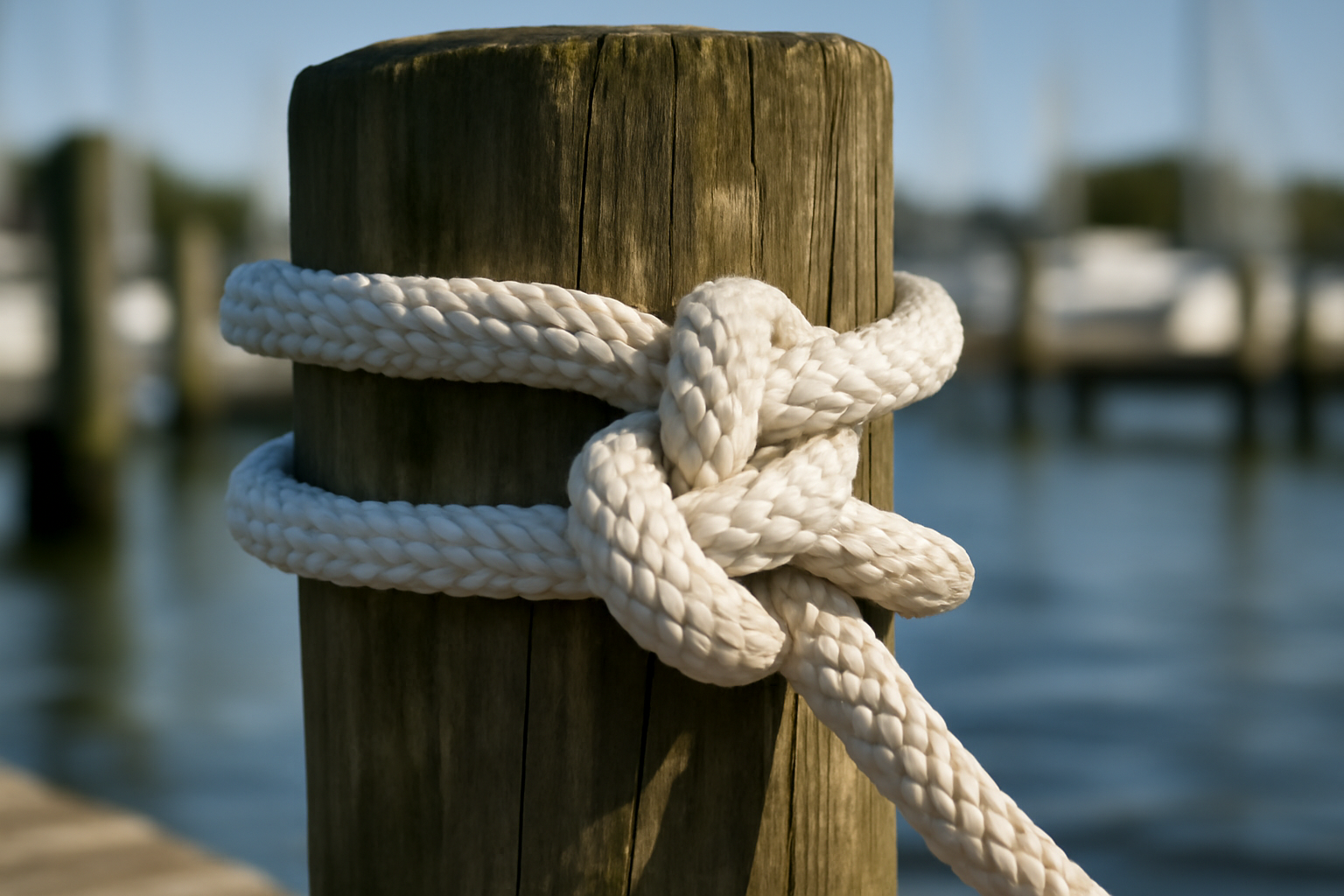
Over two decades working marine construction along the Gulf, I’ve thrown this knot at everything the water throws back—dead-calm mornings and 40-knot wind events, corroded pilings and polished fiberglass, 3/8-inch three-strand poly through 5/8-inch double-braid nylon. The round turn and two half hitches has never once failed me. That’s not casual conversation. That’s earned respect.
Out in Pensacola, I responded to a client’s distress call one evening. His 26-foot center console had worked itself loose during the night and collided with his neighbor’s boat. Two vessels damaged, insurance adjusters showing up, and a relationship fractured. When I inspected the cleat, the cause was unmistakable—he’d deployed a simple cleat hitch without proper tension, and the surge from the tidal swing had gradually worked the line free. I asked him to demonstrate his tying method. He didn’t know the round turn and two half hitches. Right there was the whole problem.
Whenever you’re securing to a piling, a ring bolt, a mooring post, or any stationary anchor point without a proper cleat installed, this knot becomes your foundation. It stays secure, you can adjust it before final lock-down, and it won’t bind and jam the way other knots can under sustained tension. I’m walking you through the complete process—the tying sequence, when it belongs in your toolkit, which rope materials work best, and why it outperforms competing methods in actual waterfront conditions.
When to Use the Round Turn Two Half Hitches Dock Knot
This knot performs best when your tie-off point lacks a cleat or mechanical cam system. You’ll find yourself reaching for it routinely in these exact circumstances.
- Piling-mounted dock posts: Your primary application. The cylindrical shape lets the round turn distribute your load across a broader contact zone before the locking hitches grab hold.
- Through-bolts and anchor rings: The rope feeds through cleanly and cinches without slip.
- Buoy tie-downs: When you’ve got a mooring pendant with an exposed eye and you need instantaneous security in blue water.
- Fuel dock quick-tie situations: Binds instantly, releases readily once the fuel nozzles come out.
- Fender lines to rail fittings: The round turn cradles the stanchion without scratching the surface.
The real magic emerges when you’re contending with tidal shifts. Our Gulf waters can climb or drop three feet within a twelve-hour window. Securing a line to a piling demands that the knot hold steady yet grant the rope enough flexibility to slip marginally as your boat travels vertically. The round turn and two half hitches manages precisely this—friction from the round turn prevents major slippage, and the half hitches anchor the line’s end without locking the primary rope solid.
Where This Knot Shouldn’t Be Your Go-To
Complete transparency: this knot has limitations. When you’ve got an actual dock cleat within arm’s reach, deploy a cleat hitch instead—it’s quicker and simpler to undo under tension. Additionally, on oversized pilings—anything thicker than roughly ten inches in diameter—the round turn struggles to generate adequate gripping force before those half hitches take control. On typical 6- to 8-inch pilings you’ll find at most Gulf Coast docks, though, you’re looking at the gold standard.
Tying It Right: The Complete Sequence
Work through this progression deliberately. I’ve laid it out so you can execute it dockside without rewinding footage. Drill this at home using a fence post or garage stud first. Get your muscle memory locked in before you’re doing this in darkness with weather moving in.
- Wrap the working end around the piling one complete rotation. Thread the business end completely around, bringing it back to your side of origin. One full orbit done.
- Circle around once more to finish the complete round turn. Go the full circumference a second instance. You now possess two entire wraps encircling the piling. That’s your “round turn”—not partial, not abbreviated. Two full rotations. Keep both wraps pressed firmly into the piling surface. Critical: This twin wrap carries the heavy lifting on friction. Don’t shortcut it.
- Cross the working end over the standing section. Stabilize your pair of wraps using your free hand. Lift the working end up and across the standing section, then slide it back underneath the loop you’ve formed. That’s your initial half hitch. Cinch it down.
- Create the second half hitch matching the first direction. Execute step three again—working end up and across the standing section, underneath itself, pulled taut. Verify that both half hitches run parallel along the standing section, not spiraling against each other. Helpful note: Opposing half hitches indicate you’ve accidentally made a clove hitch. Different knot entirely—untie and retry.
- Finalize the knot tension and alignment. Maintain the half hitches in their positions while pulling the standing section powerfully back toward your vessel. All components compress neatly into the piling. Your pair of half hitches should line up sequentially along the standing portion.
- Maintain adequate trailing rope. Never cut short the tail. Minimum six inches on ½-inch diameter line is mandatory. For thinner rope gauges, I always leave eight inches as my safety buffer.
That’s the whole evolution. Fifteen seconds maximum after you’ve run through the pattern several times. Under actual load, the round turn shoulders the weight. The half hitches function as your fail-safe. This design means the assembly survives aggressive wave motion and periodic surge without self-releasing, precisely what’s required in a marine dock environment.
Where This Knot Breaks Down: Failure Modes to Avoid
Several of these lessons came through personal experience, others through watching folks make the same missteps. Understanding where this knot can fail transforms you into a more careful boater.
Single Wrap Mistaken for a Round Turn
The biggest problem I observe regularly. Boaters execute one pass and declare mission accomplished on the “round turn.” Incorrect. One loop is merely a turn. A genuine round turn demands a pair of complete passes. That secondary rotation roughly doubles the surface friction happening on your piling before anything else factors in. Eliminate it, and your half hitches shoulder the complete burden. When heavy surge hammers through, those hitches have insufficient reserves and gradually creep toward failure.
Half Hitches Executed in Conflicting Rotations
Both hitches must spiral identically. If number one rotates counterclockwise and number two goes clockwise, you’ve essentially produced a clove hitch locked onto the standing segment, and wave cycling can destabilize it. I discovered this specific failure point personally through a tropical storm occurring in 2014. One of my prototype lines—I was testing different knot iterations—gradually loosened throughout the evening. The cyclic loading from wave motion had slowly defeated those mismatched half hitches and their resistance to rotational forces. Since that boat remained secured to a fixed timber, nothing ended up adrift. However, that experience became permanently embedded in my brain.
Incorrect Rope Selection
This knot delivers peak performance with nylon—either three-strand or double-braid varieties. Nylon’s inherent stretchiness permits absorption of shock forces, and its woven texture generates grip on the piling surface and along itself during hitch formation. Polypropylene becomes too smooth and unyielding. Polyester maintains knot geometry reliably yet lacks the shock-dampening qualities of nylon. I would absolutely refuse to deploy this knot using braided polyester on a Gulf Coast piling during hurricane season. The ABYC standards exist for a reason—they mandate nylon dock lines because the extension behavior acts as your natural shock buffer between hull and stationary anchor.
Neglecting to Dress the Knot Correctly
An undressed knot—one that’s loose and messy—performs beneath its capability. Squeeze each half hitch to tightness individually, then finalize the setup by hauling the standing section powerfully backward. All elements should sit flush and uniformly. If the finished knot exhibits twisting or bulging, untie and execute it fresh. A properly executed round turn and two half hitches presents a clean appearance. Appearance correlates with performance.
The Rope That Makes Me Confident in My Knot Without Second-Guessing
A round turn and two half hitches becomes reliable only through the rope carrying it. I found out quickly that smooth, degraded, or undersized dock rope can escape the knot despite flawless execution—so I transitioned toward double-braid nylon that genuinely embraces the cleat and maintains security even during intense forces.
What delivers results
- The ½” measurement rests easily in my grip and compresses tightly against standard dock hardware without deformation or distortion—exactly what’s demanded for that final hitch to hold firm.
- Double-braid construction resists splitting even following extended seasons under sun and saltwater conditions, meaning your rope’s tail stays intact and the knot stays secured all season long.
- The 20-foot configuration supplies ample working length for weathered pilings and uneven cleat placements without needing to add supplementary segments or reduce your working distance.
Where it falls short
- Double-braid soaks up moisture and dries slower than three-strand varieties, which becomes relevant if you’re storing coiled rope on a moisture-rich dock environment.
- Nylon extends when receiving shock energy—an asset for energy dissipation, but this means you’ll need to re-tighten your lines following major weather rather than just verifying they stayed put.
I once grabbed a frayed poly line off a neighbor’s dock to re-secure his boat in a squall, and the working end came apart halfway through the second half hitch—a moment that reminded me why I don’t cheap out on line anymore. That’s when I standardized on the SEACHOICE Double-Braid Nylon Dock Line 1/2″ x 20′ (Model 40241) and haven’t looked back.
Frequently Asked Questions
How many complete wraps make a proper round turn?
Two full complete rotations around the piling. One loop is just a turn; a genuine round turn requires a pair of complete passes. That secondary rotation roughly doubles the surface friction before the half hitches engage.
What minimum rope tail length do I need after tying?
Minimum six inches on ½-inch diameter line is mandatory. For thinner rope gauges, I always leave eight inches as my safety buffer to prevent the knot from slipping free under load.
Can I use polypropylene rope for this dock knot?
No. This knot delivers peak performance with nylon—either three-strand or double-braid varieties. Polypropylene becomes too smooth and unyielding. Nylon’s stretchiness absorbs shock forces and its woven texture generates grip on the piling surface.
What piling diameter works best with this knot?
On typical 6- to 8-inch pilings you’ll find at most Gulf Coast docks, this is the gold standard. On oversized pilings—anything thicker than roughly ten inches in diameter—the round turn struggles to generate adequate gripping force.
Sources and further reading
About This Article

Written by Trent Hollis. Waterfront homeowner turned DIY obsessive. After two decades tinkering with my own dock, seawall, and boat lift on the Gulf Coast, I share everything I've learned about waterfront construction, boat lift maintenance, and coastal living projects. More about this site.
Scope and limits. Trent is a waterfront homeowner, not a licensed marine contractor. Structural, electrical, and lift work should go to a licensed marine contractor, and most in-water work needs a permit before you start.
Verify this against a primary source
Specifics change, and your situation may differ from the one described here. These are the authorities worth checking directly:
- ABYC — marine electrical and construction standards
- U.S. Army Corps of Engineers — permitting for work in navigable waters
- NOAA Tides & Currents — tidal range and water level data for your site