Most waterfront property owners don’t realize that composite decking specifications—particularly color selection and cap technology—are classified differently across manufacturers, and those differences create substantial barefoot comfort disparities. Here’s what actually happens: you step out onto your new dock after 11 a.m., and within seconds you’re doing an involuntary barefoot shuffle back toward the cabin. Not because you chose poorly from an aesthetic standpoint, but because you selected a material without understanding its thermal profile. The consequences accumulate every summer day for the next fifteen to twenty years.
My background spans two decades immersed in marine construction work along the Gulf Coast before pivoting toward comprehensive DIY education and advocacy. Throughout that career, I oversaw the installation of hundreds of dock and deck systems—everything from traditional pressure-treated lumber to tropical hardwoods, vinyl systems, uncapped composite materials, capped composite systems, and hybrid approaches. Heat management became a recurring topic in project reviews, but it transformed into my primary concern after experiencing a pattern of callbacks from property owners who’d invested substantial money in premium composite decking products and discovered they couldn’t use those decks with bare feet between midmorning and early evening throughout the May-to-October window.
This article examines the specific reasons certain composite boards accumulate and retain excessive surface heat, identifies which product categories maintain cooler temperatures, and outlines actionable solutions available immediately—whether you’re still in the design and specification phase or actively dealing with buyer’s remorse. I’ll also introduce the single piece of diagnostic equipment I bring along during every composite decking assessment project.
Understanding Why Composite Decking Absorbs and Retains So Much Heat
Composite materials and traditional lumber exhibit fundamentally different thermal characteristics when subjected to intense solar exposure. Conventional pressure-treated pine reflects a meaningful portion of incident solar radiation while dispersing accumulated heat relatively efficiently. Composite decking materials, by contrast, typically contain 50–60% polymer content by total weight. Polymers function as poor thermal conductors—they capture radiant solar energy and store it in the material rather than allowing that energy to disperse into the surrounding environment. During a typical 90°F Gulf Coast afternoon receiving direct sunlight, I’ve documented uncapped composite board surface temperatures climbing to 160°F. This temperature range transcends discomfort and enters genuine injury territory.
The underlying culprit involves a measurement called solar reflectance index, commonly abbreviated as SRI. Material color directly determines SRI ratings—darker composite finishes exhibit lower SRI values, which means they intercept and retain more solar energy. From my field observations, dark espresso-toned and charcoal-finished boards routinely measure 20–30°F warmer than light gray or sand-tone options installed under identical environmental conditions. This temperature differential alone can shift a deck from uncomfortable-but-tolerable into genuinely hazardous territory. Unfortunately, the decking manufacturing industry maintains minimal public transparency regarding SRI specifications—a limitation I’ve raised with manufacturers repeatedly over the years.
The presence or absence of a protective cap layer introduces another significant variable. Capped composite decking—featuring a protective polymer shell encasing the structural core—typically demonstrates marginally reduced surface temperatures compared to uncapped composite formulations, since the cap layer deflects more ultraviolet radiation. However, marginal improvements require realistic framing. On a dock platform positioned over open water with minimal shade coverage, even high-end capped composite systems from Trex, TimberTech, or Fiberon can accumulate surface temps in the 140–150°F range during peak heat conditions. That reading remains well above the 140°F temperature threshold science establishes as the point where skin damage begins occurring in under one second of direct contact.
Comparing Heat Performance Across Different Decking Material Categories
Two decades of installation projects and systematic surface temperature documentation provide me a comprehensive ranking of decking material thermal performance under Gulf Coast sunlight conditions:
- Ipe and tropical hardwood species — These materials exhibit exceptional density, inherent heat resistance properties, and sufficient light coloration to refract solar radiation effectively. My measurements consistently show ipe running 25–35°F cooler than dark composite materials evaluated on identical dock structures under matching environmental parameters.
- Pressure-treated pine with light stain application — This material permits better air circulation than composite-based boards, dries faster after moisture exposure, and avoids the heat-trapping characteristics of plastic-laden formulations. The financial accessibility and genuine thermal comfort advantages make this a compelling option.
- Light-toned capped composite formulations — Offerings such as Trex Enhance in “Clam Shell” finish or TimberTech in “Coastline” coloration deliver markedly improved thermal performance relative to their darker product variants. Still warm when evaluated in bright conditions, but achieves acceptable comfort levels when shade protection is implemented.
- Dark capped composite materials — These selections deliver strong visual appeal while creating substantial thermal liability. This category encompasses the majority of problem installations I run across.
- Dark uncapped composite formulations — This material classification represents the worst performing option. Absence of a reflective protective shell combined with maximum solar absorption capability. I advise avoiding dark uncapped composite entirely for any application receiving direct sunlight in climates south of the Tennessee border.
My understanding of this ranking emerged through trial and error over many summers. Early on, I helped a neighbor in Pensacola finish a full dark-gray uncapped composite deck. The finished product possessed genuine aesthetic appeal. Upon arrival at the property during Memorial Day weekend, the property owner contacted me to report that her grandchildren had declined to use the new deck. I returned to conduct an on-site assessment and measured the decking surface at 2 p.m., recording a reading of 158°F. That experience permanently altered my material selection methodology with every client engagement moving forward.
Taking Direct Surface Temperature Measurements on Your Deck
This represents the point where most property owners encounter difficulties: they depend on subjective impressions. They place their hand against the decking, characterize the sensation as excessively hot, and subsequently either accept the discomfort or commit to full material replacement. Neither outcome represents an optimal resolution. Whenever you’re evaluating an existing installation or making material choices for new construction, you require objective surface temperature measurements. Making decisions without this data squanders financial resources.
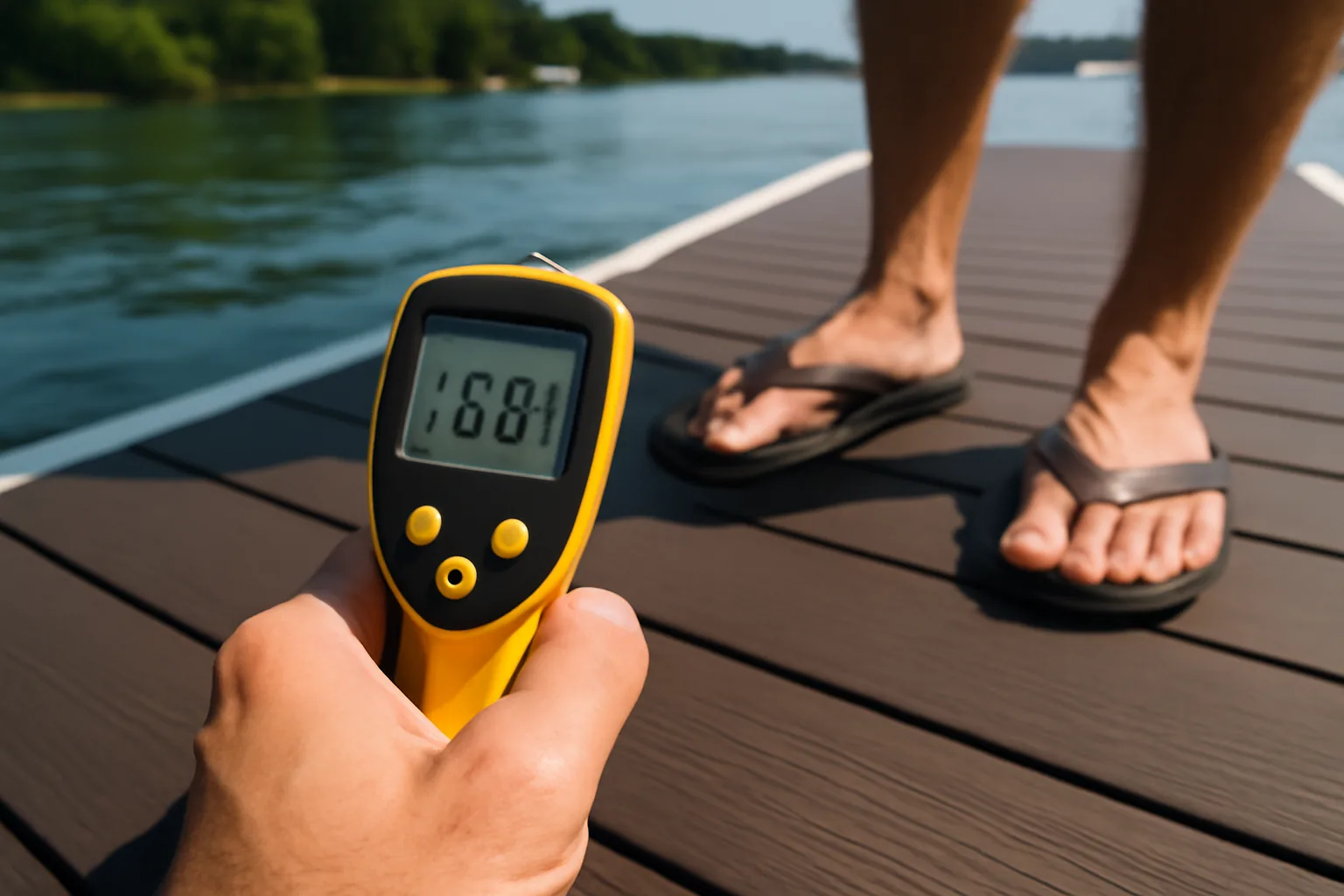
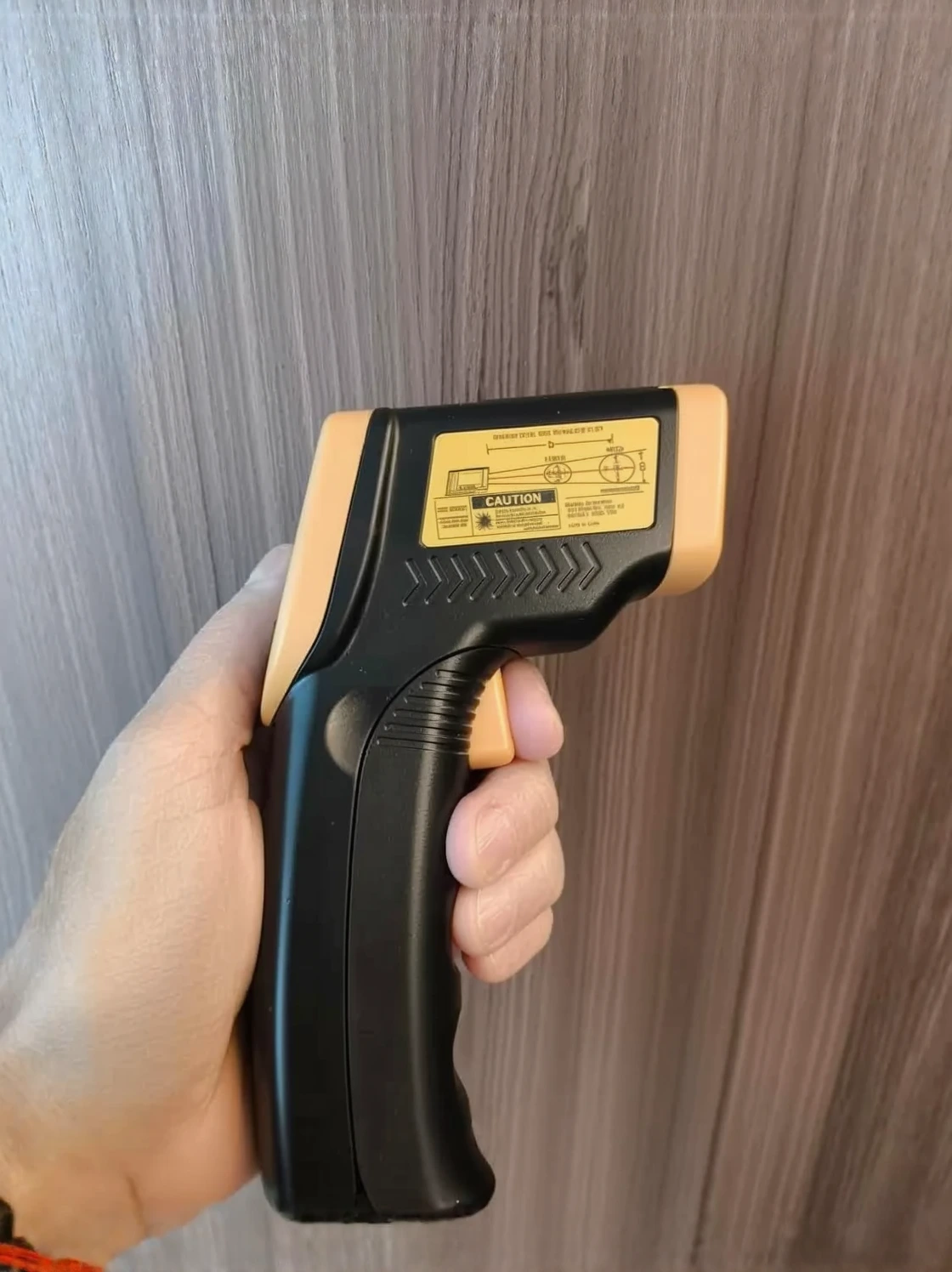
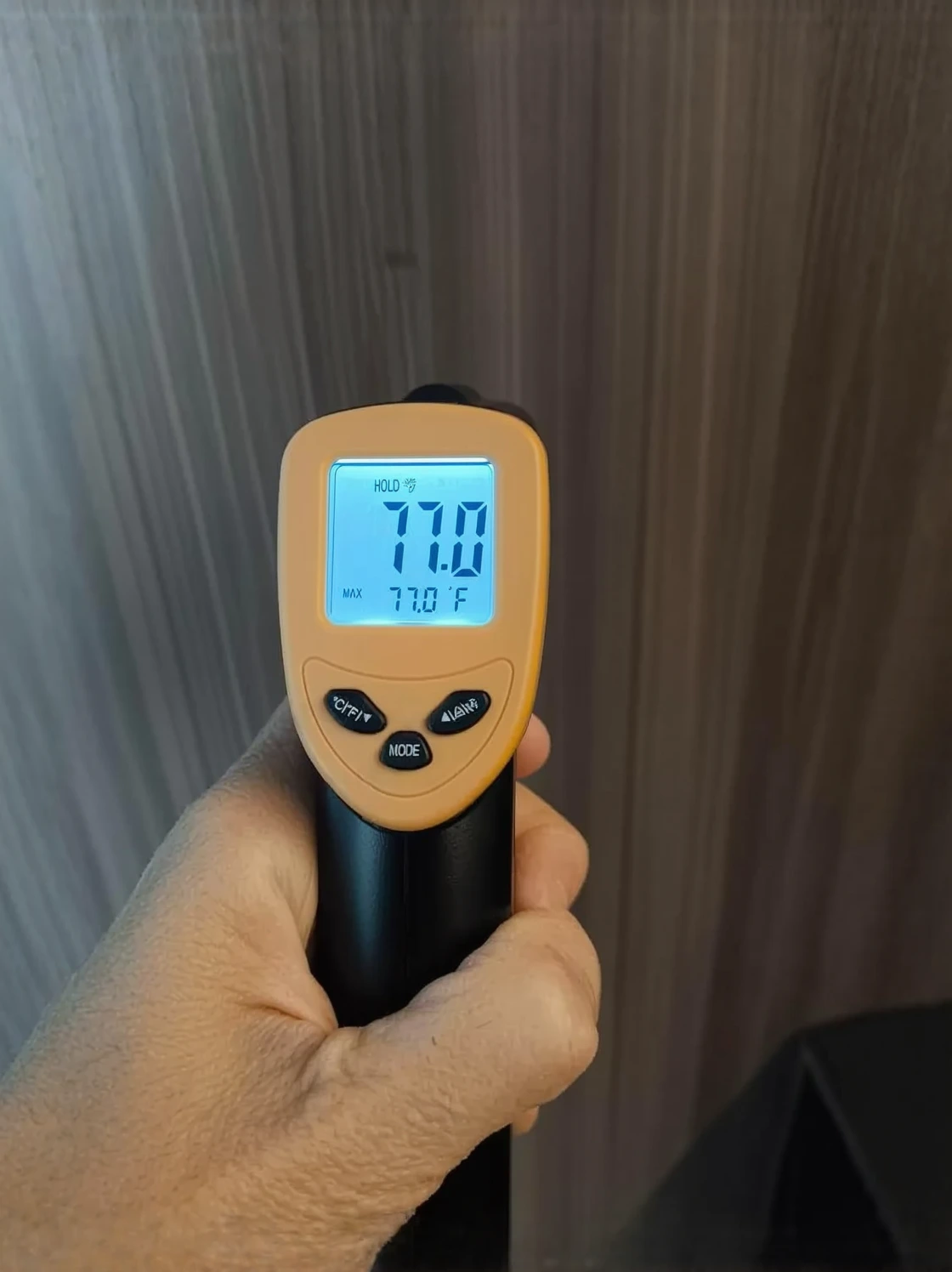
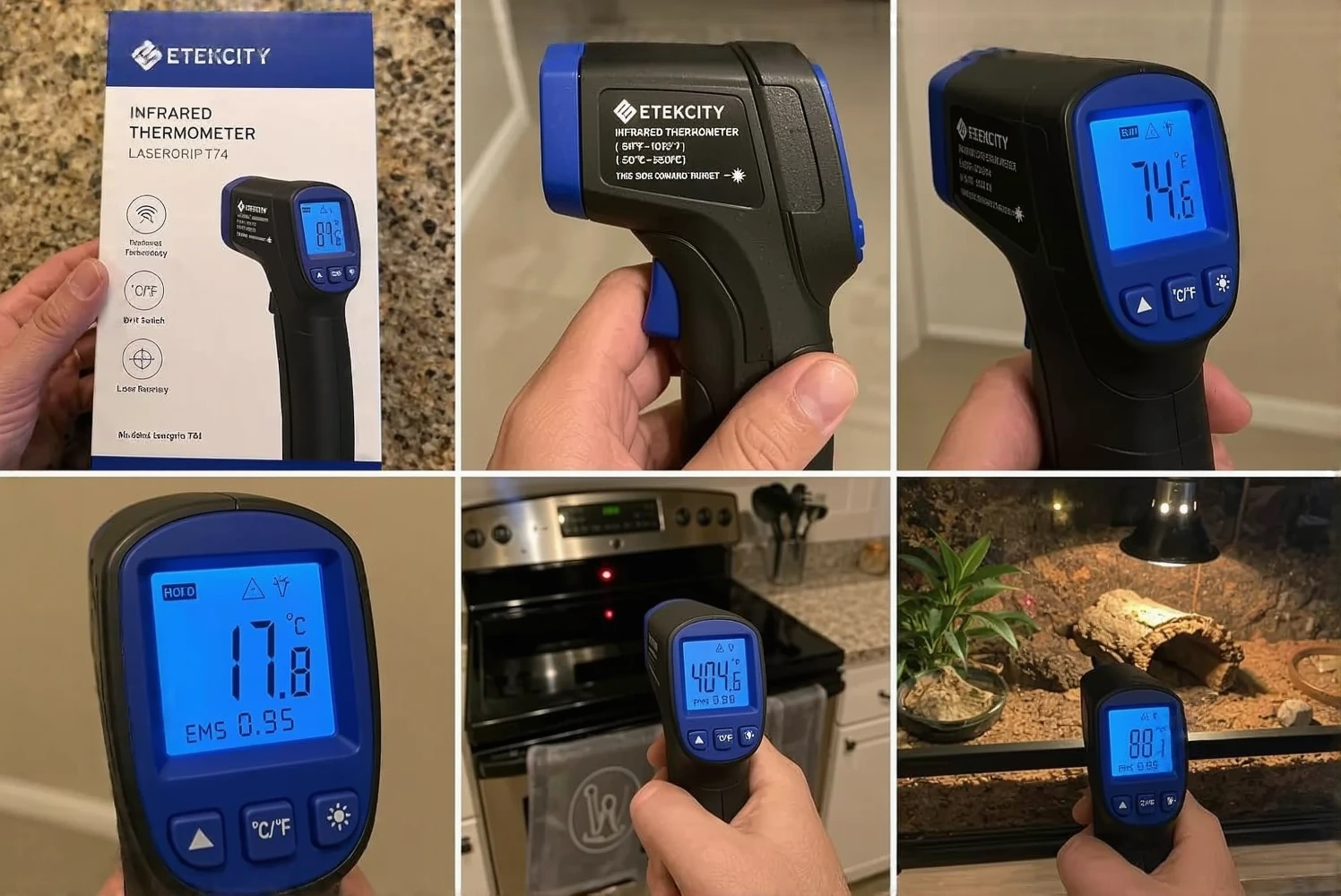
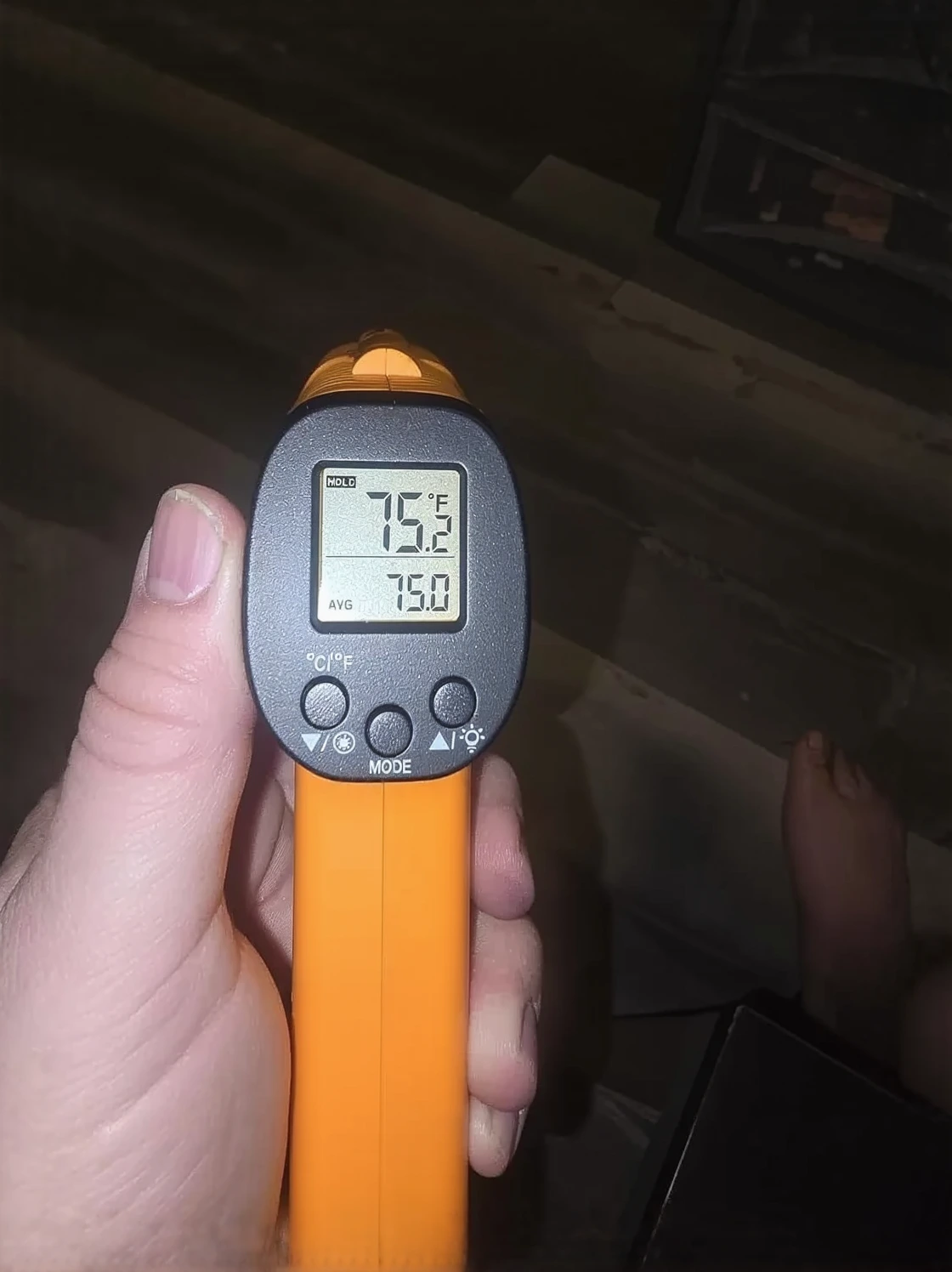
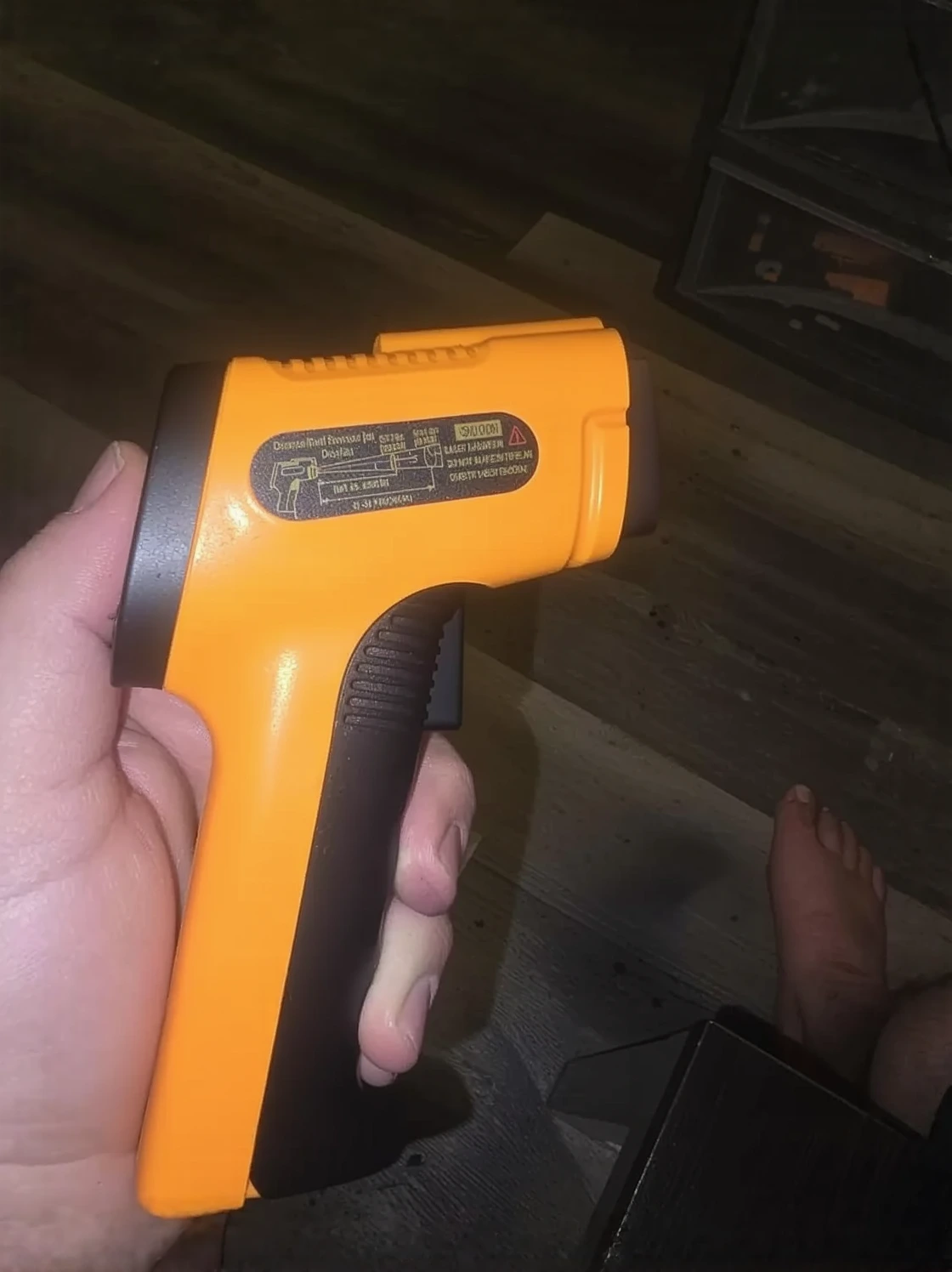
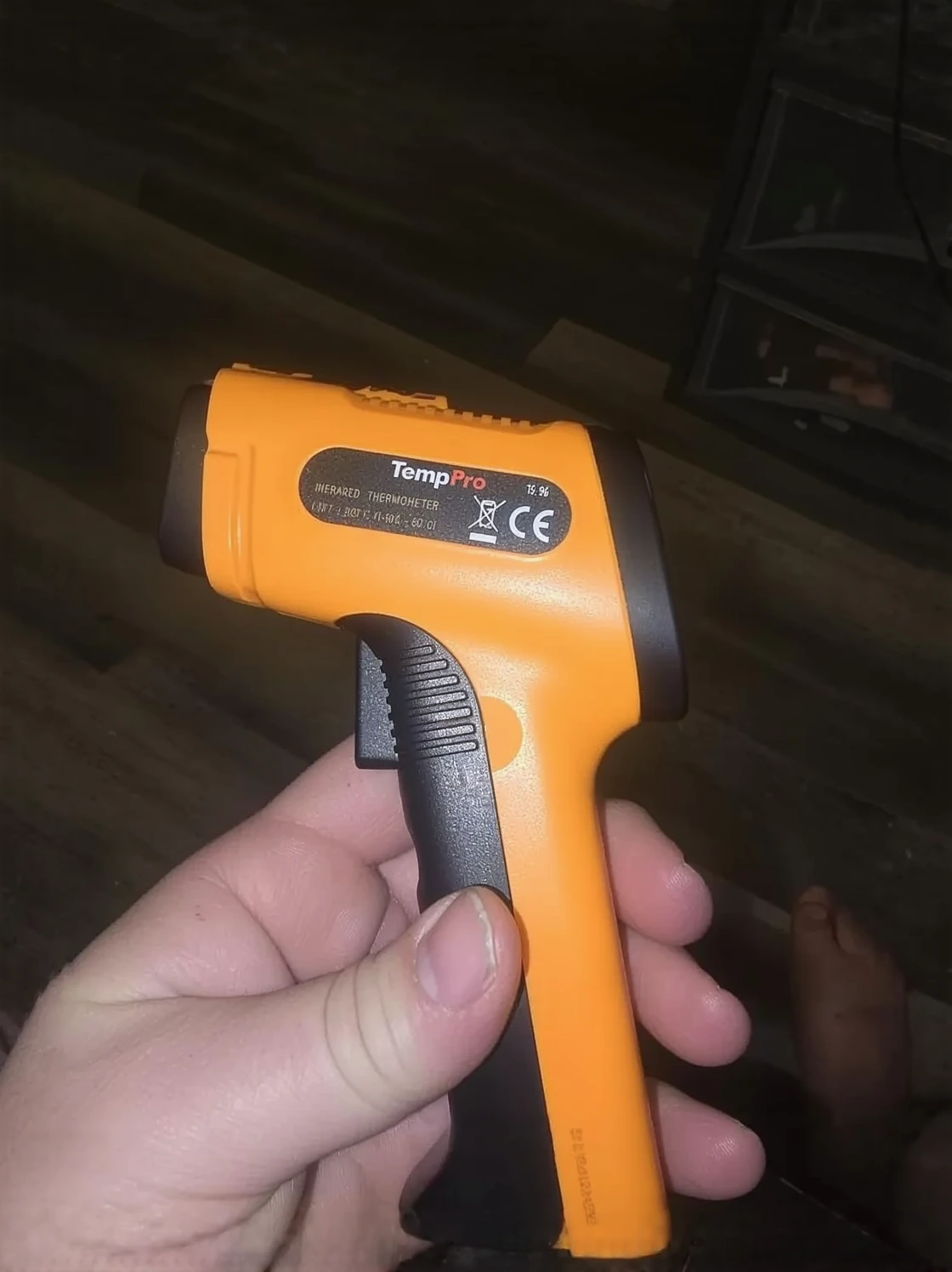
The tool I carry on every single decking evaluation is the Etekcity Infrared Thermometer Laser Temperature Gun 774. I started using this model about two years ago, and it’s become as essential as my tape measure on dock jobs. You point the laser at the surface, pull the trigger, and get an instant readout. No contact required. For composite decking evaluation, that matters — you don’t want to be pressing a probe against a 160°F surface repeatedly.
This particular unit earns my recommendation because it includes a calibration function for emissivity adjustment. Composite deck materials maintain an emissivity coefficient ranging approximately 0.90–0.95, whereas marine hardware fabricated from polished aluminum exhibits substantially lower emissivity around 0.05–0.15. An infrared thermometer with locked emissivity produces severely inaccurate readings when measuring different surface compositions. The Etekcity 774 permits manual adjustment to match your target material, ensuring you obtain reliable measurements whether you’re evaluating composite boards, wood surfaces, or marine fasteners. The temperature range extends from -58°F through 1,022°F, encompassing every condition I’ve encountered during dock evaluation assignments.
My Standard Evaluation Methodology
I schedule measurements between 1 and 3 p.m. on cloudless days when solar load reaches maximum intensity. I document surface temperatures at no fewer than six distinct deck locations: areas receiving unobstructed sunlight, zones with partial shade, sections adjacent to railings, and open field positions. I simultaneously record the ambient air temperature corresponding to each surface measurement. This contextual information carries significance. A surface reading 60°F higher than ambient air on a 95°F day generates a different interpretation than a 60°F differential on a 75°F day.
This past spring, a property owner in Bay St. Louis sought my evaluation after selecting Fiberon Horizon boards in the “Ipe” tone—a deep chocolate brown finish. The selection produced a genuinely attractive appearance. During my assessment, outdoor temperature registered at 89°F. The deck surface reached 157°F under direct sun exposure. That represents a 68°F above-ambient increase. Her adjacent neighbor had installed light-gray Trex Enhance boards that measured 122°F during the same afternoon timeframe—providing 35°F additional comfort. The two decks occupied comparable positions, received equivalent sunlight exposure, and featured similar structural configuration. The divergence stemmed entirely from color selection and manufacturing cap technology.
If you want a capable unit at a lower price point, the TempPro TP30 Infrared Thermometer Gun is a solid runner-up. It also features adjustable emissivity and reads up to 1,022°F. In my experience, it’s slightly less ergonomic for extended use, but for occasional homeowner measurements it performs reliably. Either tool gives you the hard data you need to stop guessing and start solving.
Practical Solutions for Existing Composite Installations Running Too Hot
Circumstances don’t always permit a complete material replacement. If you’re currently managing an installed composite deck that generates excessive barefoot discomfort, several evidence-based mitigation approaches exist. I’ve executed all of these strategies on residential and commercial projects and can provide realistic outcome expectations for each method.
Installing Shade Structures
This solution delivers the most impressive thermal benefits. A pergola framework equipped with polycarbonate panels or fabric sunscreen can suppress surface temperatures by 40–60°F by preventing direct solar contact with the decking material. I documented one installation where a 158°F dark composite surface dropped to a comfortable 98°F following proper shade sail construction. Budget expectations range from $800–$3,500 depending on coverage area and component selections. The financial return on investment timeline is often shortest when complete board replacement doesn’t align with current budgets.
Applying Heat-Reflective Coatings and Stains
Multiple manufacturers currently offer specially formulated coatings engineered to boost solar reflectance on composite deck surfaces. Formulations including Defy Composite Deck Stain incorporate titanium dioxide compounds that enhance light reflectance properties. Realistic expectations involve temperature reductions in the 10–20°F range—significant but not revolutionary. However, reducing a 155°F surface to 135°F represents movement from dangerous-temperature-range into uncomfortable-but-survivable territory. Materials expense typically ranges $200–$600 for a typical 400 square foot installation, excluding labor costs if professional application becomes necessary.
Installing Protective Deck Coverings and Modular Tiles
Polypropylene-constructed outdoor textiles or snap-together modular deck tiles establish an insulating boundary separating bare feet from direct composite contact. This approach provides the most budget-conscious and quickest-implementation option—basic 8×10 outdoor textiles range from $60–$180 in acquisition cost. For dock applications specifically, I maintain reservations regarding moisture accumulation underneath textile coverings, which can expedite composite material degradation and generate slipping hazards during wet conditions. Choose materials featuring open-weave construction exclusively and periodically raise coverings to verify underlying conditions.
Replacing Individual Boards or Entire Deck Sections
If your composite installation remains within the initial warranty coverage window and your manufacturer-issued warranty documentation addresses heat-related concerns, investigate the specific conditions outlined in that documentation. Multiple manufacturers—including Trex and TimberTech—have encountered legal challenges involving class-action complaints regarding heat retention performance claims. Create a comprehensive documentation file containing your surface temperature measurements obtained using proper infrared equipment before initiating manufacturer contact. Those measurements function as supporting evidence. Material pricing for replacement composites spans $4–$12 per linear foot, with installation labor typically running $2–$5 per linear foot throughout the Gulf Coast market area.
Material Selection Strategies for New Deck Construction Projects
When you’re designing a fresh installation, you retain the advantage of informed material selection. Begin by prioritizing lighter color palettes. I’m conscious that charcoal and espresso finishes photograph beautifully in manufacturer catalogs. On an actual Florida dock at 1 p.m. during August, those identical colors create genuine comfort problems. Specifically, target tan, light-gray, or whitewashed product offerings. These colors deliver aesthetic appeal in photographs while avoiding the barefoot temperature hazard associated with dark finishes.
Next, request SRI performance data and documented heat testing outcomes directly from manufacturers. TimberTech publishes cool-deck specifications for multiple product lines. Trex has incorporated heat-reduction engineering into their Transcend and Select collections. Ask for these technical specifications before finalizing material selections. Professional decking suppliers should furnish this information upon request without hesitation.
Finally, carefully evaluate deck positioning and sun exposure patterns. A deck platform facing northeast experiences considerably reduced afternoon solar radiation compared to installations facing southwest orientation. For dock applications specifically, accounting for water-surface light reflection becomes critical—open water bounces additional solar radiation upward onto already sun-exposed boards. My field measurements consistently show dock surfaces operating 8–12°F warmer than comparable land-installed decks receiving identical sunlight, driven entirely by reflected radiation from the water surface.
Situations Requiring Professional Assessment and Installation
The majority of surface temperature evaluation work and heat mitigation projects fall comfortably within DIY competency zones. Pick up an infrared thermometer, collect your measurements, and apply that information to guide your next steps. However, three specific circumstances warrant bringing in professional expertise.
- Permanent shade structure installation attached to dock systems: Shade structures and pergolas anchored to dock framing require engineering calculations for structural safety. Dock framing commonly lacks the design capacity for the additional stresses a shade structure introduces, particularly in hurricane-prone coastal zones. The vast majority of Gulf Coast jurisdictions mandate building permits for any structure exceeding 200 square feet affixed permanently to a dock.
- Complete board replacement work on elevated dock installations: Handling and positioning sixteen-foot composite planks while working from elevated dock framing suspended above water represents a significant safety concern. Minimum two-person crews should handle this work, and anything positioned higher than 4 feet above water level warrants enlisting a licensed marine construction professional.
- Addressing warranty claims and manufacturer liability disputes: When pursuing a replacement warranty claim based on thermal performance shortcomings, maintain comprehensive documentation and think carefully about engaging a licensed contractor who can supply an objective written professional assessment. Manufacturing companies treat third-party professional evaluation documents with greater weight compared to homeowner-supplied documentation.
Wrapping Up: Preventing an Overheated Deck From Dominating Your Summer
A composite deck too hot barefoot signals a fundamental misalignment between your regional climate patterns, color specifications, and sun exposure characteristics. The encouraging news: this condition remains measurable, identifiable, and solvable—provided you gather actual measurements instead of relying on assumptions.
Start your process with comprehensive surface temperature documentation using a dependable infrared measurement tool. Lock down your actual measurements prior to committing financial resources toward any solution. From this foundation, shade structures deliver maximum temperature suppression benefits. Light-toned board selections and reflective coating applications yield noticeable comfort improvements. And during the planning stages for new construction, prioritize color and product specifications based on thermal data rather than appearance considerations alone.
My two-decade immersion in Gulf Coast dock construction revealed that thermal performance functions as an overlooked variable influencing every composite decking installation decision. Composite materials look magnificent in showroom environments maintained at 70°F with artificial illumination. Your actual dock during July operates in an entirely different thermal environment. Gather measurements before purchasing, make your material selections based on evidence, and experience your dock summers the way they should be—comfortable barefoot and genuinely enjoyable.
Is Composite Decking Heat a Major Problem? The Direct Response
Absolutely. Composite decking generates significant heat—substantially greater than wood-based alternatives—and Gulf Coast dock builders must incorporate this reality into planning.
Across the infrared surface readings I’ve taken on composite dock installations, the underlying physics demonstrates absolute consistency: composite boards contain wood fiber material suspended within plastic resin matrix. That plastic component resists water absorption while simultaneously capturing solar energy intensely. Unlike pressure-treated lumber, which reflects substantial incident light, composite materials transform that radiation directly into thermal energy. During intense July conditions in areas like Galveston or Destin, my thermometer readings on dark-colored composite surfaces regularly hit 155–162°F. Light-toned gray or sand-colored options run approximately 20–30°F lower—typically 125–135°F under identical circumstances. This difference carries genuine significance. A lighter-colored alternative at 130°F versus a dark alternative at 160°F represents the distinction between tolerable discomfort and genuine hazard.
Contrasting results appear when measuring ipe hardwood and conventional pressure-treated lumber, which stabilize in the 110–130°F range because denser composition and superior light reflection keep absorbed energy lower. Most dock builders gravitate toward composite materials specifically for extended lifespan and minimal maintenance obligations, so accepting the thermal penalty represents a trade-off. Fortunately: you can design around this limitation. Most barefoot dock activities concentrate before 10 a.m. or after 6 p.m., when surface temperatures remain below 130°F. During midday peak hours, water shoes or rubber sandals transition from optional to essential equipment.
What Temperature Creates Actual Skin Damage? Field Testing Data
Scientific literature establishes 140°F as the surface temperature threshold where unprotected skin sustains first-degree burn damage within one continuous second of contact. Temperatures lower than this create discomfort sensations. At 140°F and above, susceptible populations—children, elderly residents, individuals with existing skin sensitivity—face meaningful injury potential.
I’ve personally documented Gulf Coast dock conditions where surface measurements reached 158–160°F during daylight hours between 11 a.m. and 4 p.m. at peak summer intensity. A child sprinting across that deck barefoot will experience immediate discomfort. Most kids respond with instinctive movement or hopping to minimize contact duration—but a single stumble creating momentary foot contact presents legitimate burn potential. I witnessed this happen personally. An older woman living in Pensacola sustained a painful blister on her heel following a brief barefoot contact with her new composite dock at 2 p.m. during July conditions. This situation was entirely avoidable.
The temperature danger window extends reliably from 10 a.m. through 6 p.m., with maximum hazard between noon and 4 p.m. Exactly two effective field-tested mitigation strategies reduce this hazard meaningfully: construct shade coverage—pergola, canopy, or sun-blocking material—above high-traffic dock areas, or select light gray or tan composite products rather than charcoal or black finishes. Light-colored composites maintain temperatures 25–30°F lower and permit safer barefoot use during most daylight periods. When light color combines with shade installation, hazard reduction becomes substantial. I’ve incorporated both elements into every dock specification I’ve created for residential applications throughout the last five years.
The Measurement Device That Finally Revealed Which Decks Generate Dangerous Heat
Problem solving requires first observing the actual problem. Composite deck surface temperatures fluctuate dramatically depending on finish color, material composition, and exposure orientation — and estimating by tactile sensation delivers unreliable and potentially hazardous results. An infrared temperature measurement device removes speculation and delivers precise surface temperature readings allowing informed decisions.
What works
- Records surface temperature instantly—you can evaluate your entire dock systematically within minutes and immediately identify temperature hotspots before guests discover them.
- Pinpoint laser aiming delivers accuracy sufficient to compare thermal differences between light and dark planks, between shaded and sun-exposed sections, clarifying exactly what environmental factors drive uncomfortable conditions.
- Delivers actionable readings despite intense sunlight without requiring guesswork—the display remains legible even facing bright conditions, providing objective measurement when determining whether sealing, sanding, or replacement represents your best option.
What doesn’t
- Captures only surface temperature, not heat existing beneath the surface—a board reading 135°F might feel marginally cooler underfoot depending on material moisture content and density composition.
- You’ll require multiple measurement sessions throughout different daylight periods (early morning, midday, late afternoon) establishing a thorough understanding of your specific dock’s thermal behavior throughout the calendar year.
I’ll admit, I hesitated before spending money on yet another tool — until I pointed this at a light-gray composite board and a dark walnut one side by side and saw a 28-degree difference at 10 a.m. That’s when the whole “choose lighter colors” advice suddenly made financial sense. Grab the Etekcity Infrared Thermometer Laser Temperature Gun 774 and stop guessing.
Frequently Asked Questions
What surface temperature makes composite decking unsafe for bare feet?
Science establishes 140°F as the threshold where unprotected skin sustains first-degree burn damage within one second of contact. I’ve documented Gulf Coast dock surfaces reaching 158–160°F during peak summer conditions between 11 a.m. and 4 p.m., creating genuine injury potential for children and elderly residents.
How much cooler is light gray composite than dark composite decking?
Light-gray and sand-tone composite boards run approximately 20–30°F cooler than dark espresso or charcoal finishes under identical Gulf Coast sunlight conditions. A light gray surface might measure 122°F while a dark chocolate brown reaches 157°F on the same afternoon.
Can I reduce my hot composite deck temperature with a shade structure?
Yes. A pergola with polycarbonate panels or fabric sunscreen suppresses surface temperatures by 40–60°F by preventing direct solar contact. I documented one installation where a 158°F dark composite surface dropped to a comfortable 98°F following proper shade sail construction, with budget ranging $800–$3,500.
Do capped composite boards stay cooler than uncapped composite?
Capped composite demonstrates marginally reduced surface temperatures compared to uncapped formulations. However, on a dock over open water with minimal shade, even high-end capped systems from Trex, TimberTech, or Fiberon can accumulate 140–150°F during peak heat—still above the 140°F injury threshold.
Sources and further reading
About This Article

Written by Trent Hollis. Waterfront homeowner turned DIY obsessive. After two decades tinkering with my own dock, seawall, and boat lift on the Gulf Coast, I share everything I've learned about waterfront construction, boat lift maintenance, and coastal living projects. More about this site.
Scope and limits. Trent is a waterfront homeowner, not a licensed marine contractor. Structural, electrical, and lift work should go to a licensed marine contractor, and most in-water work needs a permit before you start.
Verify this against a primary source
Specifics change, and your situation may differ from the one described here. These are the authorities worth checking directly:
- ABYC — marine electrical and construction standards
- U.S. Army Corps of Engineers — permitting for work in navigable waters
- NOAA Tides & Currents — tidal range and water level data for your site