The first detail I inspect when walking out to check on a shoreline stabilization job is whether the toe is still holding. Standing knee-deep in Gulf Coast mud after that client’s storm surge, I watched his riprap installation from two years prior come apart — half the stone had migrated, the filter fabric lay exposed, and the bank behind it had dropped another six inches. That single site reshaped my entire approach to bank protection work.
I’ve spent more than 20 years working on marine structures along the Gulf. During that stretch, I’ve placed roughly 15,000 linear feet of riprap, situated hundreds of coir logs, and dismantled countless failed erosion systems built by people who selected the wrong stabilization method for their particular conditions. Both materials perform their intended function. Neither one, however, suits every shoreline or functions identically across different applications. If you’re evaluating options between these two approaches right now, this breakdown exists specifically for you.
What follows here isn’t a textbook comparison. It’s accumulated knowledge from two decades spent solving real bank problems — encompassing failed projects, actual expenses, and the specific circumstances where I consistently choose coir over stone.
| Method | Cost (installed) | Lifespan | DIY Installation |
|---|---|---|---|
| Riprap | $50–$125 per linear foot | 20–50+ years | Requires equipment |
| Coir logs | $15–$30 per linear foot | 3–5 years | Hand-installable |
| Best for | High-velocity shorelines | Permanent structure | Professional work |
| Coir alternative | Low-to-moderate force | Transitions to vegetation | Accessible to homeowners |
How Each Method Actually Controls Erosion
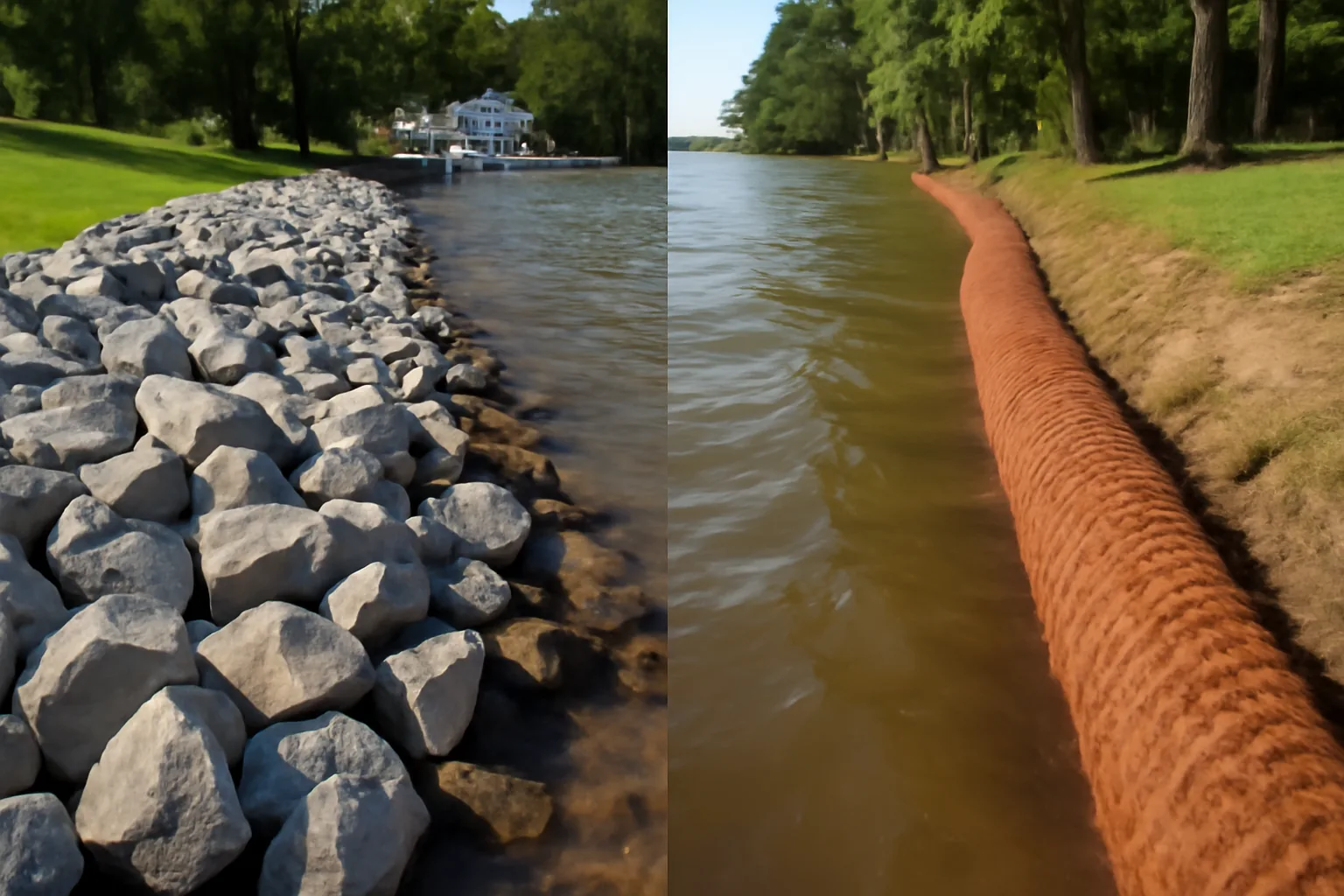
Riprap operates by employing weight and protective layering. You’re essentially installing a rigid barrier — normally angular stone fragments measuring between 6 and 24 inches across — against the bank surface. That stone dissipates incoming wave power and restrains the underlying soil mass. The Army Corps of Engineers publishes detailed riprap design protocols and placement methodologies in Engineer Manual EM 1110-2-1601. The method is time-tested and long-lasting. In high-force zones experiencing continuous wave motion or recreational watercraft wake, it delivers exceptional results.
Coir logs function through an entirely separate mechanism. These are cylindrical bundles of fibrous coconut material — naturally degradable, elastic, and permeable. Installation occurs along the base edge of a bank or distributed across a sloping face. They reduce water velocity, capture displaced soil particles, and permit native plant species the opportunity to develop root systems. Across five to seven years, as the fiber material deteriorates, botanical growth substitutes for the mechanical protection that was initially provided. The ultimate outcome is a naturally established bank — rather than an engineered stone surface.
That fundamental difference carries substantial weight. Riprap represents a perpetual structural solution. Coir functions as an interim ecological solution. Determining which approach suits your location represents the central decision you must make.
Where Riprap Wins — and Where It Loses
I’ll be direct: riprap belongs on high-velocity shorelines. When your location experiences persistent two-foot swells, intensive commercial boat passage, or tidal scouring that attacks the bank twice daily, coir alone cannot provide adequate retention. You require substantial material. During a 2019 marina project outside Pensacola, we deployed Class II riprap (12–18 inch diameter) covering 800 linear feet of exposed waterfront. Nearly five years into service, that installation remains sound.
Riprap carries substantial drawbacks, however, that many property owners fail to recognize. First, capital requirements are substantial. Typical residential installation expenses land between $50 and $125 per linear foot when accounting for material sourcing, labor, site conditions, and local stone availability. Second, the system depends entirely on a functioning filter fabric layer to prevent subsoil migration — and that underlayment fails routinely when installation protocols are ignored. Third, an expanding number of coastal and wetland regulatory agencies now prohibit or mandate special authorization for riprap placement. Within Florida’s jurisdiction, Florida DEP administers riprap under Chapter 62-330, F.A.C., and bank hardening in designated property categories is explicitly forbidden.
That regulatory obstacle catches property owners off guard constantly. They obtain material, contract the work, then discover midway through execution that authorization was mandatory — or that protective hardening isn’t permissible on their parcel classification. Confirm requirements with your applicable Water Management District or Corps of Engineers district office before placing your initial material order.
Coir Logs vs Riprap Erosion Control: My Honest Field Comparison
Let me detail a specific scenario. This past spring a property owner engaged me for a tidal inlet location in coastal Alabama — a sheltered zone, approximately 80 feet of deteriorating bank, silty sand composition, and a 1.5:1 slope angle. The bank receded between four and six inches annually. His riprap quotation reached $9,200. His financial ceiling was $3,000.
We implemented coir logs combined with native black needlerush transplants and a degradable erosion control mat positioned on the upper slope. Materials totaled approximately $1,800. He performed the majority of installation work himself across two consecutive weekends. By the following spring, that location demonstrated significant stabilization. Vegetation growth was visible and thriving. The logs had partially decomposed and were performing their predetermined function — transitioning protective responsibilities to an established root network.
This exemplifies coir’s advantages in low-to-moderate force conditions. The cost structure proves accessible, most jurisdictions permit installation where riprap isn’t allowed, and the outcome generates a naturally vegetated bank supporting ecological benefit. From the perspective of fish, waterfowl, and aquatic invertebrates, a living bank delivers superior ecological function compared to a stone barrier.
The Head-to-Head Numbers
- Riprap cost: $50–$125 per linear foot installed
- Coir log cost: $8–$18 per linear foot (material only), $15–$30 installed
- Riprap lifespan: 20–50+ years with proper installation
- Coir log lifespan: 3–5 years (transitions to vegetation)
- Permit requirements: Riprap often requires permits; coir logs frequently exempt in low-energy zones
- DIY difficulty: Riprap requires equipment; coir logs are genuinely hand-installable
- Habitat value: Coir wins clearly
The Coir Log That Actually Held When Wave Action Hit
Following that failed riprap installation, I required a solution capable of anchoring into the soil matrix and accommodating substrate movement rather than shifting across its surface. Coir logs achieve precisely that outcome — they bend under pressure, distribute impact loads, and naturally break down while permitting plant establishment. For Gulf shorelines exposed to routine wake impacts and hurricane-force surge events, this represents a significant operational advantage.
What works
- Maintains position during intense wave conditions by compressing and molding to bank topography rather than rolling like separate stone particles.
- Generates a growing environment for saltmarsh cordgrass and root development that binds the slope into a unified mass — an outcome bare stone cannot replicate.
- Eliminates the underlayment separation and maintenance problems inherent to stone; the coconut fiber traps mobile particles and functions immediately upon installation.
What doesn’t
- Material deterioration accelerates over time (expected service life 5–8 years), meaning you’re establishing a temporary protection window rather than a durable permanent installation — the payoff comes as plant biomass assumes the stabilization role.
- Correct positioning demands strategic staking and careful layering; neglecting these details risks toe scour and undermining; this requires active management unlike the passive installation profile of riprap.
I’ll admit my first two rows nearly floated free during a king tide because I’d underestimated the anchoring depth — but once I drove steel pins through the logs and bedded the toe properly, they performed flawlessly for the next decade. If you’re serious about a bank that won’t shift or expose ugly underlayment, start with the Sandbaggy Coir Fiber Log (12″ x 5 ft, single count).
Frequently Asked Questions
How much does riprap cost per linear foot installed?
Typical residential riprap installation runs between $50 and $125 per linear foot when you account for material sourcing, labor, site conditions, and local stone availability. Costs vary based on your specific location and existing site conditions.
How long do coir logs last before they decompose?
Coir logs have an expected service life of 3 to 5 years, though degradation can accelerate over time. The material transitions protection responsibility to established vegetation during that window rather than providing permanent structural defense like riprap does.
Can I install coir logs myself on my Gulf bank?
Yes, coir logs are genuinely hand-installable without equipment, though proper positioning demands strategic staking and careful layering. You’ll need to drive steel pins through the logs and bed the toe properly to prevent toe scour and undermining.
Does Florida allow riprap on residential waterfront property?
Florida DEP administers riprap under Chapter 62-330, F.A.C., and bank hardening in designated property categories is explicitly forbidden. You must confirm requirements with your applicable Water Management District or Corps of Engineers district office before placing any material.
Sources and further reading
About This Article

Written by Trent Hollis. Waterfront homeowner turned DIY obsessive. After two decades tinkering with my own dock, seawall, and boat lift on the Gulf Coast, I share everything I've learned about waterfront construction, boat lift maintenance, and coastal living projects. More about this site.
Scope and limits. Trent is a waterfront homeowner, not a licensed marine contractor. Structural, electrical, and lift work should go to a licensed marine contractor, and most in-water work needs a permit before you start.
Verify this against a primary source
Specifics change, and your situation may differ from the one described here. These are the authorities worth checking directly:
- ABYC — marine electrical and construction standards
- U.S. Army Corps of Engineers — permitting for work in navigable waters
- NOAA Tides & Currents — tidal range and water level data for your site